Marketing asset management is how a marketing team stores, finds, approves and shares its campaign and brand assets (logos, brand guidelines, product photos, videos, ads, social posts and sales decks) in one governed library instead of scattered folders, and marketing asset management software is the tool that holds that library. It is digital asset management applied to marketing work. This page compares 10 marketing asset management tools a small or medium company would really shortlist, from Brault, Air and Playbook to Canto, Bynder and Frontify, with each public starting price in US dollars and the monthly cost for a team of five, all checked on 5 November 2026.
This comparison is for a marketing team of 4 to 20 people whose shared Google Drive or SharePoint no longer finds anything, who juggle a stack of separate apps, or whose traditional DAM is up for renewal. Brault, a creative file management platform, publishes this comparison and is one of the ten tools; it is listed last, and every price links to its source.
TL;DR
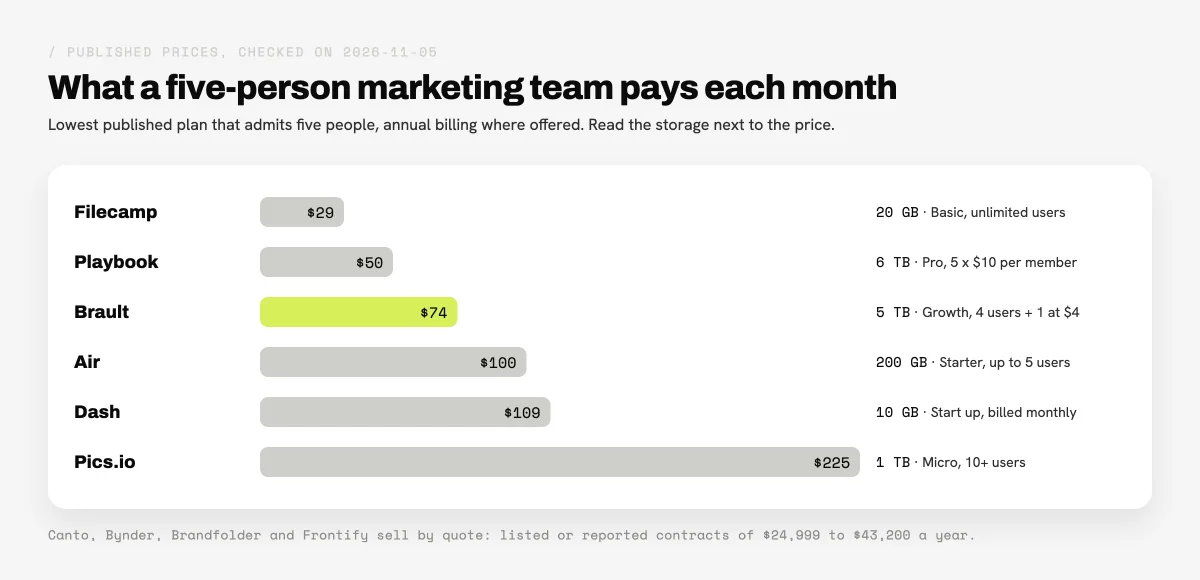
- Team of five on published prices: $29 (Filecamp) to $225 (Pics.io) a month; Brault Growth is $74.
- Quote-only DAMs: $24,999 to $43,200 a year, listed or reported.
- Our four-app stack example for five people: $328 a month.
How do the 10 marketing asset management tools compare?
The table shows each tool's public starting price and what five people pay a month on the lowest plan that admits them.
| Tool | Best for | Starts at (USD) | Team of five, a month | Brand portal |
|---|---|---|---|---|
 Air.inc |
Teams on Figma, Canva and Slack | Free; Starter $100 a month | $100 (Starter, 200 GB) | Share links, Showcase Links |
 Playbook |
Visual libraries on a budget | Free; $10 per member a month | $50 (Pro, 6 TB) | Publish pages, custom logo |
 Filecamp |
Many occasional users, small library | $29 a month | $29 (Basic, 20 GB) | From $59 (Advanced) |
 Dash |
Product brands sharing with retailers | $109 a month | $109 (Start up, 10 GB) | Every plan |
 Pics.io |
Teams that keep storage on their own cloud | $100 a month (Solo) | $225 (Micro, 1 TB) | From Micro |
 Canto |
Marketing teams with many viewers | Quote; $25,000 a year listed | About $2,083 | Portals in the package |
 Bynder |
Global brands with many teams | Quote; median $43,200 a year reported | About $3,600 | In the package |
 Brandfolder |
Brand teams on Smartsheet | Quote; median $24,999 a year reported | About $2,083 | In the package |
 Frontify |
Brand guidelines and templates | Quote; median $42,000 a year reported | About $3,500 | Guidelines and portals |
 Brault |
Marketing teams of 4 to 20 | Free; Growth $70 a month | $74 (Growth, 5 TB) | Every plan |
Checked on 2026-11-05 on each vendor's pricing page. Canto: AWS Marketplace listing (12 months, 2 TB, 5 power users). Bynder, Brandfolder, Frontify: Vendr median contracts (February 2026) divided by 12, for the whole contract. Quote-only tools sign annual contracts; the self-serve ones do not require one.
Six tools publish a price you can multiply by the team; four sell by quote, and their strength is governance and integrations at scale. Storage behind the self-serve prices runs from 10 GB to 6 TB, so the chart shows both.
What should a small marketing team look for in marketing asset management software?
A marketing asset management system earns its place when it replaces a habit that costs the team time every week. Six checks separate the tool a small team keeps from the one it abandons after the trial:
- Search by content. Filename search fails the day someone exports
banner_final_v3.png. Search that reads the image, the text in a PDF and the speech in a video finds the asset by what it shows. - Libraries and permissions. One library per brand, product line or region, with viewers, editors and admins, so a freelancer sees one campaign and not the whole archive.
- Approval on the file. Comments and approvals pinned to the frame or the pixel, with versions, so the approved cut is the one that ships.
- A brand portal. A page where agencies, sales and press download approved logos and photos without asking marketing for them.
- Large deliveries. Video masters and print files are too big for email; a branded transfer with a password and an expiry keeps them under control.
- A bill that scales by team. Per member, per editor, per download, flat with unlimited users, or storage with users included. The unit decides what happens when you hire the sixth person.
Before Brault, Pablo and I co-founded creative and advertising agencies, and the most common request we had from clients' marketing teams was the same one every week: "can you send me the logo again?" The brand portal check above exists because of that. For the wider market view, see our best digital asset management software roundup, and for studios and agencies the best creative asset management software comparison.
Which are the best marketing asset management tools in 2026?
These are the 10 tools, self-serve platforms first, quote-only DAMs next and Brault last. The numbers make the list easier to scan; they are not a score. Every price below was checked on 5 November 2026 (Brault plans on 8 November 2026) and each entry links to the vendor's pricing page.
1Air: best for marketing teams that work in Figma, Canva and Slack
Air is a creative operations platform built around integrations and an AI agent for creative tasks.
- Best forIn-house brand and content teams whose work already flows through Figma, Canva, Slack and Premiere Pro
- PricingStarter $100 a month billed annually ($1,200 a year, or $125 month to month), Business $900 a month billed annually ($1,100 month to month), Enterprise custom (checked 2026-11-05)
- Free planYes: 10 GB, 100 AI credits a month, up to 3 users
- Watch outStarter covers 200 GB and up to 5 users; the next published plan is Business at 2 TB
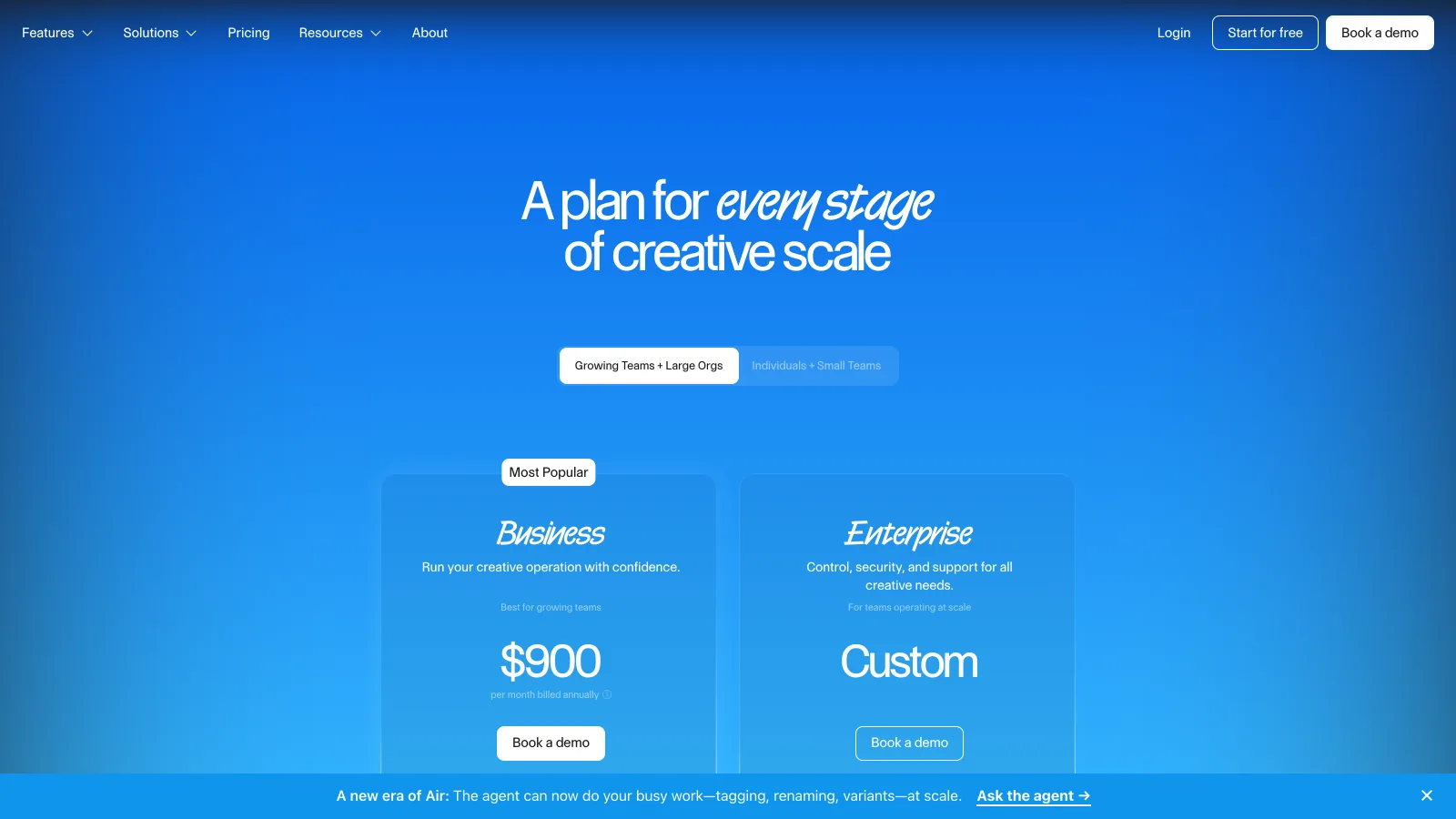
Air is strongest where a marketing team's work already lives in other apps. It connects natively to Figma, Canva, Slack, Adobe Premiere Pro and Shopify, and from Business adds a public API, Zapier, n8n and an MCP server. Storage no longer draws on AI credits: credits pay for AI creation and editing, and extra packs are $1,000 a year for 1,000 credits a month.
For a five-person team Air Starter is $100 a month on annual billing with 200 GB and up to 5 users, so a sixth hire means Business at $900 a month with 2 TB and unlimited users. Air shares through share links and Showcase Links rather than a dedicated transfer product. Teams weighing it against Brault can read Air vs Brault.
2Playbook: best for visual libraries on a small budget
Playbook is a visual media library that browses like a moodboard and bills per member.
- Best forSmall content and social teams that browse by image and publish asset pages
- PricingPro $10 and Team $20 per member a month billed yearly ($120 and $240 a year per member); Enterprise custom (checked 2026-11-05)
- Free planYes: 100 GB or up to 300 assets, 1 member, 3 guests
- Watch outAI tagging for images and video, custom fields and version history start on Team
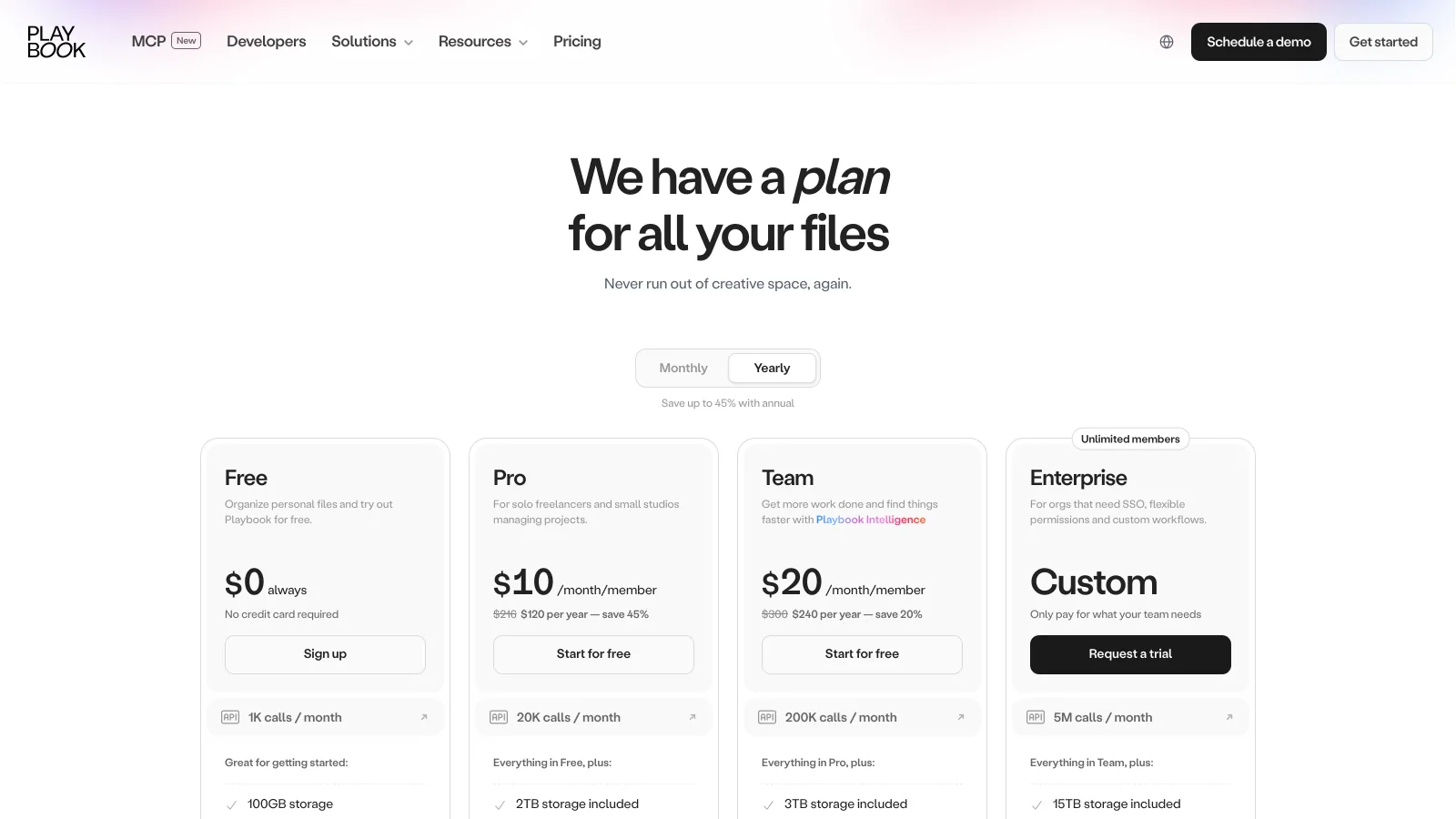
Playbook gives the most storage per dollar in this list: Pro includes 2 TB plus 1 TB per added member and Team 3 TB plus 2 TB per added member, both up to 10 TB. Pro adds a custom logo and branding, unlimited publish pages, CDN links and desktop and mobile sync.
A five-person team pays $50 a month on Pro or $100 on Team, billed yearly, and the bill moves with every member. For a team that cares most about how the library looks, Playbook is a strong fit; it does not list a proofing workflow or a dedicated transfer product on its pricing page.
3Filecamp: best for many occasional users on a small library
Filecamp is a long-running DAM with flat monthly plans and unlimited users on every tier.
- Best forMarketing teams that share a modest library with many colleagues, distributors or franchisees
- PricingBasic $29 (20 GB), Advanced $59 (50 GB), Professional $89 (100 GB) a month; same price on annual billing (checked 2026-11-05)
- Free planNo; free trial
- Watch outPublished plans stop at 100 GB; video-heavy teams need the storage add-on
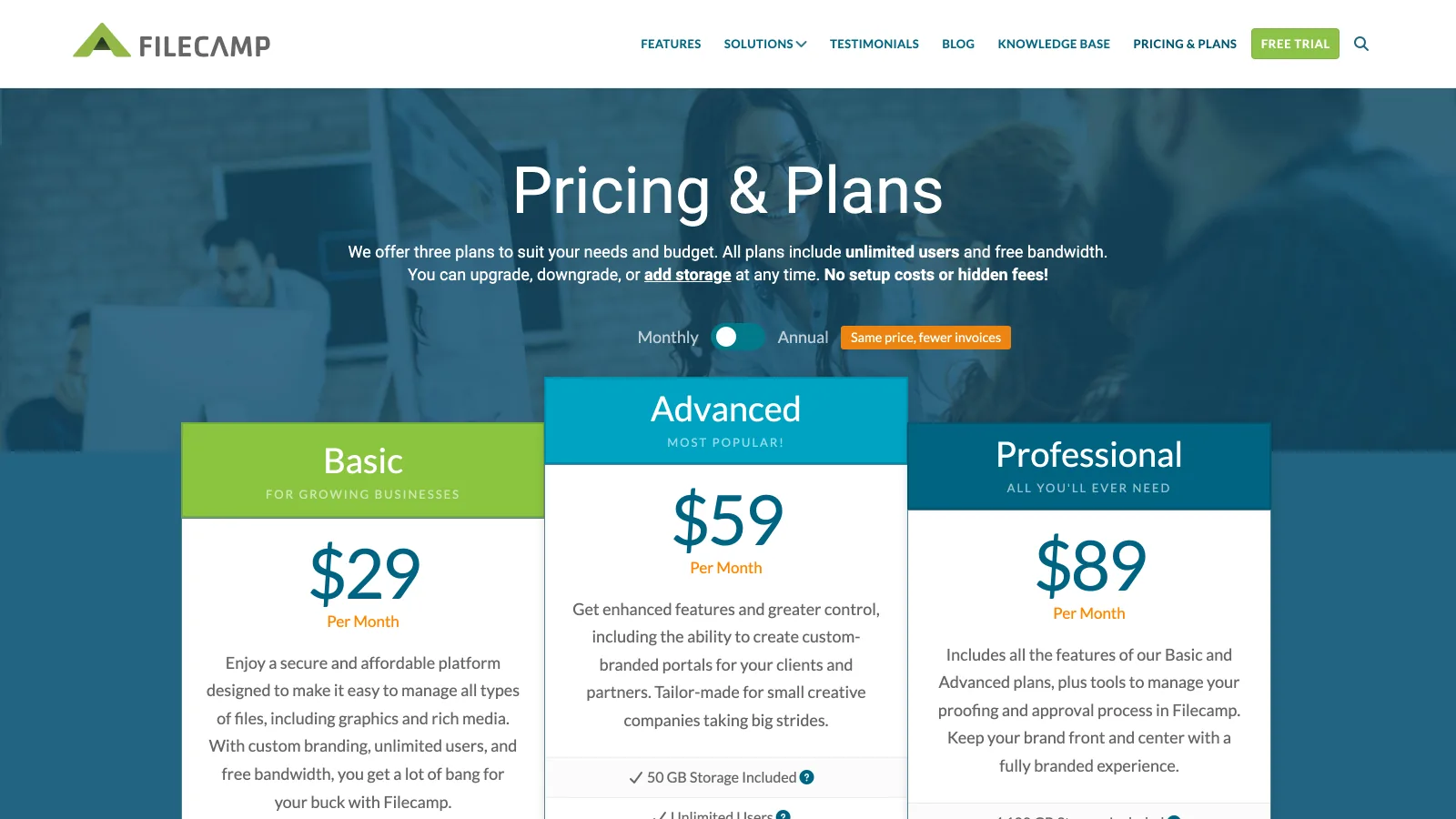
Filecamp keeps pricing simple: three plans, unlimited users, free bandwidth and custom branding from Basic. Advanced adds pages, collections, auto tags and custom-branded portals for clients and partners; Professional adds commenting for proofing and approval, access requests, a custom domain and white label.
At $29 a month, Filecamp is the lowest bill in this comparison for five people, and it stays $29 for fifty. The trade is storage: 20 GB holds a logo library and a few campaigns of images, not a year of video. A team whose assets are mostly documents and photos will be comfortable here.
4Dash: best for product brands that share with retailers and press
Dash is a DAM for consumer brands, with every feature and unlimited users on every plan.
- Best forEcommerce and product marketing teams whose main job is distributing finished assets
- PricingStart up $109, Small team $239, Growing brand $389, Established brand $589 a month; 10% off on annual billing (checked 2026-11-05)
- Free planNo; free trial and free onboarding
- Watch outPlans step up by monthly downloads (250, 500, 1,000, unlimited); Start up includes 10 GB
Dash includes every feature on every plan: AI search, custom branding, branded portals for retailers and press, guest upload links and migration support. The plans differ by monthly downloads and by storage, which can be raised from a dropdown on each plan.
A five-person team pays $109 a month on Start up, and the same price covers fifty people. The unit to watch is downloads: a brand whose partners pull hundreds of assets a month moves up a tier for that reason, not for seats. Dash focuses on distribution more than on review of work in progress.
5Pics.io: best for teams that want to keep files on their own cloud storage
Pics.io is a DAM that can run on its own storage or on a Google Drive or Amazon S3 account you already pay for.
- Best forMarketing teams of 10 or more that want DAM features on top of storage they control
- PricingSolo $100 a month (monthly only); Micro $225 a month billed annually ($2,700 a year, $250 month to month); Small $680 a month billed annually; Enterprise custom (checked 2026-11-05)
- Free planNo; 7-day free trial without a card
- Watch outBranding, watermarking and the API start on Small; AI tagging is a paid add-on from $50 a month
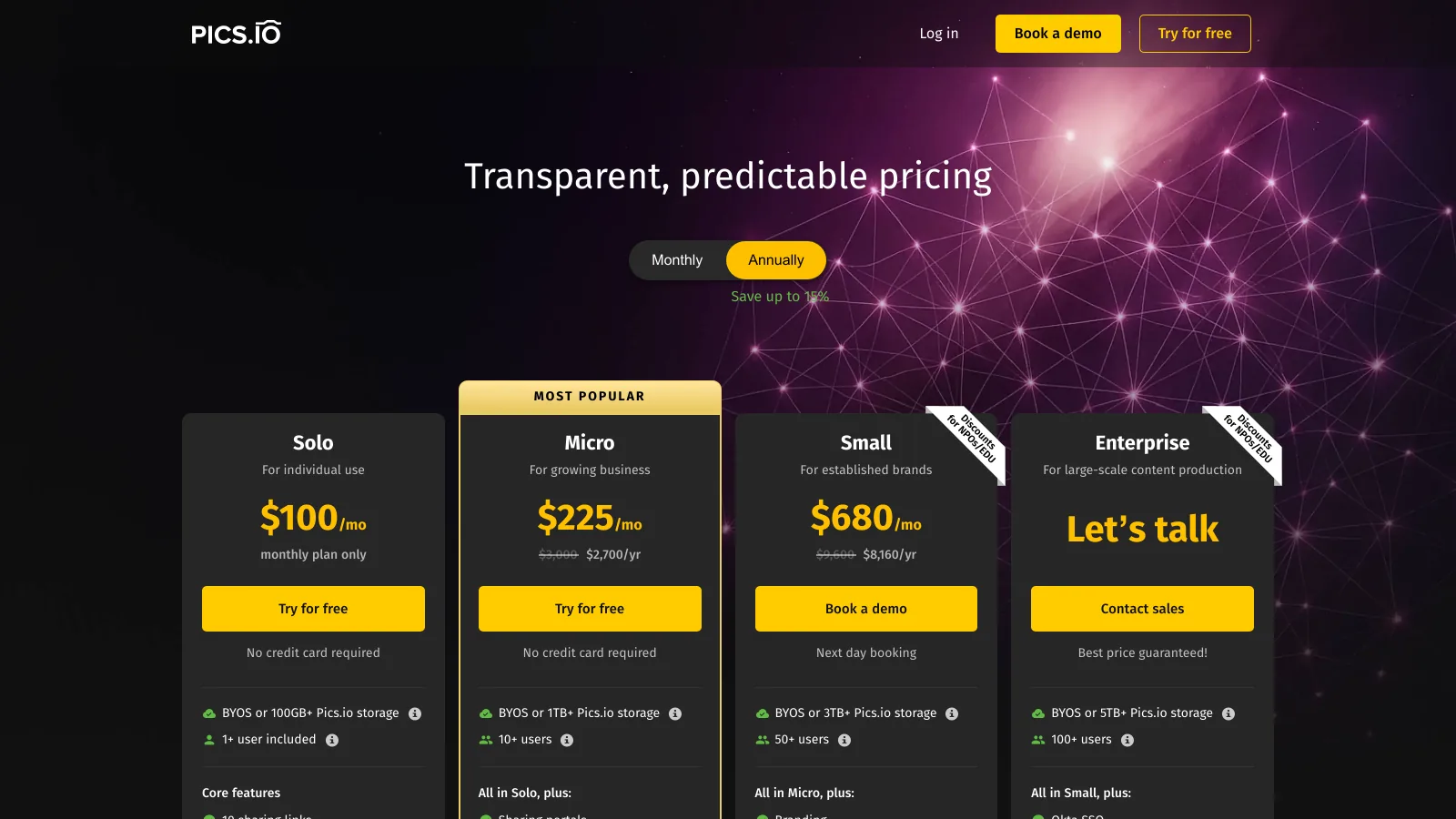
Pics.io lets a team bring its own storage or use 1 TB and more of Pics.io storage on Micro, with 10 or more users included. Micro adds sharing portals, an inbox for uploads, version control, custom fields, commenting and roles and permissions; Small adds branding, watermarking, metadata replication and the API.
For five people the plan meant for teams is Micro at $225 a month on annual billing, which is the highest self-serve bill here but also includes room for ten users. Pics.io suits a team that already lives in Google Workspace and wants metadata and portals without moving the files.
6Canto: best for marketing teams that share approved assets with many viewers
Canto is an established DAM with AI search, portals and style guides, sold by quote.
- Best forMid-size marketing departments that share approved assets with many people outside the team
- PricingQuote only; one public listing at $25,000 for 12 months with AI-powered DAM, 2 TB, 5 power users and support on AWS Marketplace (checked 2026-11-05)
- Free planNo; demo and quote
- Watch outAnnual contract; the package is priced per power user and storage
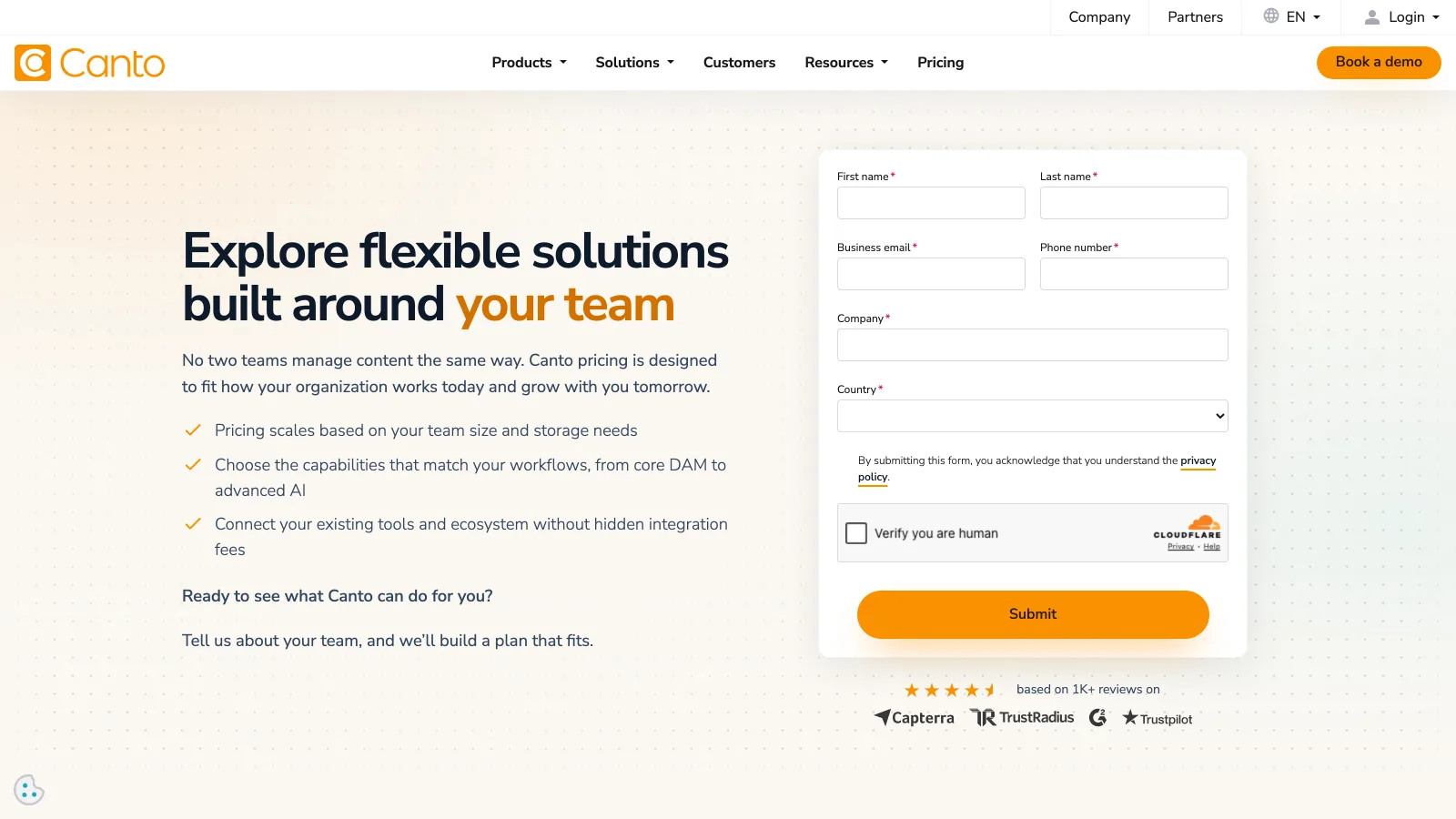
Canto says its pricing scales with team size and storage, and that a team chooses capabilities from core DAM to advanced AI. Its AWS Marketplace listing is the one public number: $25,000 for 12 months with 2 TB and 5 power users, about $2,083 a month.
Canto is a good fit for a marketing team that has outgrown shared drives and needs portals, style guides and governance for a large audience of viewers. The detail, with what each package adds, is in our Canto pricing guide.
7Bynder: best for global brands with many teams and agencies
Bynder is an enterprise DAM built around an AI-powered core with modular add-ons.
- Best forBrand organizations running content across regions, channels and agencies
- PricingQuote only; buyer-reported median $43,200 a year, range $9,865 to $108,740 (Vendr, February 2026; read 2026-11-05)
- Free planNo; demo and quote
- Watch outWorkflow, templates and analytics are separate modules; contract sized per organization
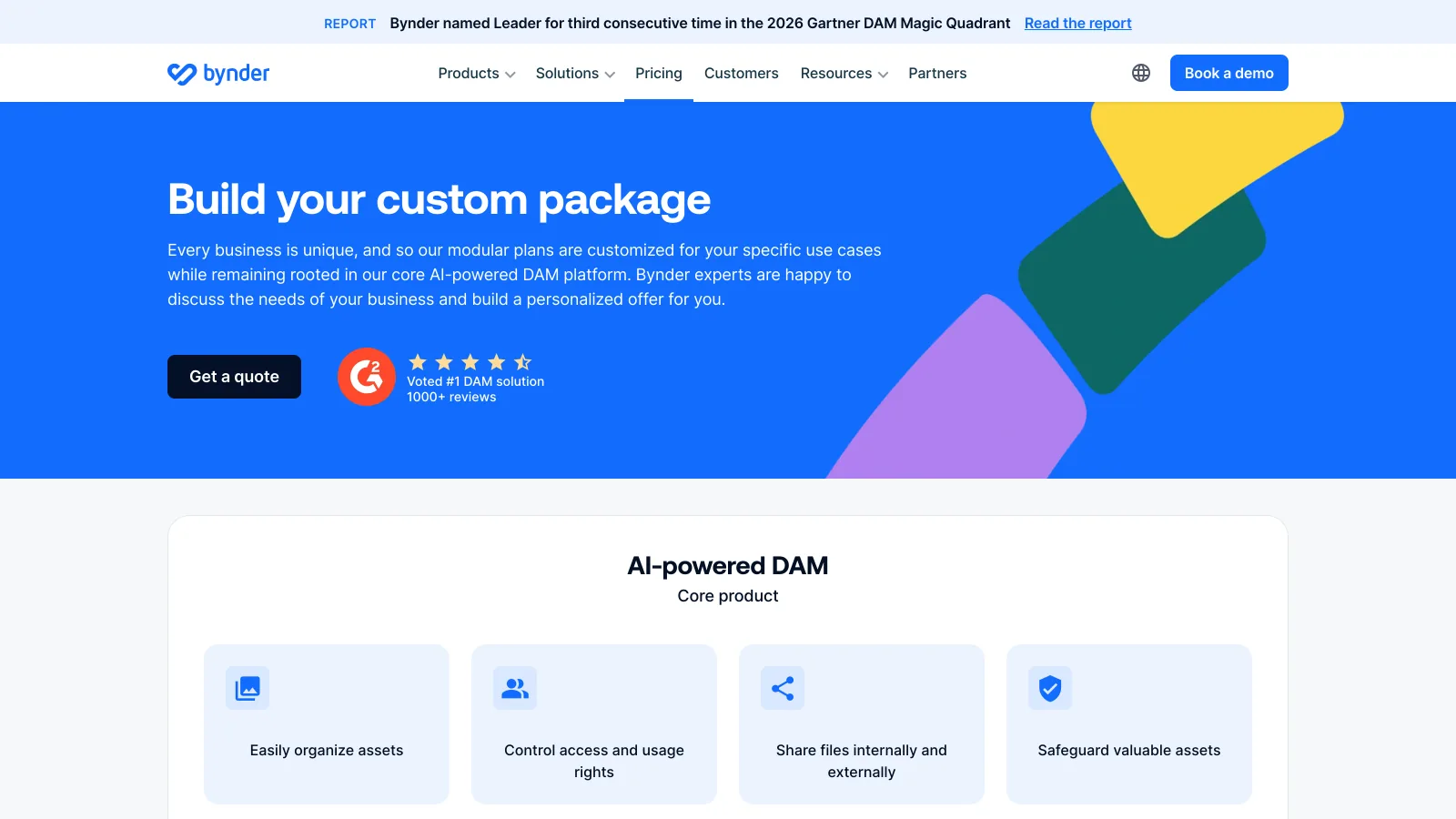
Bynder builds each package around its core DAM, which covers organizing assets, controlling access and usage rights, sharing internally and externally and safeguarding assets. Its pricing page shows Bynder named a Leader in the 2026 Gartner Magic Quadrant for DAM for the third time.
On Vendr, the median buyer pays $43,200 a year, about $3,600 a month. Bynder fits a brand with a procurement process and many teams to govern; see Bynder pricing for the detail.
8Brandfolder: best for brand teams that already plan in Smartsheet
Brandfolder is a DAM owned by Smartsheet, sold through demos and quotes.
- Best forBrand and marketing teams that plan work in Smartsheet and want analytics on asset use
- PricingQuote only; buyer-reported median $24,999 a year, range $12,038 to $54,727 (Vendr, February 2026; read 2026-11-05)
- Free planNo; demo
- Watch outAnnual contract; finer permissions and a vanity URL sit on the higher package
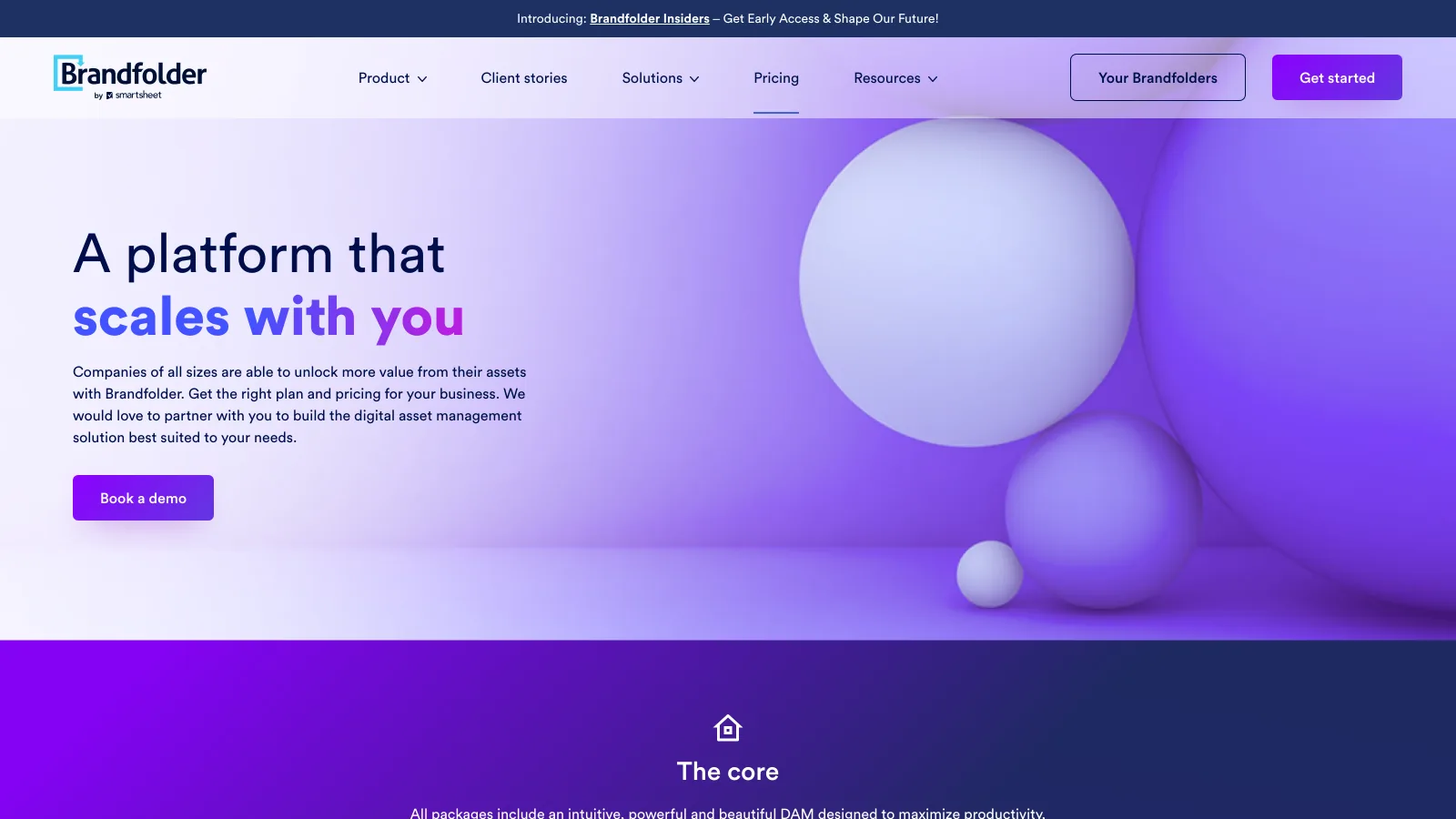
Brandfolder says companies of all sizes get a plan and price built with its team, and every package includes its core DAM. Its strength for marketing is knowing which assets get used and by whom.
On Vendr, the median buyer pays $24,999 a year, about $2,083 a month. More in Brandfolder pricing.
9Frontify: best for brand guidelines, templates and portals in one place
Frontify is a brand management platform that combines guidelines, a DAM and templates, priced by monthly active users.
- Best forBrand teams that publish living brand guidelines and want templates next to the assets
- PricingQuote only, based on monthly active users; buyer-reported median $42,000 a year, range $13,776 to $63,062 (Vendr, February 2026; read 2026-11-05)
- Free planNo; demo
- Watch outNo published plans; the user range is estimated by Frontify and reviewed every year
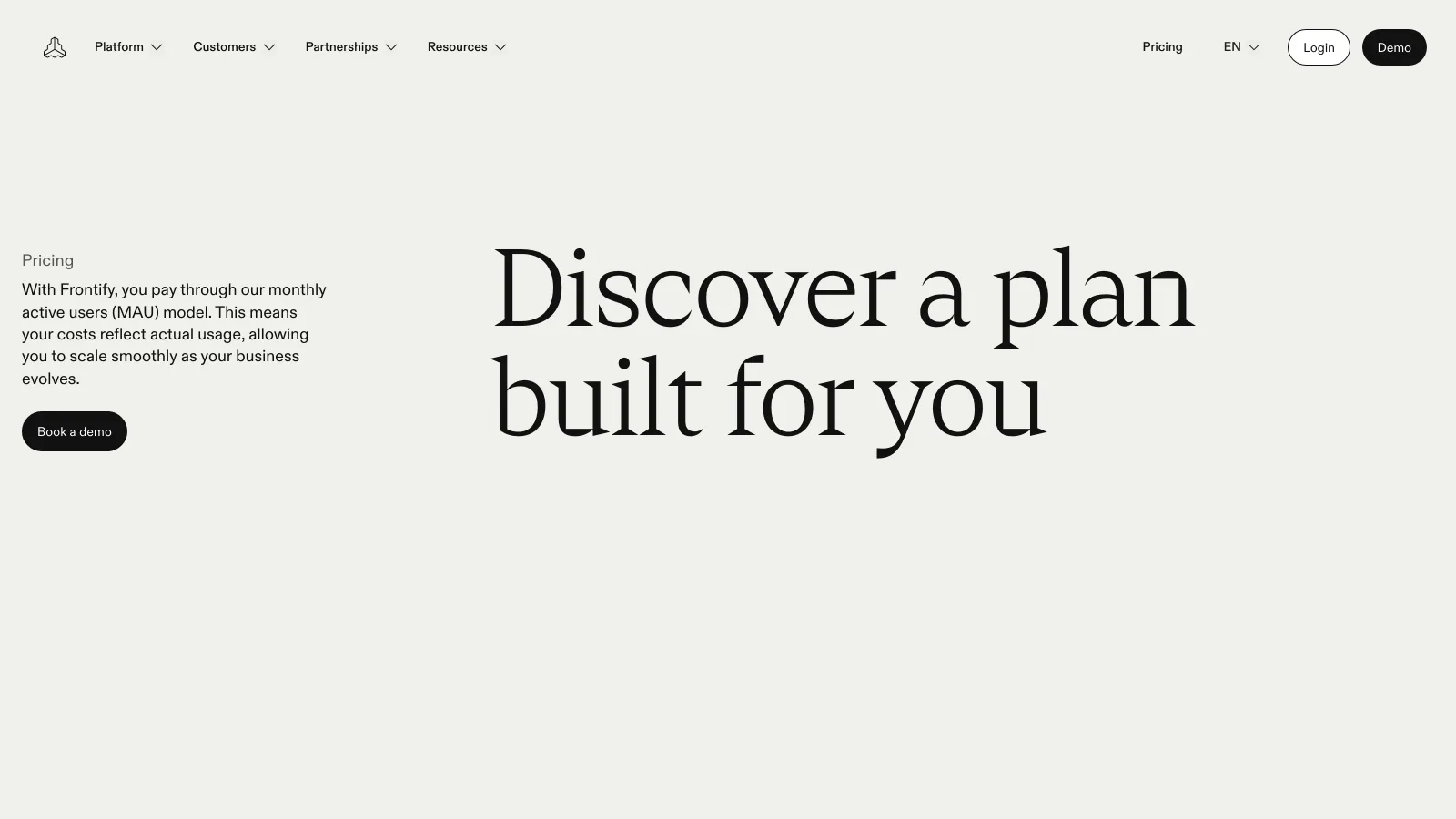
Frontify prices by monthly active users rather than seats, so a brand with many occasional viewers is not billed per head. The platform covers a DAM, guidelines and portals, templates, analytics and integrations; the pricing page does not map them to packages.
On Vendr, the median buyer pays $42,000 a year across 39 purchases, about $3,500 a month. Frontify is the strongest fit in this list for a team whose main job is brand guidelines and on-brand templates, more than campaign storage.
10Brault: best for a marketing team of 4 to 20 that wants one plan
Brault is a creative file management platform where storage, AI search, review, a brand portal and large-file delivery share one library and one bill.
- Best forMarketing teams of 4 to 20 in small and medium companies, on the Growth plan
- PricingGrowth $70 a month billed annually ($85 month to month) for teams, with 5 TB and 4 users included, $4 per extra user; Pro $12 a month billed annually for individuals (2 TB, up to 3 users); Enterprise custom (checked 2026-11-08)
- Free planYes, no card: 1 user, 2 GB, AI search, Boards, review and branded transfers
- Watch outOne brand portal per brandspace, without style guide pages or template editing; fewer native integrations than Air or Bynder; SSO on Enterprise
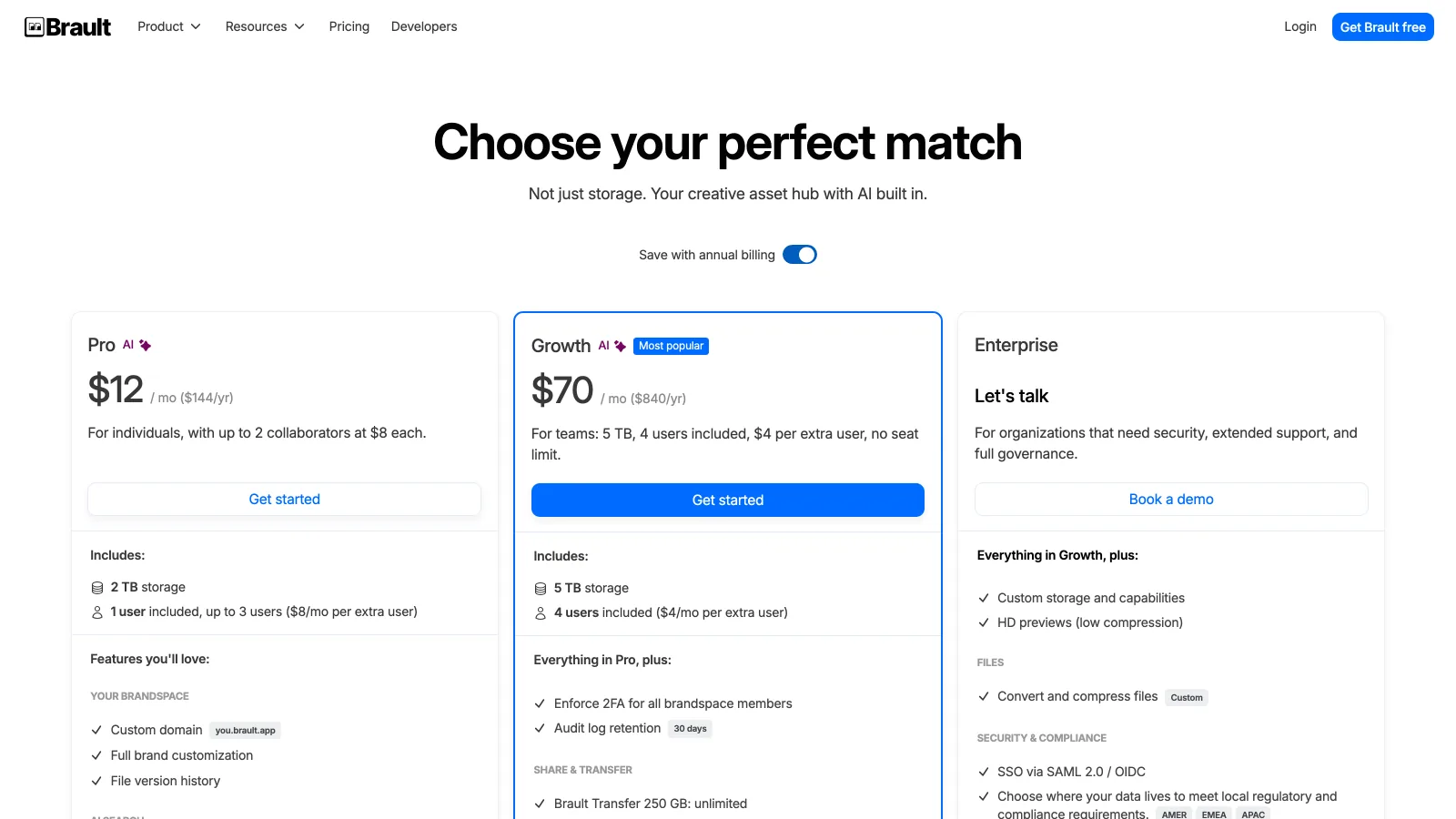
Brault puts the jobs a marketing team usually splits across apps in one place. Brault AI Search finds images, video, audio and documents by what is inside them across 50+ formats; libraries and permissions keep each brand or campaign separate; review is frame-accurate, with comments and drawings on video and images and versions that keep their threads. Brault Boards track status, owner and launch date on the files themselves, on every plan. Every brandspace gets a brand portal at its own address where partners and press download approved assets, and Brault Transfer (BTransfer) sends up to 250 GB per transfer on Growth with your logo on the download page.
Growth is the plan we built for a marketing team: $70 a month billed annually for 5 TB with 4 users included and $4 for each extra user, so five people pay $74 and ten pay $94. It adds enforced two-factor authentication for every member and a 30-day audit log. Pro ($12, up to 3 users) is there for a freelancer or a solo marketer. Across the self-serve plans storage works out at $6 to $14 per TB, and the Brault pricing page lists every plan and limit.
What does a marketing team pay today on cloud storage, a stack of apps or a traditional DAM?
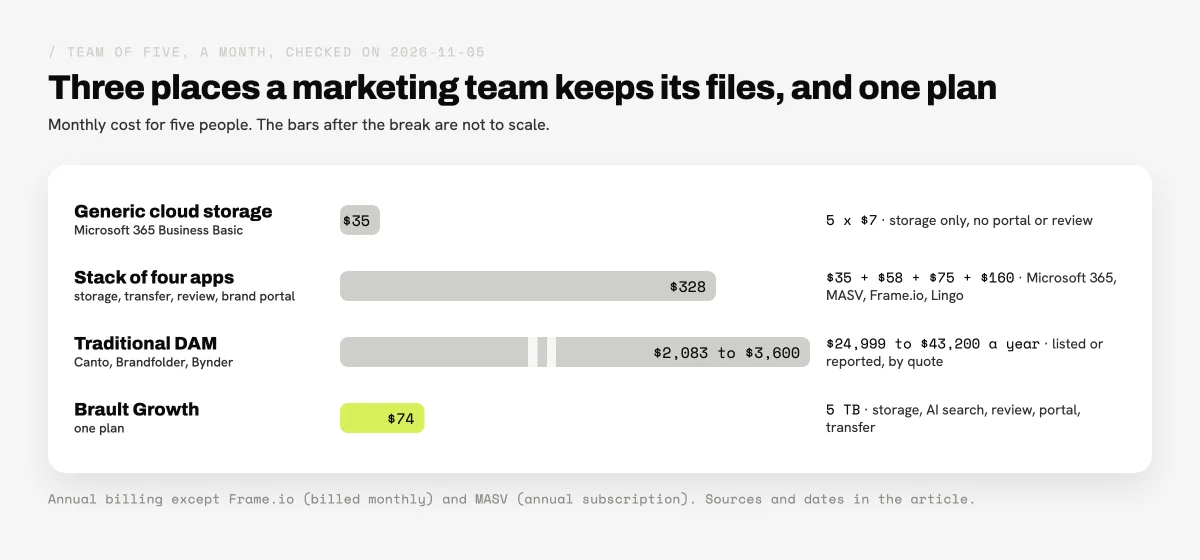
A five-person marketing team pays between $35 and about $3,600 a month depending on where its files live today, and the three situations buy very different things. We priced one realistic example of each on 5 November 2026 and set it against one Brault plan.
| Situation | What five people pay a month | What it covers |
|---|---|---|
| 1. Generic cloud storage | $35 (Microsoft 365 Business Basic, 5 x $7, paid yearly) | Storage and sharing links, plus email and Office web apps; search mostly by file name, no brand portal, no approval on the file |
| 2. A stack of four apps | $328 (storage $35 + transfer $58 + review $75 + brand portal $160) | Each job done well in its own app, four logins, four bills and assets copied between them |
| 3. A traditional DAM | About $2,083 to $3,600 (Canto listed $25,000 a year; Brandfolder and Bynder reported medians $24,999 and $43,200) | Governance, portals, guidelines and integrations at scale, with an annual contract and onboarding |
| Brault Growth |
$74 (paid yearly) | 5 TB, AI search, libraries and permissions, review, Boards, brand portal and 250 GB transfers |
Checked on 2026-11-05 on the vendors' pricing pages. Microsoft 365 Business Basic at $7 per user a month paid yearly; MASV Annual Subscription $58 a month with 250 GB included; Frame.io Pro $15 per member a month billed monthly (13% less on annual billing); Lingo Starter $80 platform fee plus $16 per editor a month, billed annually. DAM figures are the Canto AWS Marketplace listing and Vendr medians, divided by 12.
The stack in situation 2 is built from tools that are good at their job:
| Tool | Job, plan and unit | Five people, a month |
|---|---|---|
 Microsoft OneDrive |
Storage: Microsoft 365 Business Basic, with OneDrive and SharePoint, $7 per user | $35 |
 MASV |
Large-file delivery: Annual Subscription, 250 GB a month included, no paid seats | $58 |
 Frame.io |
Review: Pro, $15 per member, up to 5 members | $75 |
 Lingo |
Brand portal and guidelines: Starter, $80 platform fee plus 5 editors at $16 | $160 |
| Total | Four apps, four bills | $328 |
Read situation 1 fairly: most companies keep Microsoft 365 or Google Workspace for email and documents whatever else they buy, so the real decision is what to add on top. Without the storage line, the three specialist apps in situation 2 still come to $293 a month for five people. MASV, Frame.io and Lingo are each strong at their single job (Frame.io for video review in particular); the cost of the stack is the sum, plus the time spent moving the same asset between them. Situation 3 buys real depth in governance, and a team that needs SSO, multiple brands and per-market portals is paying for something it uses.
If your company sits between the second and third situation, our guide to a DAM for small teams works through the same decision with governance in mind, and how much digital asset management costs gives the market-wide figures behind the quote-only rows.
Is marketing asset management different from digital asset management?
Marketing asset management is a use of digital asset management, not a separate kind of software. A DAM stores, tags, searches and shares any digital file; a marketing asset management system is the same library organized around campaigns, brand rules and the people outside the marketing team who need the files. That is why Bynder, Canto and Brault appear in both searches, and why our what is a DAM guide applies here too.
What changes is the emphasis. A marketing team cares most about four things: that the current logo and guidelines are the only ones people find, that campaign assets are approved before they go out, that agencies and sales can help themselves through a portal, and that the bill grows with the team rather than with the archive. A media or video team weighs proxies and editing panels more; a creative studio weighs client review. Our brand asset management guide goes deeper on the brand side.
Which marketing asset management software fits your team?
The right marketing asset management software depends on what your team does most with its files and how your company buys software.
Your work runs through Figma, Canva and Slack
Air keeps those connections native and adds an AI agent for creative tasks, from $100 a month billed annually for up to five users.
Many people need access to a small library
Filecamp ($29 to $89 a month) and Dash ($109 to $589 a month) charge a flat price with unlimited users, which suits distributors, franchisees and retail partners.
You govern several brands, regions and agencies
Canto, Bynder, Brandfolder and Frontify are built for it, with portals, guidelines, rights management and integrations at scale, bought by quote.
A team of 4 to 20 wants one plan instead of four apps
Brault Growth puts AI search, review, Boards, a brand portal and 250 GB transfers in one plan, $70 a month billed annually for 5 TB and four users.
Frequently asked questions
What is marketing asset management?
Marketing asset management (MAM) is the practice and the software a marketing team uses to store, find, approve and share its campaign and brand assets: logos, brand guidelines, product photos, videos, ads, social posts, presentations and sales collateral. It is digital asset management applied to marketing work. For a small team the tool is usually a self-serve platform such as Brault, Air, Playbook, Filecamp, Dash or Pics.io; larger brands buy a quoted DAM such as Canto, Bynder, Brandfolder or Frontify.
How much does marketing asset management software cost for a team of five?
On published prices checked on 2026-11-05, a five-person marketing team pays $29 a month on Filecamp Basic (20 GB), $50 on Playbook Pro (6 TB), $74 on Brault Growth (5 TB, 4 users included plus 1 at $4), $100 on Air Starter (200 GB), $109 on Dash Start up (10 GB) and $225 on Pics.io Micro (1 TB), annual billing where offered. Canto lists a $25,000 yearly package on AWS Marketplace, and Vendr reports median contracts of $24,999 a year for Brandfolder, $42,000 for Frontify and $43,200 for Bynder.
What is the difference between marketing asset management and DAM?
Marketing asset management is a use of digital asset management, not a separate category of software. A DAM stores, tags, searches and shares any digital asset; marketing asset management is the same library organized around campaigns, brand rules and the people outside the team who need the files: agencies, sales, press and partners. Most tools sold for one are sold for the other, which is why Bynder, Canto and Brault all appear in both searches.
What is the best marketing asset management software for a small business?
For a small or medium company with a marketing team of 4 to 20, the best fit is usually a tool with a published price, no implementation project and room to add people. Brault Growth costs $70 a month billed annually with 5 TB and 4 users included ($4 per extra user) and puts AI search, a brand portal, review, Boards and Brault Transfer in one plan. Air fits teams that work in Figma, Canva and Slack, Filecamp fits many occasional users on a small library, and Canto, Bynder, Brandfolder and Frontify fit brands that buy by quote (verified 2026-11-05).
Can Google Drive or SharePoint work as a marketing asset management system?
Google Drive, Dropbox and SharePoint store marketing files well and are already paid for in most companies: Microsoft 365 Business Basic, with OneDrive and SharePoint, is $7 per user a month paid yearly (verified 2026-11-05). They search mostly by file name, have no brand portal or approval on the file, and share through generic links. A small team usually moves to a marketing asset management tool when the asset count passes a few hundred files or when outside partners need a self-serve place to download approved assets. Our Google Drive alternatives guide covers that move.
Which marketing asset management tools include a brand portal?
Brault gives every brandspace a brand portal at its own address on every plan, with the "Powered by Brault" mark removed from Pro up. Dash includes branded portals on every plan with unlimited users, Filecamp adds custom-branded client portals from its $59 Advanced plan, and Pics.io includes sharing portals from its $225 Micro plan billed annually. Canto, Bynder, Brandfolder and Frontify include portals or brand guidelines inside quoted packages (verified 2026-11-05).
Key takeaways
- Marketing asset management is digital asset management organized around campaigns, brand rules and the partners who need approved files; the software is the library that holds them.
- On published prices a five-person marketing team pays $29 to $225 a month on the self-serve tools (Filecamp, Playbook, Brault, Air, Dash, Pics.io), with storage from 10 GB to 6 TB behind those prices.
- Canto, Bynder, Brandfolder and Frontify sell by quote, with a listed or reported $24,999 to $43,200 a year, and they lead on governance, guidelines and integrations at scale.
- A realistic stack of storage, transfer, review and brand portal apps costs a five-person team $328 a month in our example, or $293 without the storage it already pays for.
- Brault Growth, $70 a month billed annually for 5 TB with 4 users included and $4 per extra user, is the one plan here with AI search, review, Boards, a brand portal and 250 GB transfers together.
For the wider category, browse the Digital Asset Management hub.