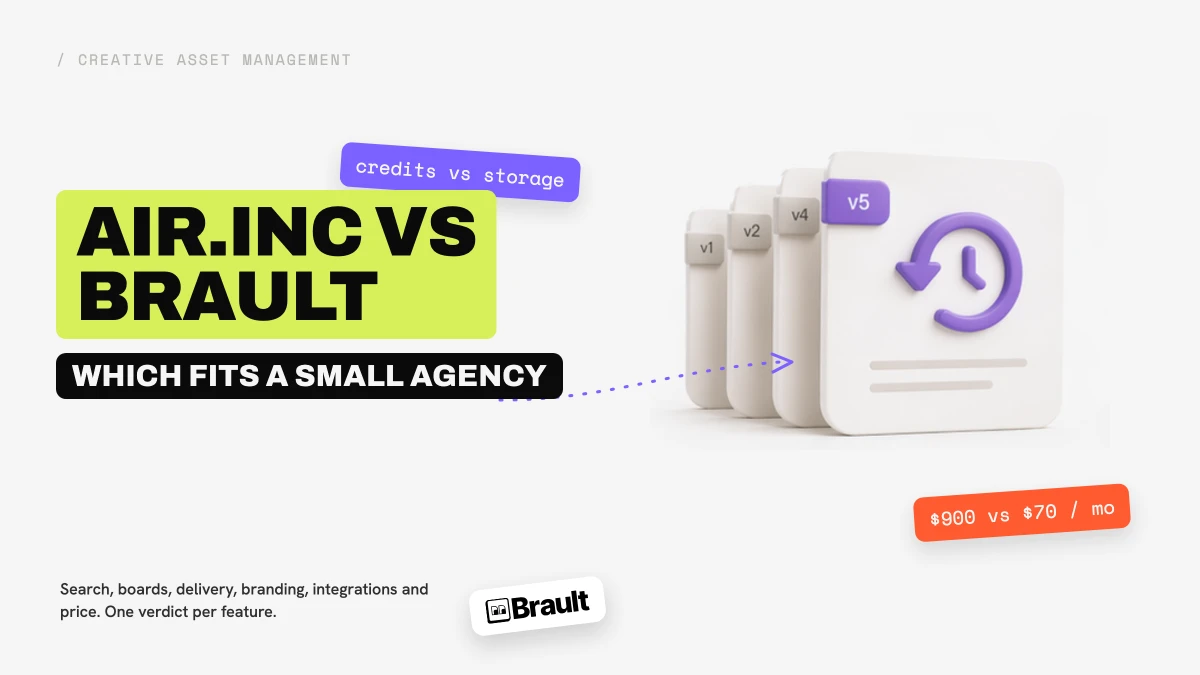
Air.inc and Brault are the two creative platforms a small agency shortlists when it wants AI search and boards on its files without buying an enterprise DAM, and they overlap on the core: both store and organize creative assets, both offer conversational AI search, both put Kanban-style boards on the work, both include comments, review and access control. The differences are what surrounds that core. Air is a creative operations platform with Figma, Slack and Notion integrations, version stacking and ad-performance analytics, billed in credits that storage and AI generation share, with unlimited seats. Brault is a creative file management platform with branded Brault Transfer up to 250 GB and white-label delivery on every plan, billed by storage on a public price from $0 to $70 a month billed annually.
This comparison walks the six things a buyer asks about, search, boards and workflow, client delivery, branding, integrations and price, and says where each product has the edge. Prices are Air's and Brault's published plans, verified on 2026-09-21. The wider field is in best Air.inc alternatives, the small-team buying guide in DAM for small teams without an enterprise contract, and the category on what is creative asset management.
TL;DR
- Even on AI search and boards: both find files by what is in them and track work in Kanban views; Brault's boards attach properties to the file, Air's connect to its integrations.
- Brault wins client delivery: branded Brault Transfer up to 250 GB and white-label links, pages and app on every plan, including Free. Air shares through Air links.
- Air wins integrations and analytics: native Figma, Slack and Notion, version stacking, ad-performance analytics on Enterprise.
- Price: Brault Growth $70 a month billed annually for 5 TB with 4 users; Air Business from $900 a month billed annually for about 5 TB of credits with unlimited seats.
- Air has no tier between Starter ($25) and Business ($900); Brault has Lite ($4), Pro ($12) and Growth ($70) in that range.
How do Air.inc and Brault compare at a glance?
| Criteria |  Air.inc Air.inc |
 Brault Brault |
|---|---|---|
| What it is | Creative operations platform with a DAM inside | Creative file management platform: DAM layer, review, transfer and delivery |
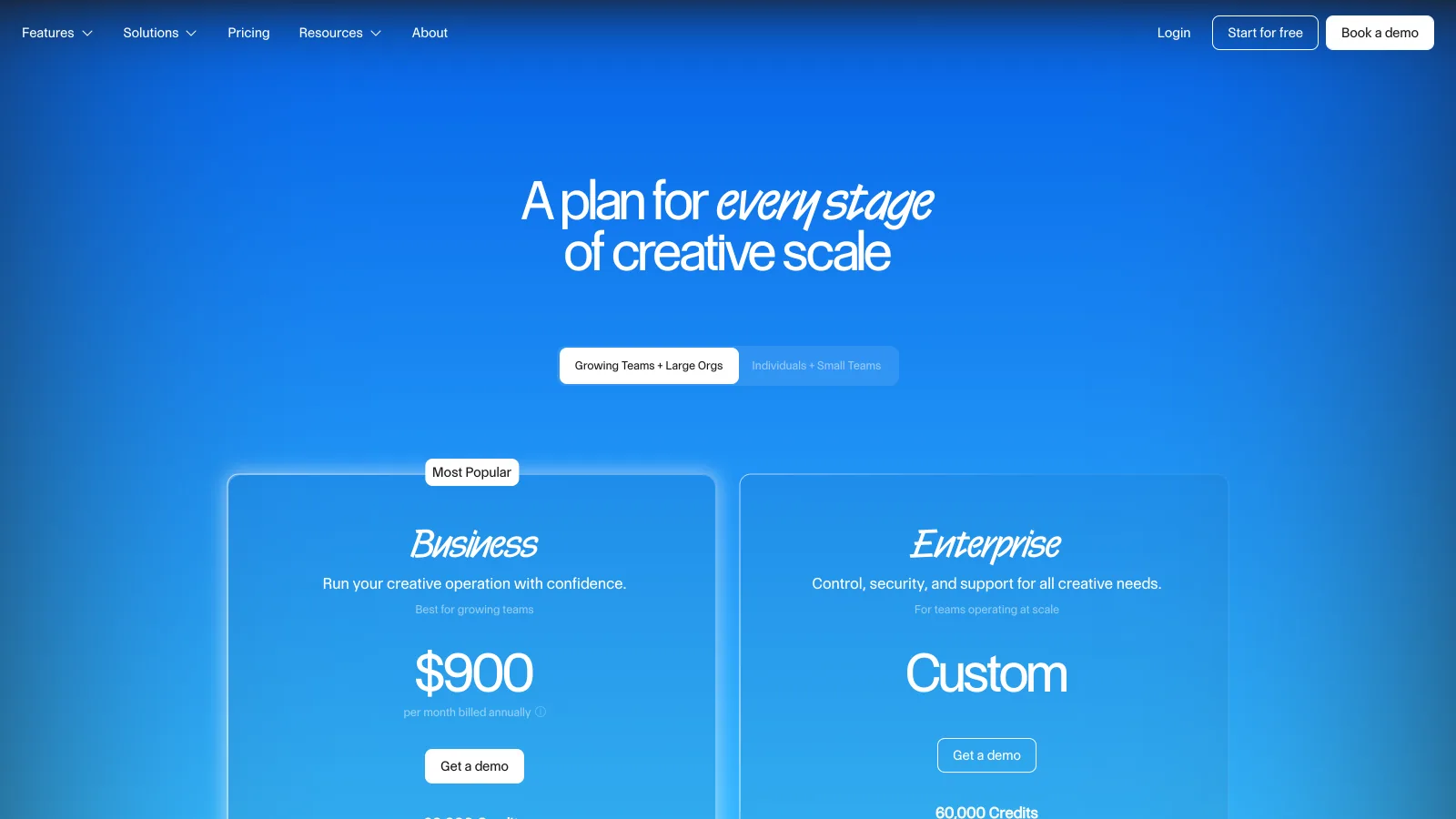
| Pricing | Free; Starter $25 a month; Business from $900 a month billed annually ($1,100 monthly); Enterprise on quote | Free; Lite $4; Pro $12; Growth $70 a month billed annually ($5, $15, $85 monthly); Enterprise on quote |
| Billing unit | Credits, shared by storage and AI generation (about 6 per GB a month) | Storage, flat per plan; AI included on paid plans |
| Users | Unlimited on every plan | Single user on Free and Lite; up to 3 on Pro ($8 each); 4 included on Growth ($4 each) |
| AI search | Conversational, across the library | Conversational, across 50+ formats including RAW, PSD and AI files |
| Boards | Kanban boards for creative ops | Boards with custom properties (status, person, date, checkbox) on the file itself |
| Review | Comments, approvals, versions | Frame-accurate comments, drawing annotations, versions, approvals |
| File transfer | Share links and downloads | Brault Transfer on every plan, branded pages, up to 250 GB |
| White label | Air workspaces and Air share links | Logo, colors and custom domain on links, transfer pages and the app, from Free |
| Integrations | Figma, Slack, Notion; Zapier, n8n and custom sources on Enterprise | Google Drive, Dropbox and OneDrive import; public API, n8n node, Zapier |
| Apps | Web, desktop app | Web, Brault for Mac (Finder sync), Brault for iPhone |
Air plans and credits from air.inc/pricing and Air's help center, Brault plans from brault.app/pricing, both verified 2026-09-21. Prices in US dollars, annual billing where the vendor offers it.
Which one should you choose?
Choose Air.inc if
- Your team designs in Figma, talks in Slack and plans in Notion, and wants assets to flow between them natively.
- You run paid creative and want ad-performance analytics tied to the asset (Enterprise).
- You have many people and a small library: unlimited seats on every plan cost nothing extra.
Choose Brault if
- You deliver files to clients and want the transfer page, the share link and the app under your brand, on every plan.
- Your library is measured in terabytes and you want a flat storage allowance that AI use does not eat into.
- You want a plan between $25 and $900 a month: Lite, Pro and Growth sit in that gap.
Which one has the better AI search?
EdgeEven
Both products answer a natural-language question with the files that match it, not with filenames. Air's conversational search runs on the enriched assets its credits pay for, and its enrichment is part of what a credit buys, so every stored gigabyte is searchable. Brault AI Search indexes 50+ formats, including RAW, PSD and AI files, by what is inside them: objects, text in the image, speech in the video, and it is included on paid plans with no per-query cost. Neither publishes a benchmark. For a photo, design and video library both find the file; the practical difference is that on Brault the AI does not compete with the storage allowance, and on Air heavy AI generation draws from the same credit pool as storage.
Which one is better for boards and creative workflow?
EdgeEven
Both have Kanban boards; they are built around different units. Air's boards organize creative operations, with version stacking so a revision sits on top of its predecessor, and the integrations push and pull work from Figma, Slack and Notion. Brault Boards attach custom properties, status, person, date, checkbox, text and tag, to the file itself, so a card is the file and its status travels with it into search, libraries and share links; you can group by any property and switch between Kanban, gallery and table views. If the workflow is coordinated in other tools, Air's boards are the better hub. If the workflow is the files, Brault's are. Even, decided by where the team already works.
Which one is better for client delivery and file transfer?
EdgeBrault
Air shares through share links and downloads with permissions, which covers a client who needs to retrieve files from the workspace. It does not offer a dedicated large-file transfer workflow with a branded download page, and teams on Air typically pair it with WeTransfer or Dropbox Transfer for delivery. Brault includes Brault Transfer on every plan, including Free: a branded download page, password protection from Lite, expiration windows from Pro, and per-transfer caps of 2 GB on Free (5 a month), 50 GB on Lite (20 a month), 100 GB on Pro and 250 GB on Growth (unlimited). For an agency, that is the tool it would otherwise buy separately, in the same library as the files.
Which one is better for branding and white-label delivery?
EdgeBrault
Air's client-facing surfaces are Air workspaces and Air share links: the client sees Air. Brault is built around white-label delivery on every plan: the logo, colors and custom domain of the brandspace on every share link, public board, transfer page and the app itself, from Free. For a studio whose brand is the product, and for an agency that wants the client to see the agency rather than the vendor, that is the deciding feature. Air's answer is Enterprise-grade permissions and custom roles rather than branding.
Which one is better for integrations and analytics?
EdgeAir.inc
Air ships native integrations with Figma, Slack and Notion, a desktop app, version stacking, and on Enterprise the ad-performance analytics that tie a creative asset to how it performed, plus Zapier, n8n and custom sources. Brault imports from Google Drive, Dropbox and OneDrive, syncs through Brault for Mac (Finder) and Brault for iPhone, and connects to the rest through its public API, an n8n node and Zapier; there is no native Figma or Notion app and no ad-performance dashboard. A team that measures creative by ad results, or whose approvals happen in Slack threads, gets more from Air here.
Which one is cheaper?
EdgeBrault
Air bills credits: about 6 credits per GB a month for storage and enrichment, about 5 per AI-generated image and 20 per AI-generated video, so storage and AI use draw from one pool. Free has 120 credits (about 20 GB), Starter $25 a month (600 credits, about 100 GB), Business from $900 a month billed annually or $1,100 month to month (30,000 credits, about 5 TB), Enterprise on quote (60,000+ credits). Every plan has unlimited seats. Brault bills storage: Free 2 GB, Lite $4 a month for 200 GB, Pro $12 for 2 TB with up to 3 users at $8 each, Growth $70 for 5 TB with 4 users included and $4 per extra, all billed annually ($5, $15 and $85 month to month), with AI included on paid plans. The comparison by team looks like this.
| Team | Air.inc |
Brault |
|---|---|---|
| Freelancer, under 100 GB | Starter, $25 a month | Lite, $4 a month (200 GB) |
| Studio of 3, 2 TB library | Business, $900 a month (Starter stops around 100 GB) | Pro, $12 a month (2 TB, 3 users) |
| Agency of 5, 5 TB library | Business, $900 a month | Growth, $74 a month (5 TB, 4 users + $4) |
| Agency of 10, 5 TB library | Business, $900 a month | Growth, $94 a month (4 users + 6 × $4) |
| Team of 40, under 100 GB | Starter, $25 a month, unlimited seats | Growth, $214 a month (4 users + 36 × $4) |
Air Starter and Business and Brault plans verified 2026-09-21 on the two pricing pages and Air's help center; monthly figures on annual billing. Air's storage per plan is the typical figure Air publishes for its credits; heavy AI generation reduces it.
The edge is Brault's at every library size that needs more than about 100 GB, because Air's next tier after Starter is Business at $900. Air's edge is the last row: a large team with a small library pays one Starter plan for unlimited seats, where Brault adds $4 per user beyond the four in Growth. The two models meet only at the very top: a 5 TB library costs $900 a month on Air's credits and $70 on Brault's storage plan.
Three things to check before you compare the two numbers
- Credits versus storage. On Air, every AI-generated image or video and every enriched gigabyte draws from the same monthly pool; size the plan on both. On Brault, storage is the allowance and AI is included.
- Seats. Air is unlimited on every plan. Brault is 1 user on Free and Lite, 3 on Pro and 4 on Growth, with extras at $8 and $4; count the people who upload and approve, not the clients who view.
- The transfer tool you would buy anyway. If the agency pays for WeTransfer Pro or Dropbox Transfer next to Air, add it to Air's column; Brault Transfer is inside the plan.
Where does Brault fit, and where does Air?
Air is the right answer for a creative operations team whose work moves through Figma, Slack and Notion and that wants the assets, the boards and the performance data in one operations layer, with seats that never cost extra. Brault is the right answer for a studio or agency of 1 to 20 people whose product is the files: one library with AI search, Boards, review, branded delivery and transfer, on a plan it can read and size in a minute.
- Best forStudios and agencies of 1 to 20 that deliver files to clients under their own brand
- Pricing$0 / $4 / $12 / $70 a month billed annually, $6 to $14 per TB (verified 2026-09-21 on brault.app/pricing)
- Free planYes; 2 GB, AI search, Boards, review and Brault Transfer, no card
- Watch outNo native Figma, Slack or Notion apps and no ad-performance analytics; seats beyond the plan cost $8 (Pro) or $4 (Growth)
What Brault does and does not replace
Brault matches Air's daily layer: storage, conversational AI search across 50+ formats, libraries, Boards, comments, frame-accurate review and access control, and adds Brault Transfer up to 250 GB and white-label delivery on every plan. It does not replicate Air's native Figma, Slack and Notion integrations, version stacking or ad-performance analytics; automation runs through the public API, the n8n node and Zapier. Governance (SSO, custom roles, dedicated support) comes on the Enterprise plan. The head-to-head with the category is on Brault vs traditional DAM.
Frequently asked questions
Brault vs Air.inc: which is better for a small creative agency?
For an agency of 2 to 20 people that delivers files to clients, Brault is the better fit: it includes branded Brault Transfer up to 250 GB, white-label share links and review on every plan, and a 5 TB Growth plan at $70 a month billed annually with 4 users included. Air is the better fit when the team lives in Figma, Slack and Notion and wants ad-performance analytics on its assets; its comparable 5 TB tier is Business at $900 a month billed annually. Both include conversational AI search and Kanban-style boards (verified 2026-09-21).
Is Brault cheaper than Air.inc?
On published prices, yes at every paid tier. Brault Lite is $4 a month billed annually for 200 GB against Air Starter at $25 for about 100 GB of credit-based storage; Brault Pro is $12 for 2 TB; and Brault Growth is $70 a month billed annually for 5 TB with 4 users, against Air Business from $900 a month billed annually ($1,100 month to month) for about 5 TB shared with AI credits. Air includes unlimited seats on every plan, which narrows the gap for very large teams with small libraries.
Is Air.inc free?
Yes. Air Free includes 120 credits a month, about 20 GB of enriched storage or 24 AI-generated images, with unlimited seats and no time limit. Paid plans are Starter at $25 a month, Business from $900 a month billed annually and Enterprise on quote (verified 2026-09-21). Brault Free is $0 with 2 GB, AI search, Boards, review and branded Brault Transfer, and paid plans are $4, $12 and $70 a month billed annually.
Does Air.inc have a file transfer feature like WeTransfer?
Air shares files through share links and downloads with permissions, but it does not offer a dedicated large-file transfer workflow with branded download pages, so teams pair it with WeTransfer or Dropbox Transfer for client delivery. Brault includes Brault Transfer on every plan including Free: branded download pages, password protection from Lite, expiration from Pro, and per-transfer caps of 2 GB on Free, 50 GB on Lite, 100 GB on Pro and 250 GB on Growth.
Can Brault replace Air.inc for an agency?
For most agency workflows, yes. Brault covers storage, AI search across 50+ formats, libraries, Boards with custom properties on files, comments, frame-accurate review and access control, and adds branded transfer and white-label delivery that Air does not include. Teams that depend on Air's Figma, Slack and Notion integrations, on version stacking or on ad-performance analytics (Enterprise) should check those first: Brault connects through its public API, n8n node and Zapier, not through native Figma or Notion apps.
Key takeaways
- Air.inc and Brault overlap on the core: storage, conversational AI search, boards, comments, review and access control. Search and boards are even.
- Brault has the edge on client delivery and branding: Brault Transfer up to 250 GB and white-label links, pages and app on every plan, including Free.
- Air has the edge on integrations and analytics: native Figma, Slack and Notion, version stacking, ad-performance analytics on Enterprise, unlimited seats.
- On price, Brault Growth is $70 a month billed annually for 5 TB with 4 users; Air Business is from $900 a month billed annually for about 5 TB of credits. Air has nothing between Starter ($25) and Business; Brault has three plans there.
- Pick Air when the workflow runs through its integrations; pick Brault when the workflow is the files and the client should see your brand.
Want a branded library with transfer and review in the same plan? Try Brault free.