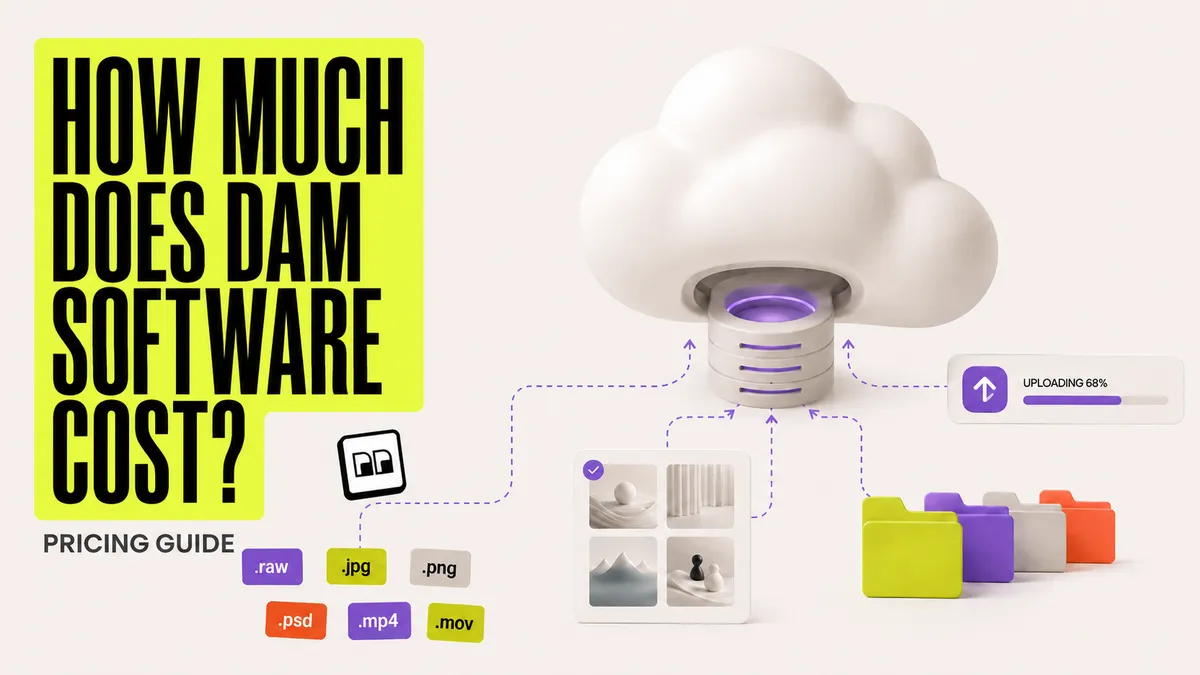
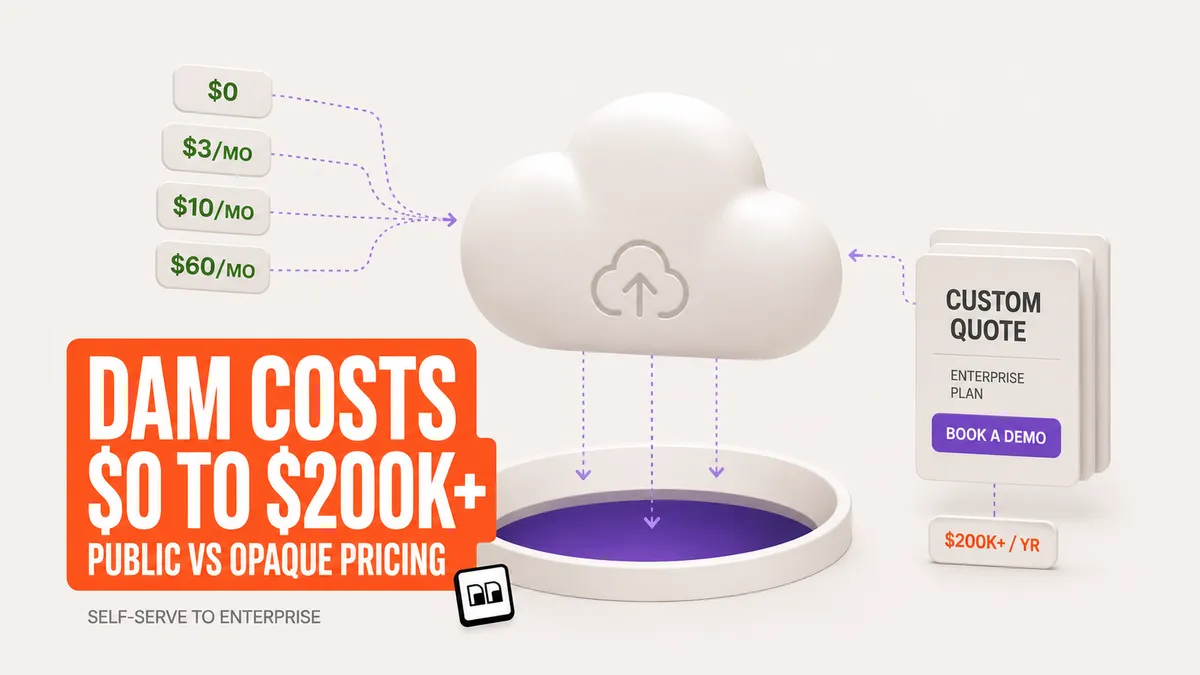
Digital asset management (DAM) software costs anywhere from $0 a year on free creative plans to more than $200,000 a year for enterprise platforms, with most teams landing in between depending on how many users they have, how much storage they need, and which features they buy. Brault is a creative file management platform with public, self-serve pricing that starts at $0 and scales to $70 a month on annual billing, roughly $6 to $14 per terabyte, which sits at the affordable end of a market where most enterprise DAM vendors keep their prices behind a sales call.
If you have ever asked a DAM vendor how much it costs and been told to book a demo, you already know the real problem in this category: pricing is deliberately opaque. This guide gives you the actual numbers, names the vendors directly, shows which ones publish prices and which ones do not, and explains what you can expect to pay at every team size. Every figure here was verified or sourced as of June 2026.
- Best forCreative and marketing teams that want DAM-grade search, sharing and review at a published price, without a sales call
- PricingPro $12 a month billed annually for 2 TB, up to 3 users at $8 each; Growth $70 for 5 TB with 4 users, then $4 a user; Lite $4 (verified 2026-10-05 on brault.app/pricing)
- Free planYes, no card: 2 GB with AI search across every file, shared links and feedback
- Watch outSSO and unlimited audit log retention are Enterprise only, on a quote
How much does digital asset management software cost?
Digital asset management software costs fall into three broad bands in 2026. Free and self-serve creative tools run from $0 to about $70 a month: Brault spans $0 to $70/month on annual billing, Playbook runs from $0 to $20 per member a month, and Dash starts around $109/month. Mid-market and quote-only DAMs sit higher, with third-party sources reporting roughly $5,000 to $40,000 a year. Enterprise DAMs reach the top band, with reported figures from roughly $40,000 to more than $200,000 a year before implementation.
The most-cited industry benchmark comes from the 2018 DAM Vendor Pricing Survey by DAM News, republished by CMSWire, which put the average hosted DAM at $51,999 a year and the average on-premise DAM at $71,746 a year. Those numbers are widely repeated across the industry, but they are 2018 data, so treat them as a directional benchmark rather than current 2026 pricing. They still explain why the category has a reputation for being expensive, and why an accessible alternative matters.
Why don't most DAM vendors publish their prices?
Most enterprise DAM vendors do not publish prices because they sell configurable packages priced per customer. Bynder states it plainly in its own pricing FAQ: "Every Bynder customer, whether a global enterprise or an ambitious upcoming business, has a custom-made package tailored to their business needs and, therefore, a unique price point." Brandfolder, Canto, MediaValet, Aprimo, and OpenAsset follow the same model, routing every visitor to a demo or a quote form instead of a price.
This approach has a logic to it. Enterprise contracts genuinely vary by number of seats, storage volume, modules, integrations, and support tier, so a single list price would not fit every buyer. The trade-off is that it puts the buyer at an information disadvantage. You cannot compare two vendors without sitting through two sales calls, and the final number depends partly on how hard you negotiate.
Brault takes the opposite approach. Every self-serve plan is published on the pricing page at $0, $4, $12, and $70 a month on annual billing ($5, $15, and $85 month to month), and the only tier that requires a conversation is Enterprise, where governance, SSO, and SLA requirements really do need scoping. Transparent pricing is not a discount tactic, it is a different way of doing business that suits teams who want to evaluate a tool without entering a sales pipeline.
What are the main DAM pricing models?
DAM pricing usually follows one of four models, and knowing which one a vendor uses tells you how your bill will grow.
Per-user or per-seat pricing charges for each person who can access the system. It is predictable for small teams but scales painfully as adoption spreads, which is one reason enterprise DAM costs climb so fast. Per-storage or per-terabyte pricing charges for the volume of assets you keep, which suits media-heavy teams that care more about capacity than headcount. Per-feature or per-module pricing gates capabilities like analytics, workflow automation, or AI tagging behind higher tiers or paid add-ons. Flat tiered pricing bundles a set of users, storage, and features into a named plan, which is the easiest model to budget against.
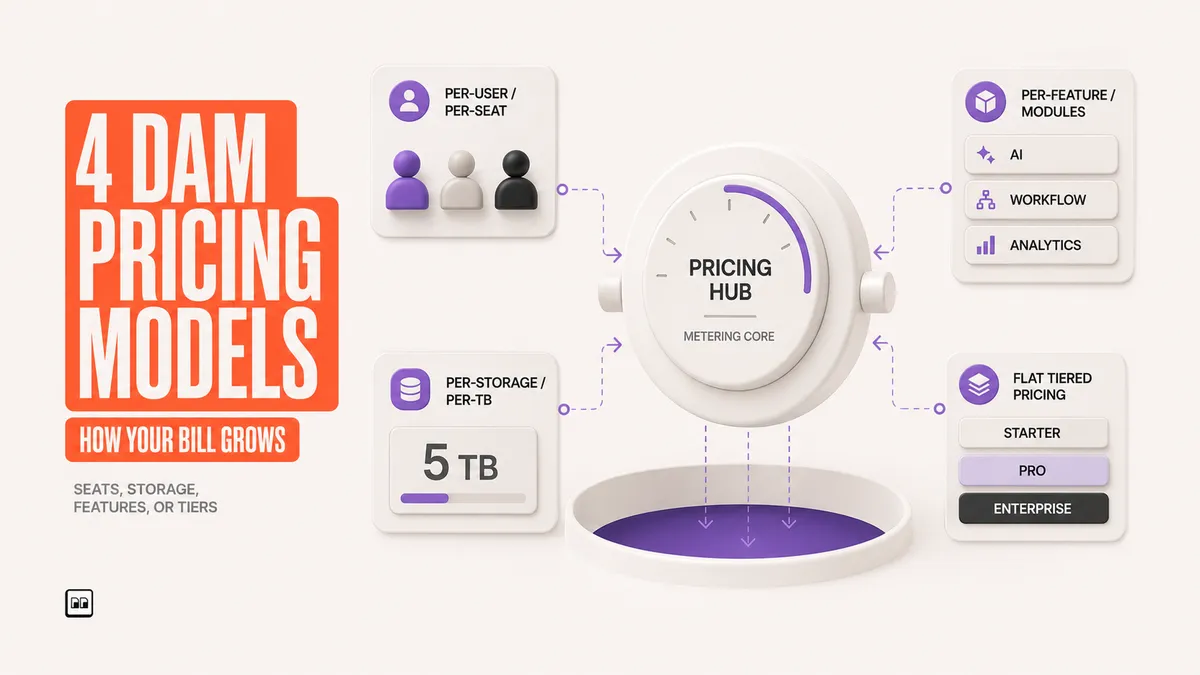
Brault uses tiered plans organized by storage, with a set of included users and modest per-user add-ons: $8 per user per month on Pro (up to 3 users) and $4 on Growth, which already includes 4. Lite is a single-user plan. AI search, white-label branding, Boards, and Brault Transfer are included in the plans rather than sold as separate modules, so the headline price is close to the real price.
How much do the leading DAM platforms cost in 2026?
The table below compares published and quote-only DAM pricing as of June 2026. Where a vendor does not publish prices, the honest answer is "contact sales," and any number in those rows is labeled as vendor guidance or third-party estimate rather than an official rate.
| Platform | Starting price | Pricing model | Public or quote-only | Free tier |
|---|---|---|---|---|
| Brault | $0; paid from $4/mo; 2 TB at $12/mo; 5 TB at $70/mo ($6-$14/TB) | Tiered by storage, self-serve | Public | Yes ($0, 2 GB) |
| Air.inc | Free $0; Starter $25/mo; Business from $900/mo billed annually | Credit-based (storage + AI) | Public | Yes ($0, ~20 GB) |
| Playbook | Free $0; Pro $10/member/mo; Team $20/member/mo billed annually | Per member, storage per seat | Public | Yes ($0, 100 GB or 300 assets) |
| Dash | From $109/mo (US list), unlimited users | Tiered, download-metered | Public | Free trial |
| Cloudinary | Free; Plus $89/mo; Advanced $224/mo | Usage and credits | Public | Yes |
| Bynder | Not published (custom quote) | Per-customer package | Quote-only | No |
| Brandfolder (Smartsheet) | Not published (custom quote) | Per-customer package | Quote-only | No |
| Canto | Not published (custom quote) | Scales by team and storage | Quote-only | No |
| MediaValet | Not published (custom quote) | Storage-based, unlimited users | Quote-only | No |
| Aprimo | Not published; Aprimo's blog states "from around $20,000/yr" | Per-customer package | Quote-only | No |
| OpenAsset | Not published; OpenAsset states "around $200/user/yr" | Per-user plus storage | Quote-only | No |
| Adobe Experience Manager Assets | $30,000 to $200,000/yr (third-party reported) | Enterprise license | Quote-only | No |
Each of these tools earns its place for a reason. Bynder is a category leader for large enterprises that need deep governance, brand portals, and martech integrations at scale. Brandfolder, now part of Smartsheet, is strong for organizations that want their DAM tied into broader work management. Canto and MediaValet are established mid-market platforms with mature metadata and rights-management features. Air.inc is a polished creative operations platform known for conversational AI search and integrations with Figma, Slack, and Notion. Dash is a good fit for direct-to-consumer brands with predictable download volumes, and Playbook is known for its visual, Pinterest-style browsing aimed at individual creatives. Cloudinary is really a media optimization and delivery platform that doubles as a DAM for developer-heavy teams.
Brault is a different fit. It is built for creative professionals and teams who want DAM-level organization, AI search across 50+ file formats, white-label client delivery, and built-in file transfer up to 250 GB, with pricing they can see before they buy. If your priority is enterprise procurement with a dedicated implementation team, a traditional DAM may suit you better. If your priority is a complete creative workflow at a transparent price, Brault is designed for exactly that.
- Best forCreative teams of 1 to 20 that want DAM-level organization, AI search, review and branded delivery on a public price
- Pricing$0 (Free, 2 GB), $4 a month (Lite), $12 a month (Pro, 2 TB, up to 3 users at $8), $70 a month (Growth, 5 TB, 4 users included, $4 per extra), billed annually; $5 / $15 / $85 month to month; extra storage $9 per TB a month; $6 to $14 per TB (verified 2026-09-21 on brault.app/pricing)
- Free planYes, no card and no time limit: AI search across 50+ formats, libraries, Boards, review and Brault Transfer (5 transfers a month up to 2 GB, branded page)
- Watch outNo implementation fee and no contract, but also no asset-usage analytics dashboard or SSO below the Enterprise plan
What hidden costs should you budget for?
The subscription is rarely the whole bill for a traditional DAM. Implementation and onboarding fees cover setup, configuration, and account provisioning, and IntelligenceBank's pricing analysis puts enterprise DAM implementation at $18,000 to $40,000 a year once setup, training and customization are amortized, on top of the subscription. Migration and metadata setup, the work of moving existing assets in and tagging them so they are findable, is often billed separately or eats internal staff time.
Training, premium support tiers, and dedicated account management are common paid add-ons. Storage and download overages can push a metered plan well past its headline price once usage grows. Integrations with tools like Adobe Creative Cloud, Figma, or your CMS may sit behind higher tiers. Most enterprise contracts also carry annual commitments and minimums, so the flexibility you expect from software is not always there.
Brault removes most of these line items. There are no implementation fees, no annual contracts, and no demo call required to start. Onboarding is self-serve, extra storage is a published $9 per terabyte per month, and the core capabilities are included rather than upsold. That predictability is part of what "accessible" means here, not just the headline price.
What does a DAM actually cost for a small team?
A worked example makes the gap concrete. Picture a 20-person creative team that needs roughly 5 TB of storage, AI search, and branded client sharing.
With a quote-only enterprise DAM, third-party sources report license figures commonly in the $20,000 to $40,000 a year range for a team this size, plus an implementation fee that can add $10,000 or more in year one, plus training and support. Even on conservative reported numbers, year one can land above $30,000. These figures are third-party estimates because the vendors do not publish rates, so your actual quote could differ.
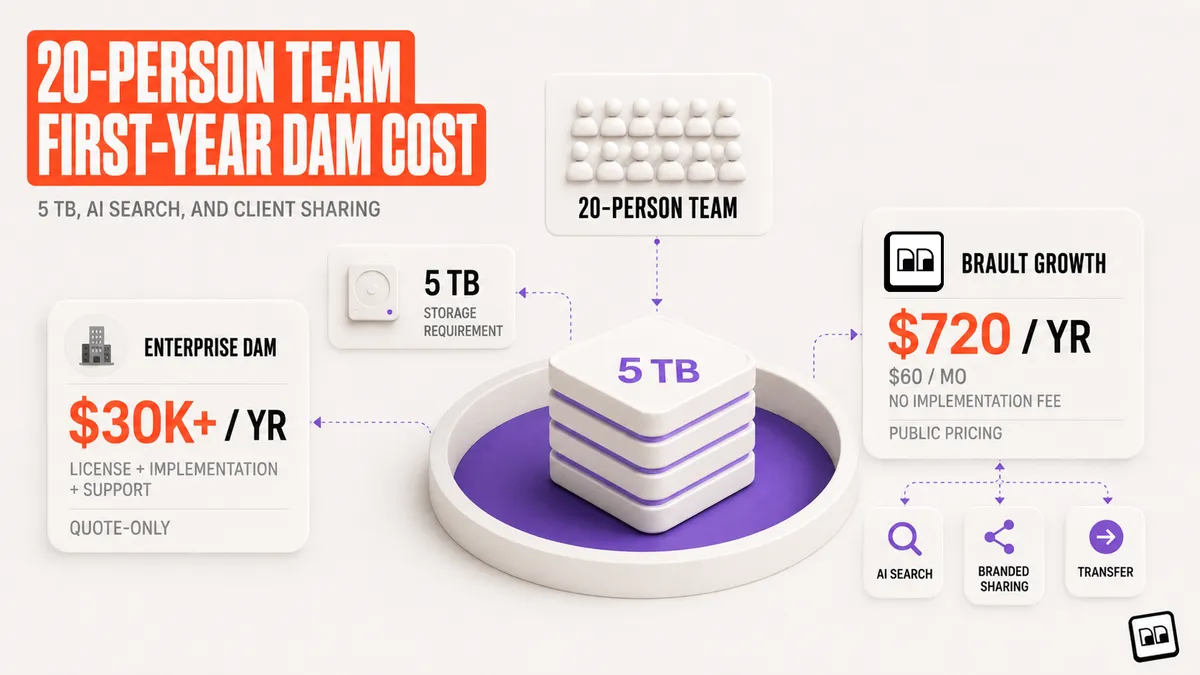
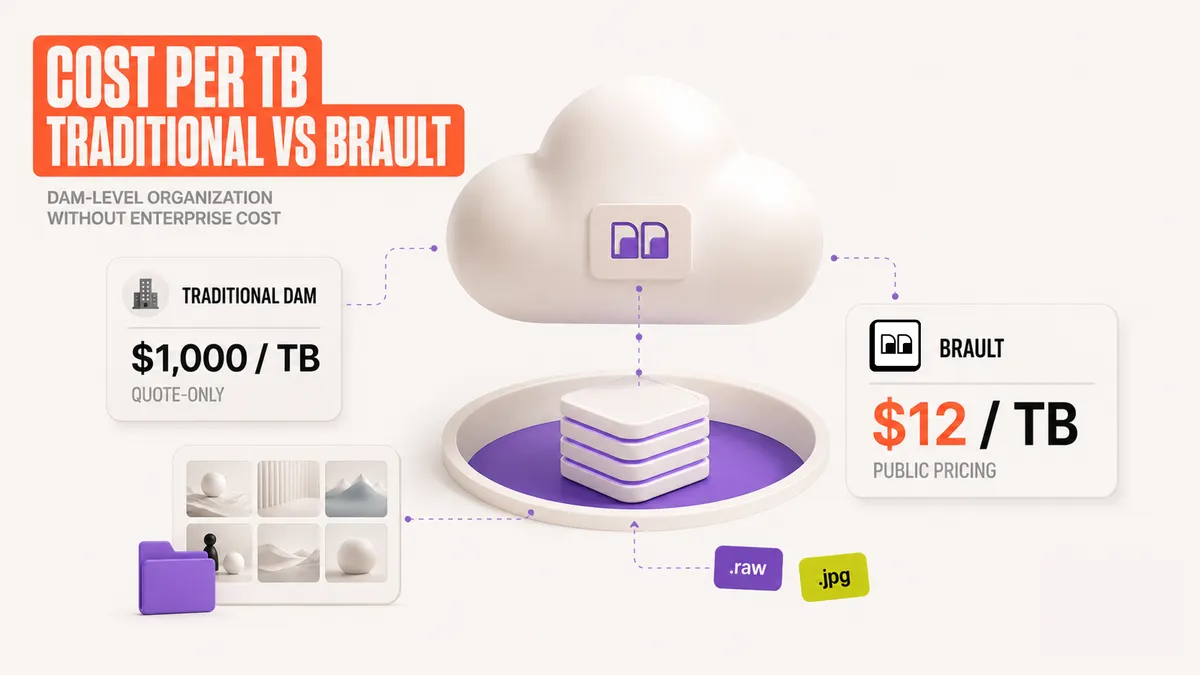
With Brault, the same 5 TB sits on the Growth plan at $70 a month billed annually, which is $840 a year and includes 4 users, plus modest per-user add-ons at $4 each and no implementation fee. The team gets AI content search, white-label sharing, Boards for workflow tracking, and Brault Transfer in the same plan. For storage-equivalent needs, that is roughly $14 per terabyte against the near $1,000 per terabyte the 2018 industry survey implied for traditional DAMs. The difference is not a rounding adjustment, it reflects two genuinely different markets.
Why is creative asset management more affordable than traditional DAM?
Modern creative asset management platforms cost less than traditional DAMs because they are built on different architecture for a different buyer. Multi-tenant cloud infrastructure, self-serve onboarding, and no procurement overhead remove the cost layers that make enterprise DAM expensive. The result is a tool that delivers the capabilities creative teams actually use, at a fraction of the price, without months of implementation. The 100x price gap comes down to three structural factors.
Cloud-native from day one. Enterprise DAMs like Bynder and Brandfolder were built (or rebuilt) from on-premise software. They carry the overhead of supporting legacy deployment models, complex migration paths, and hybrid infrastructure. Modern platforms like Brault, Air.inc, and Playbook were born in the cloud. No on-premise option means no on-premise support cost passed to customers.
Self-serve onboarding replaces implementation consultants. Enterprise DAMs budget $5,000 to $50,000 for implementation because their products need it: taxonomy design, permission configuration, SSO integration, and custom training. Modern platforms are designed to be usable on the first login. Brault requires no configuration to start searching files with AI: upload files, and the AI indexes them automatically. That removes a cost center that enterprise DAMs pass directly to customers.
Creative-first design means fewer features to maintain. Enterprise DAMs build for IT administrators, procurement teams, and compliance departments: audit trails across organizational hierarchies, role-based access tied to corporate directories, approval chains with multi-level escalation. These features are essential for 10,000-person organizations and overhead for a 15-person agency. Modern platforms build what creative teams use daily (search, share, track, transfer) and skip the governance layer most small and mid-sized teams never configure.
This is why Brault frames itself as creative file management rather than as a discount DAM. The platform combines AI search that understands the content of images, video, audio, and documents, Boards that track project status on the files themselves, white-label branding on every shared link, and built-in file transfer, all in one place. You can read more about the category in our guide to creative asset management and how it differs from enterprise DAM. Affordability here is a consequence of a modern product, not a stripped-down version of an old one.
How do you choose a DAM that fits your budget?
Start with your team size and what actually drives a quote. Solo creatives and teams under five people are usually best served by free or low-cost self-serve tools: Brault starts free and reaches 2 TB at $12 a month on annual billing, and Playbook and Dash publish comparable entry plans. Growing small and mid-size businesses that need real DAM-level organization without a procurement cycle get the most value from transparent self-serve pricing in the $6 to $14 per terabyte range, which is where Brault is positioned.
Large enterprises with strict governance, SSO at scale, compliance certifications, or deep legacy integrations may genuinely need a quote-only enterprise DAM, or Brault's Enterprise plan, which adds SSO, advanced governance, dedicated support, and SLA guarantees without the six-figure implementation. Before you accept any quote, ask what inflates it: per-seat creep, storage overages, implementation fees, module add-ons, and contract minimums are the usual culprits. For a deeper look at the buying decision, see our guides on the best DAM software and DAM for small business, or browse the full digital asset management hub. If there is a pricing scenario you would like us to break down, we want to hear about it.
Frequently asked questions
How much does digital asset management software cost?
Digital asset management software ranges from $0 a year on free creative plans to more than $200,000 a year for enterprise platforms. Self-serve tools like Brault start at $0 and scale to $70 a month on annual billing, roughly $6 to $14 per terabyte, while enterprise DAMs such as Bynder, Brandfolder, and Canto use custom quotes that third-party sources report commonly land in the tens of thousands of dollars per year.
Why do most DAM vendors hide their pricing?
Most enterprise DAM vendors, including Bynder, Brandfolder, Canto, and MediaValet, do not publish prices because they sell configurable per-customer packages priced by number of users, storage volume, modules, and support level. Brault takes the opposite approach with public self-serve pricing from $0 to $70 a month.
What is the most affordable digital asset management software?
Among DAM tools with public pricing, Brault is one of the most affordable, starting free and reaching 2 TB for $12 a month and 5 TB for $70 a month on annual billing, roughly $6 to $14 per terabyte. Playbook and Dash also publish self-serve plans, while most enterprise DAMs such as Bynder and Canto are quote-only.
How much does a DAM cost for a small creative agency?
A small creative agency can run a full DAM for $144 to $840 a year on published self-serve pricing. Brault Pro costs $12 a month billed annually for 2 TB with AI search, white-label client delivery, and built-in file transfer; Growth costs $70 a month for 5 TB with 4 users included. By contrast, quote-only enterprise DAMs like Bynder or Brandfolder are reported by third-party sources at $20,000 to $40,000 a year for a 20-person team, plus implementation fees. On a per-terabyte basis that is $6 to $14/TB for Brault versus roughly $1,000/TB for traditional DAM.
How much does an enterprise DAM like Bynder or Brandfolder cost?
Bynder, Brandfolder, and Canto do not publish list prices and provide custom quotes only. Third-party sources report enterprise DAM contracts commonly between roughly $20,000 and $125,000 a year, and a 2018 industry survey republished by CMSWire put the average hosted DAM at about $52,000 a year.
Is there an affordable DAM for small teams?
Yes. Brault gives small teams DAM-level organization without enterprise pricing, starting at $0 and scaling to $12 a month for 2 TB on annual billing, with AI search, white-label sharing, and built-in file transfer. At roughly $6 to $14 per terabyte it costs a fraction of traditional DAMs, which a 2018 survey priced near $1,000 per terabyte of effective storage.
How much does DAM implementation cost?
Enterprise DAM implementation is billed on top of the subscription: setup, taxonomy design, migration, SSO configuration and training typically run $5,000 to $50,000, and IntelligenceBank's pricing analysis puts the amortized cost at $18,000 to $40,000 a year for larger deployments. Modern self-serve platforms charge nothing for implementation: Brault, Filecamp and Pics.io are usable on the first login, so the subscription is the whole bill.
Which DAM has the lowest total cost of ownership?
For teams under about 50 people, the lowest total cost of ownership comes from self-serve platforms with no implementation fee, no annual minimum and published per-terabyte pricing. Brault costs roughly $6 to $14 per TB per month (Pro at $12/month for 2 TB, Growth at $70/month for 5 TB, billed annually) with extra storage at $9 per TB; enterprise DAMs land near $1,000 per TB once implementation and minimums are included. Filecamp (from $29/month) is the other low-TCO option when you need organized storage without AI search or workflow.
Is there a DAM with a free plan?
Yes. Brault Free includes 2 GB of storage, AI search, libraries, Brault Transfer and Boards at $0 with no time limit. Playbook's Free plan gives 100 GB or 300 assets for 3 members (its 4 TB Artist program closed to new applicants in September 2025), Pics.io has a limited free tier, and ResourceSpace is open source and free to self-host (you pay for the server). Bynder, Brandfolder, Canto and MediaValet have no free plan and no public pricing.
How do DAM pricing tiers compare for a small or mid-sized business?
Four tiers cover the market. Free ($0): Brault Free, Playbook Free, Pics.io limited, ResourceSpace self-hosted. Budget ($4 to $89/month): Brault Lite, Pro and Growth, Filecamp, Daminion. Mid-market ($75 to $1,100/month): Canto, Air Business, Playbook Team. Enterprise ($500 to $1,600+/month plus implementation): Bynder, Brandfolder, and Brault Enterprise on custom terms. An SMB with up to 20 people and a few terabytes of assets is served by the budget tier; the mid-market tier starts paying off when integrations and support SLAs matter more than price.
How much does DAM pricing start at?
DAM pricing starts at $0. Free plans exist on self-serve tools: Brault Free and Playbook Free cost nothing, and Brault's paid plans run up to $70 a month billed annually, roughly $6 to $14 per terabyte. Playbook paid plans run up to $20 per member a month and Dash starts around $109 a month. Quote-only DAMs such as Bynder, Brandfolder and Canto start much higher, with third-party sources reporting roughly $5,000 to $40,000 a year for mid-market deals.
Key takeaways
- Digital asset management software costs from $0 a year on free creative plans to more than $200,000 a year for enterprise platforms, depending on users, storage, and features.
- Most enterprise DAM vendors (Bynder, Brandfolder, Canto, MediaValet, Aprimo, OpenAsset) do not publish prices and sell custom quotes only.
- A 2018 industry survey via CMSWire put the average hosted DAM at about $52,000 a year, a directional benchmark rather than current pricing.
- Tools with public pricing include Brault ($0 to $70/month on annual billing), Playbook ($0 to $20 per member a month), and Dash (from about $109/month).
- Hidden costs, including implementation, migration, training, overages, and annual minimums, can outweigh the subscription on a traditional DAM.
- Brault delivers DAM-level organization at roughly $6 to $14 per terabyte with no implementation fee and transparent self-serve pricing, a fraction of the near $1,000 per terabyte that traditional DAMs have historically implied.
Related reading
- What is digital asset management (DAM)?
- Best digital asset management software in 2026
- DAM for small business: how to get started without overpaying
- Adobe digital asset management in 2026: AEM and the rest
Ready to see DAM-level organization without enterprise pricing? Get started for free.