Free and open source DAM software is digital asset management you can use without paying for a licence: either open source code you install on your own server (ResourceSpace, Phrasea, AtroCore, Omeka S) or a commercial platform with a permanent free plan (Brault Free, Razuna Free, Air Free). This guide checks ten options on 2026-10-29 for licence, last release, free plan limits and what "free" costs once a server and someone's time enter the bill. Brault, a creative file management platform with a free plan, is one of the ten; we say where it fits and where it does not.
The short version: an open source digital asset management system is free to download and rarely free to run. On DigitalOcean list prices a modest server with 1 TB of storage costs about $1,488 a year before anyone patches it. Teams with an IT person and a reason to keep files in-house get real value from self-hosting. Small creative teams without that person usually spend less on a hosted free DAM plan and move to a paid tier when they outgrow it.
What does "free" really cost in a DAM?
A free DAM costs whatever the licence leaves out: the server, the storage, the backups and the hours of the person who keeps it running. With open source, the licence is the only line that reads $0. With a hosted free plan, the vendor carries the server and the hours, and the limit you pay with is the quota.
We priced a realistic case: a three-person team with 1 TB of assets, self-hosting on DigitalOcean. A Basic droplet with 4 GiB of memory and 2 vCPUs costs $24 a month, and DigitalOcean block storage costs $0.10 per GiB a month, so a 1,000 GiB volume adds $100 a month. That is $1,488 a year in infrastructure. Count 16 hours to install and configure, then 4 hours a month for updates, backups and user requests, at the US Bureau of Labor Statistics median wage for network and computer systems administrators ($47.66 an hour, May 2025), and the first year comes to about $4,538.
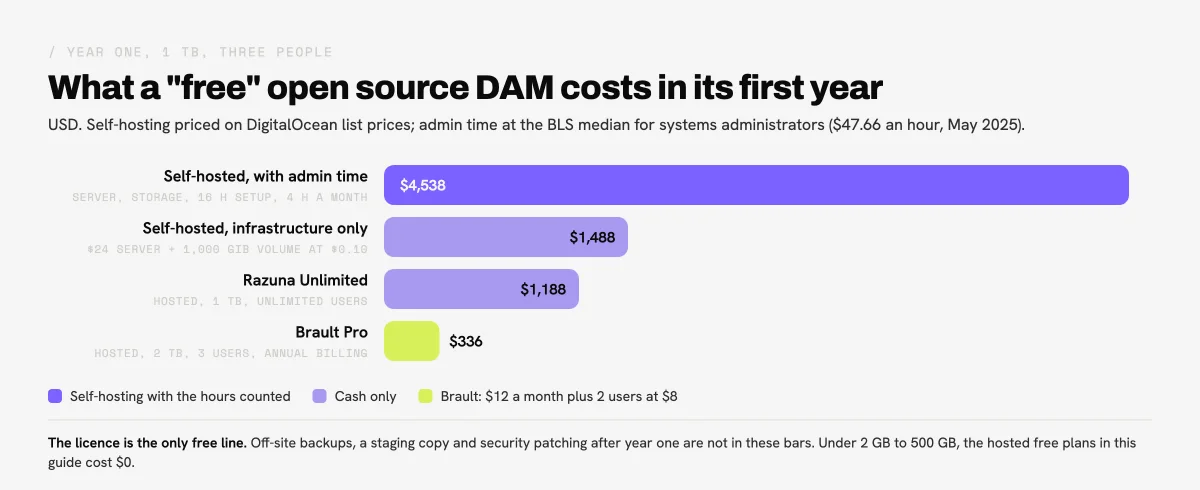
The same team on a hosted plan pays $1,188 a year on Razuna Unlimited (1 TB, unlimited users) or $336 a year on Brault Pro (2 TB, up to 3 users: $12 a month billed annually plus two users at $8). Below the free quotas, hosted plans cost nothing at all. Self-hosting still wins in specific cases, covered below, but those cases are about control and compliance, not about price. For the paid side of the market, our guide to digital asset management cost breaks down what enterprise DAMs charge.
How do free and open source DAM options compare in 2026?
The table lists every option in this guide with the kind of free it offers. Open source projects show their licence and last release; hosted products show their free plan limits.
| # | Tool | Kind of free | Free limits or licence | Last release or paid from |
|---|---|---|---|---|
| 1 | RResourceSpace | Open source + free hosted plan | BSD-style licence; hosted free 10 GB, 10 users | v11.0 branch updated 2026-10-28 |
| 2 |  Phrasea |
Open source | MIT (Phrasea), GPL-3.0 (Phraseanet) | 4.5.2 on 2026-10-21 |
| 3 |  AtroCore |
Open source | GPL-3.0 | 2.5.4 on 2026-10-28 |
| 4 |  Pimcore |
Source available | POCL: free under 5 million euros revenue | v2026.3.3.1 on 2026-10-22 |
| 5 | OOmeka S | Open source | GPL | v4.2.1 on 2026-06-18 |
| 6 |  Brault |
Hosted free plan | 2 GB, 1 user, AI search, Boards | Lite $4/mo billed annually |
| 7 |  Razuna |
Hosted free plan | 500 GB, 5 users, 2 workspaces | Unlimited $99/mo |
| 8 |  Air.inc |
Hosted free plan | 10 GB, 3 users, 100 AI credits a month | Starter $100/mo billed annually |
| 9 |  Google Drive |
Free storage | 15 GB per account, shared with Gmail and Photos | Google One paid plans |
| 10 |  Eagle |
One-time licence | $34.95, 2 devices, 30-day trial | No subscription |
 Pics.io |
Trial only | 7-day trial | $100/mo (Solo) | |
 Dash |
Trial only | 14-day trial | $109/mo (Start Up) | |
 Filecamp |
Trial only | 30-day trial | $29/mo (Basic) |
Checked 2026-10-29 on each vendor's pricing page, licence file and GitHub release page (ResourceSpace on its public SVN). Air.inc paid price from air.inc/pricing, read 2026-10-27. Prices in USD; EUR-only offers are described without figures.
Two patterns stand out. The open source projects are alive: five of the six we checked shipped a release in 2026, which was not true of several names that older lists still recommend. And the hosted free plans differ more in shape than in price: Razuna gives storage, Air gives seats, Brault gives one person the full workflow (AI search, Boards, review, branded transfer) on a small quota.
Which are the best free and open source DAM options in 2026?
The ten options below split into two groups: five you install yourself (1 to 5) and five you sign up for (6 to 10). The numbers help navigation and are not a ranking: the right pick depends on who will run it.
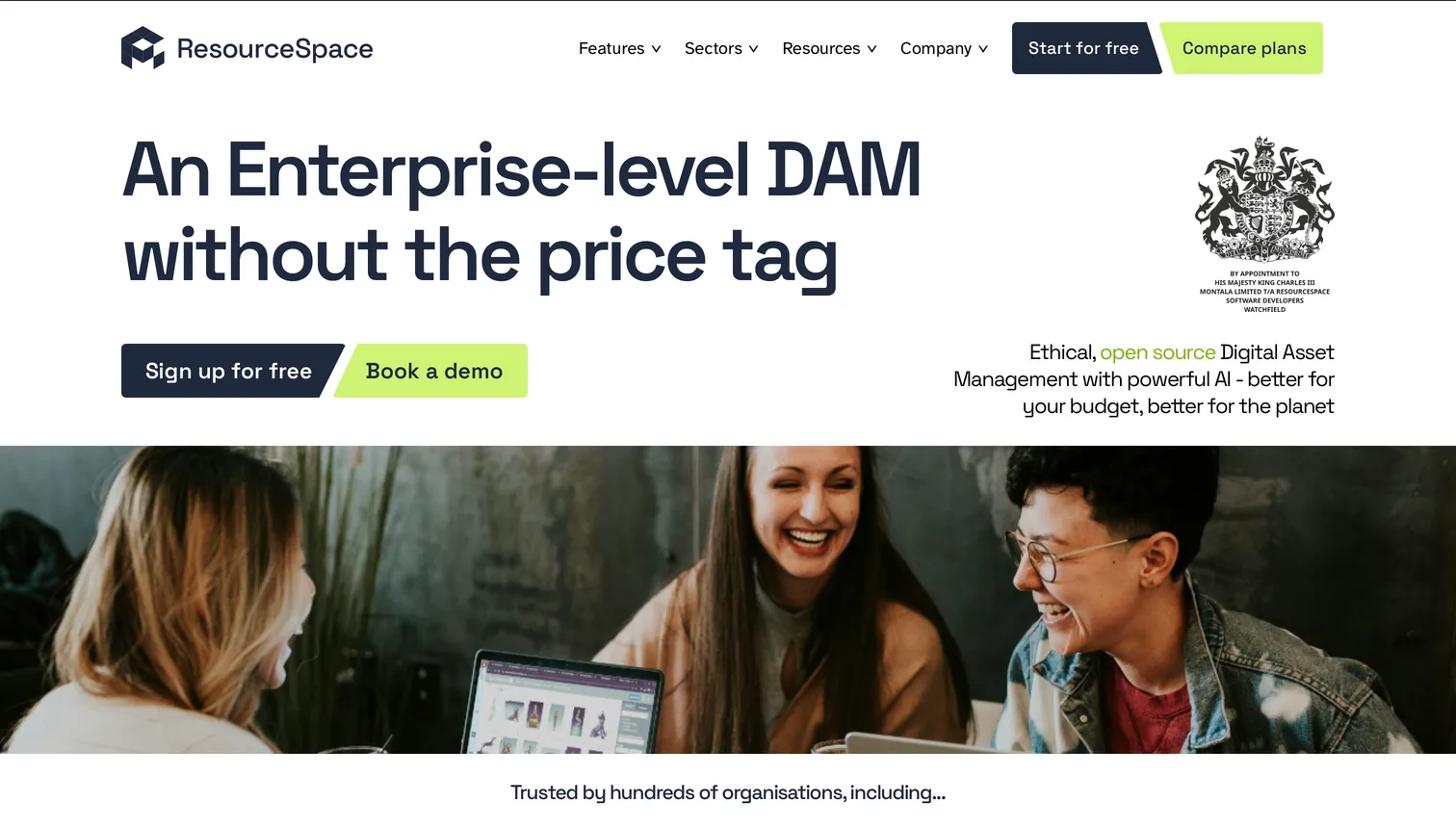
1ResourceSpace: best open source DAM with a free hosted option
ResourceSpace is one of the best-known open source DAMs, maintained by Montala and used by charities, universities, museums and brand teams. The code ships under a BSD-style licence with no licence fee, and the 11.0 release branch on its public SVN was updated on 2026-10-28. Features include metadata fields, AI tagging, face recognition, granular permissions, an API and file conversion on upload. Its strength for this guide is the bridge: you can self-host for free, or start on a free hosted instance and move to a paid hosted plan without migrating.
The free hosted plan gives 10 GB of storage, up to 10 users, AI tagging and no card, with a monthly upload and download quota of 10 GB under its free terms, and Montala may end the free service with three months' notice. Paid hosted packages (Team Cloud for 25 users with 1 to 9 TB, then Business, Enterprise and Platinum) are priced on quote.
- Best forNonprofits, universities and in-house teams with someone who can run a PHP server
- PricingSoftware free (BSD-style); hosted packages on quote (checked 2026-10-29)
- Free planSelf-hosted with no limits; hosted free 10 GB, 10 users, 10 GB monthly transfer
- Watch outSelf-hosting needs Linux, PHP and MySQL skills; the free hosted quota suits a pilot, not a library
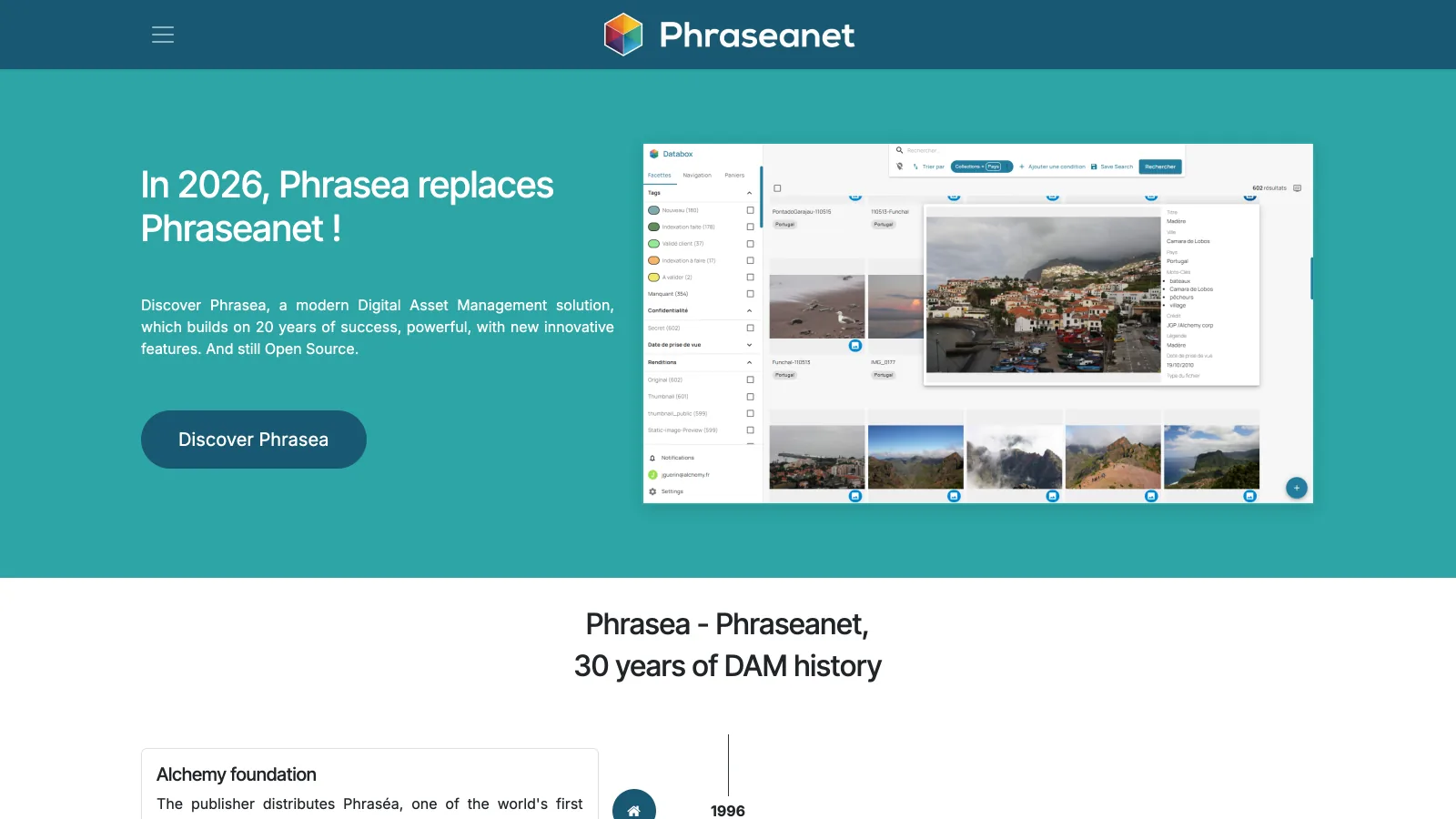
2Phrasea (formerly Phraseanet): best for media libraries that want a permissive licence
Phraseanet is an open source DAM published by Alchemy since 2005 and released under GPL v3, available both as SaaS and on-premise. In 2026 Alchemy is replacing it with Phrasea, a rebuilt platform that stays open source: the Phrasea repository on GitHub carries the MIT licence and shipped version 4.5.2 on 2026-10-21, while Phraseanet itself received a 4.1.25 maintenance release the same day. Both cover indexing, metadata, search and sharing for media libraries.
- Best forMedia, press and archive teams with developers who want a permissive licence
- PricingSoftware free (MIT for Phrasea, GPL-3.0 for Phraseanet); hosting and support on quote from Alchemy (checked 2026-10-29)
- Free planSelf-hosted
- Watch outA platform in transition: new installs should start on Phrasea, not Phraseanet
3AtroCore: best for DAM plus product data
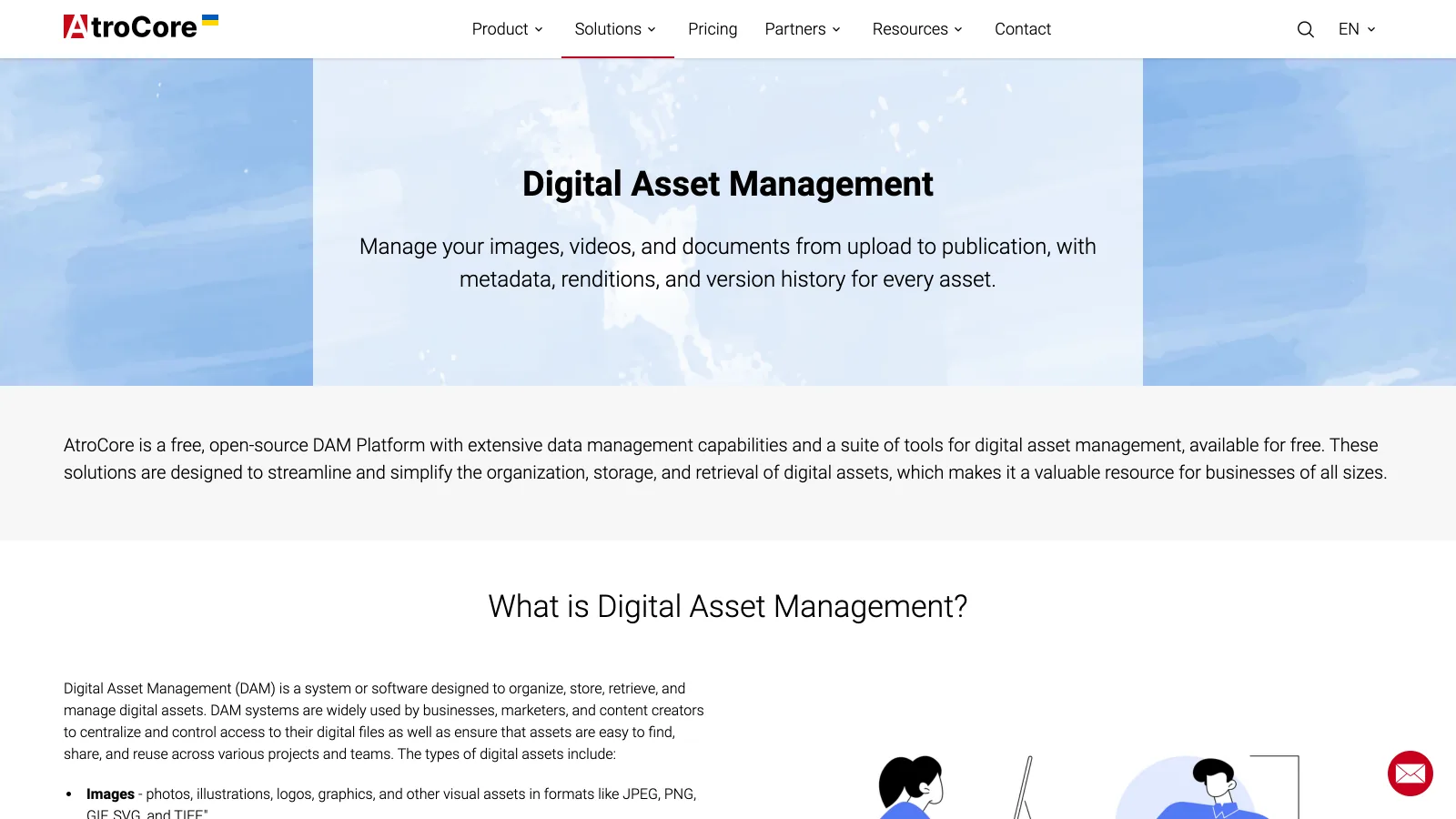
AtroCore is an open source data platform that combines digital asset management with product information management (PIM) and master data. The core is GPL-3.0 and active, with release 2.5.4 on 2026-10-28; its older standalone AtroDAM repository is archived, so new installs use the AtroCore platform. The free open source edition runs on your own infrastructure, and AtroCore sells optional support tiers, premium modules and a SaaS edition, all priced in euros on its pricing page.
- Best forManufacturers and e-commerce teams that manage assets next to product records
- PricingCore free (GPL-3.0); support, modules and SaaS priced in euros (checked 2026-10-29)
- Free planSelf-hosted open source edition
- Watch outBuilt around data models, not creative review; workflows and data quality are paid modules
4Pimcore: best for companies under its revenue threshold that need DAM and PIM
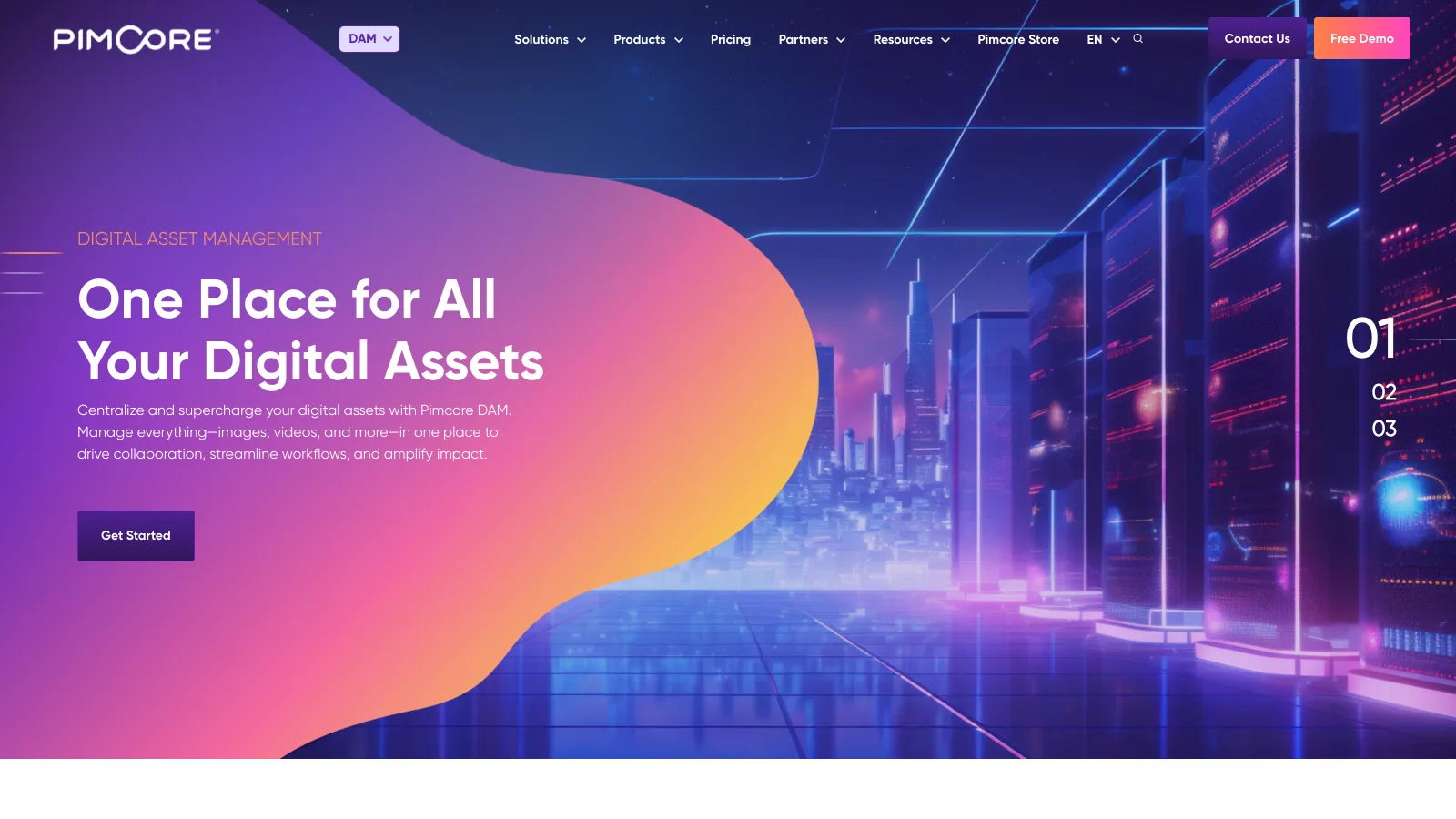
Pimcore is a mature platform for DAM, PIM, master data and web content, and it remains one of the most capable systems in this list. It is also the clearest case of "free" changing meaning. Older roundups list Pimcore as open source, but its licence file is now the Pimcore Open Core License (POCL, last updated June 2025): the source is public, and the free production licence applies only to organizations with total global revenue up to 5 million euros a year, self-certified and subject to audit. Above the threshold a paid licence is required, and fees can be charged retroactively. Development is active, with v2026.3.3.1 released on 2026-10-22.
- Best forSmall and mid-size companies with developers that want DAM and PIM in one stack
- PricingFree production licence under 5 million euros of revenue; commercial licence on quote above it (checked 2026-10-29)
- Free planSelf-hosted, within the POCL revenue threshold
- Watch outSource available, not OSI open source; the revenue line can turn a free stack into a licence bill
5Omeka S: best for archives, libraries and museums
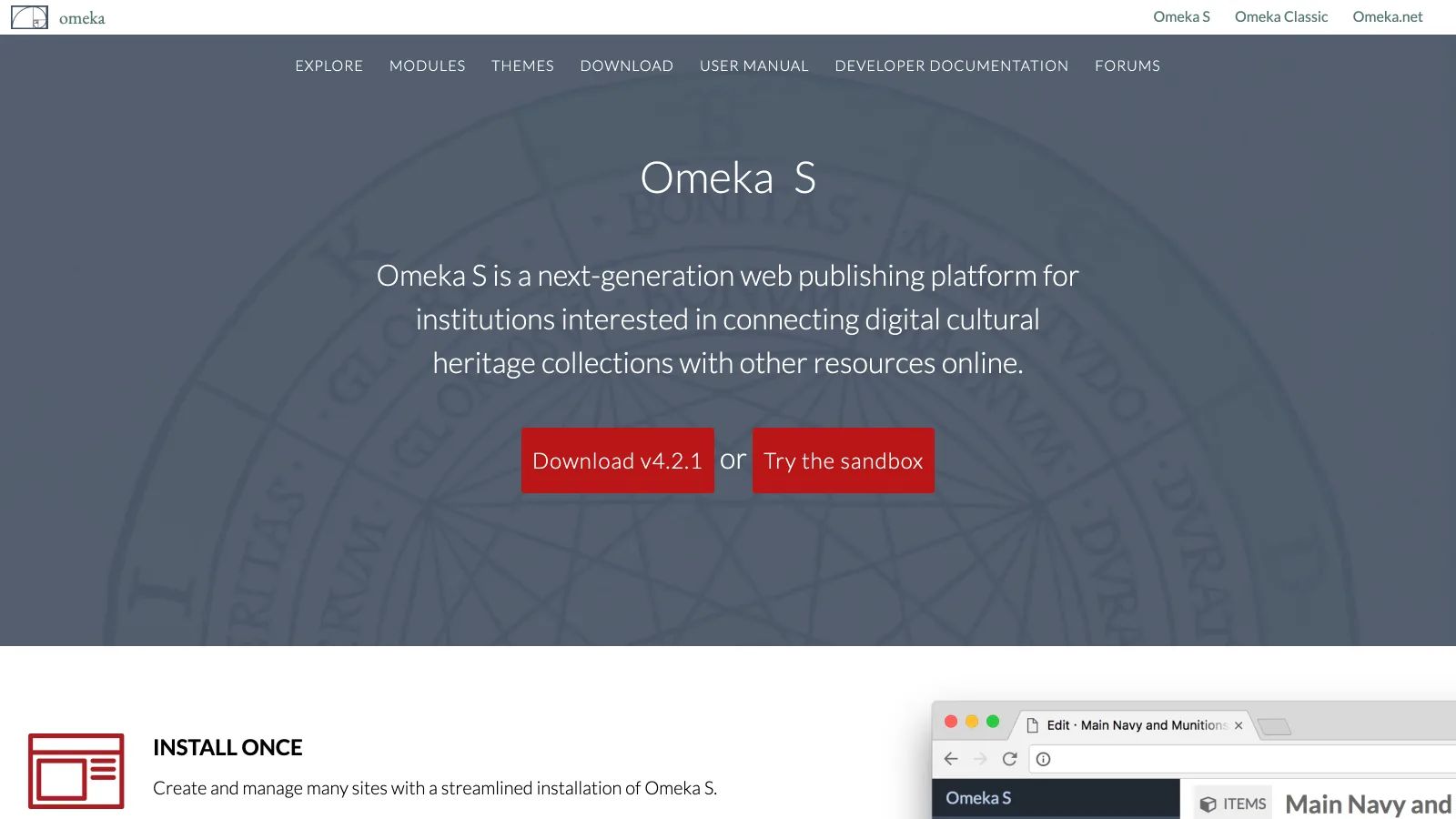
Omeka S is a GPL web publishing platform built for institutions that publish digital cultural heritage collections with standard metadata (Dublin Core, linked data). Version 4.2.1 shipped on 2026-06-18, and one installation can run many collection sites. Two neighbours fill the same niche: CollectiveAccess, for complex museum cataloguing (Providence 2.0.11, March 2026), and Islandora, a Drupal and Fedora repository for libraries (2.19.0, September 2026). These are collection systems first, so a marketing or creative team will find them heavy for day-to-day file work.
- Best forArchives, libraries, historical societies and museums publishing collections online
- PricingSoftware free (GPL); a hosted service runs at Omeka.net (checked 2026-10-29)
- Free planSelf-hosted
- Watch outPublishing and cataloguing, not a working library for creative files or client delivery
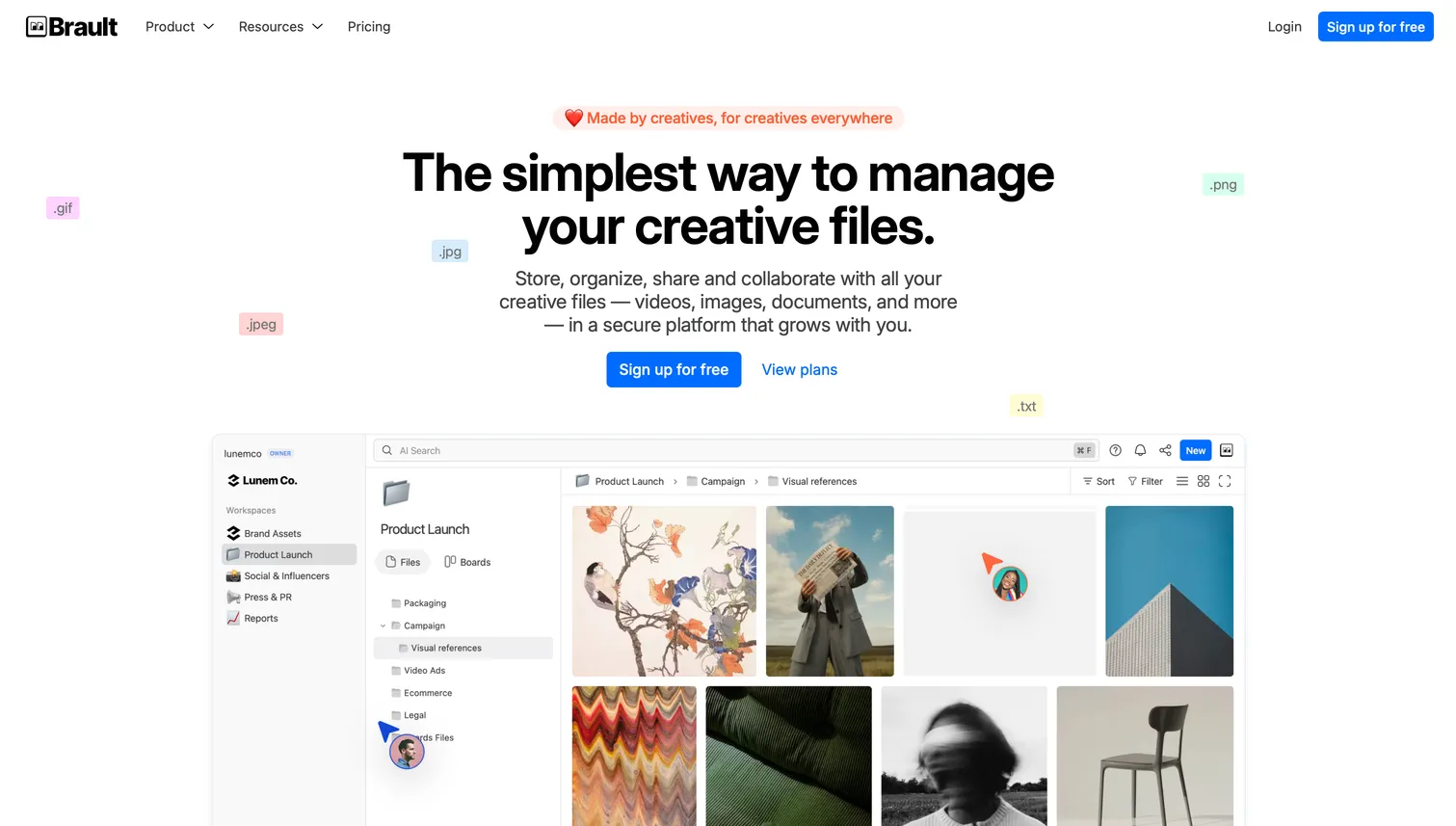
6Brault Free: best hosted free plan for freelancers and small creative teams
Brault is a creative file management platform with a permanent free plan, no card and no time limit. Brault Free gives one user 2 GB of storage with AI search across 50+ formats (images, video, audio, PDFs, RAW and design files), Libraries, Brault Boards with custom properties in gallery, kanban and table views, frame-accurate review on video and images, a brand portal and Brault Transfer (BTransfer) with 5 branded transfers a month up to 2 GB each. The quota is the smallest in this list on purpose: the free plan shows the whole workflow, and the paid plans add storage and seats.
When a team outgrows it, Brault Lite is $4 a month billed annually ($5 month to month) for 200 GB and one user, Brault Pro $12 ($15) for 2 TB and up to 3 users at $8 each, and Brault Growth $70 ($85) for 5 TB with 4 users included and $4 per extra user, which works out to $6 to $14 per TB. For the paid DAM market as a whole, see the full DAM comparison.
- Best forFreelancers and creative teams of 1 to 20 who want search, Boards and branded delivery without running a server
- Pricing$0 Free (2 GB), Lite $4 (200 GB), Pro $12 (2 TB, up to 3 users), Growth $70 (5 TB, 4 users) a month billed annually; $5, $15 and $85 month to month (checked 2026-10-29 on brault.app/pricing)
- Free planYes: 2 GB, 1 user, AI search, Boards, review, brand portal, 5 transfers a month up to 2 GB
- Watch outFree and Lite are single-user; no self-hosted edition; "Powered by Brault" shows on the Free brand portal
7Razuna Free: best for the most free storage
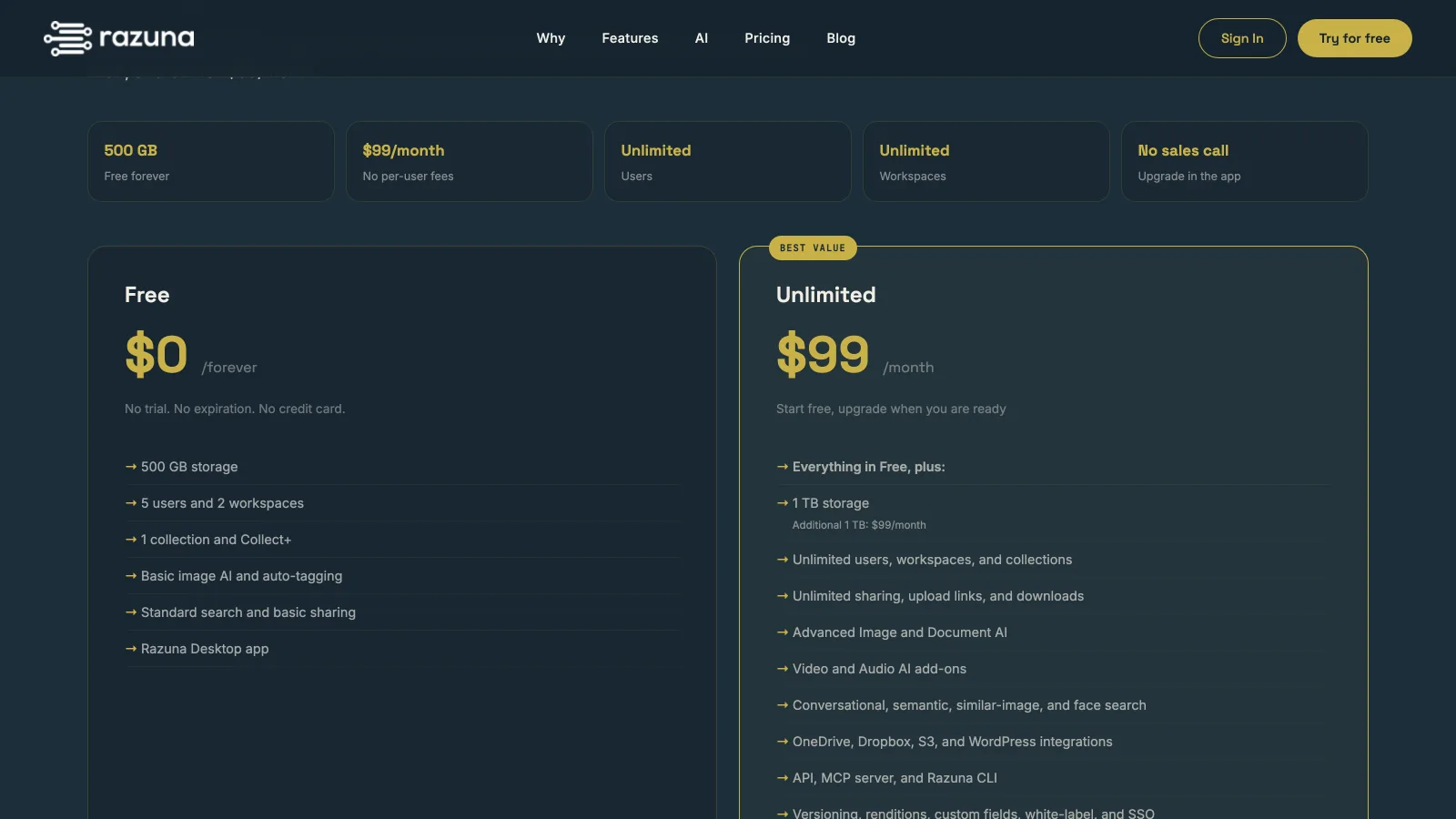
Razuna was one of the first open source DAMs, and many lists still describe it that way. The original code now sits on GitHub as razuna-legacy under AGPL-3.0, described by Razuna itself as no longer actively maintained. Today Razuna is a hosted service, and its free plan is the most generous on storage we found: 500 GB for 5 users and 2 workspaces, with basic image AI and auto-tagging, standard search, basic sharing and the Razuna Desktop app, at $0 with no trial and no expiry. Unlimited costs $99 a month for 1 TB with unlimited users, plus $99 per extra TB.
- Best forSmall teams with a lot of files and modest workflow needs
- PricingFree $0; Unlimited $99/mo (1 TB, unlimited users); Unlimited+ $499/mo (5 TB); Enterprise custom (checked 2026-10-29)
- Free plan500 GB, 5 users, 2 workspaces, 1 collection
- Watch outThe open source version is legacy; advanced AI, API, versioning and white-label start on paid plans
8Air Free: best free plan for a team of three
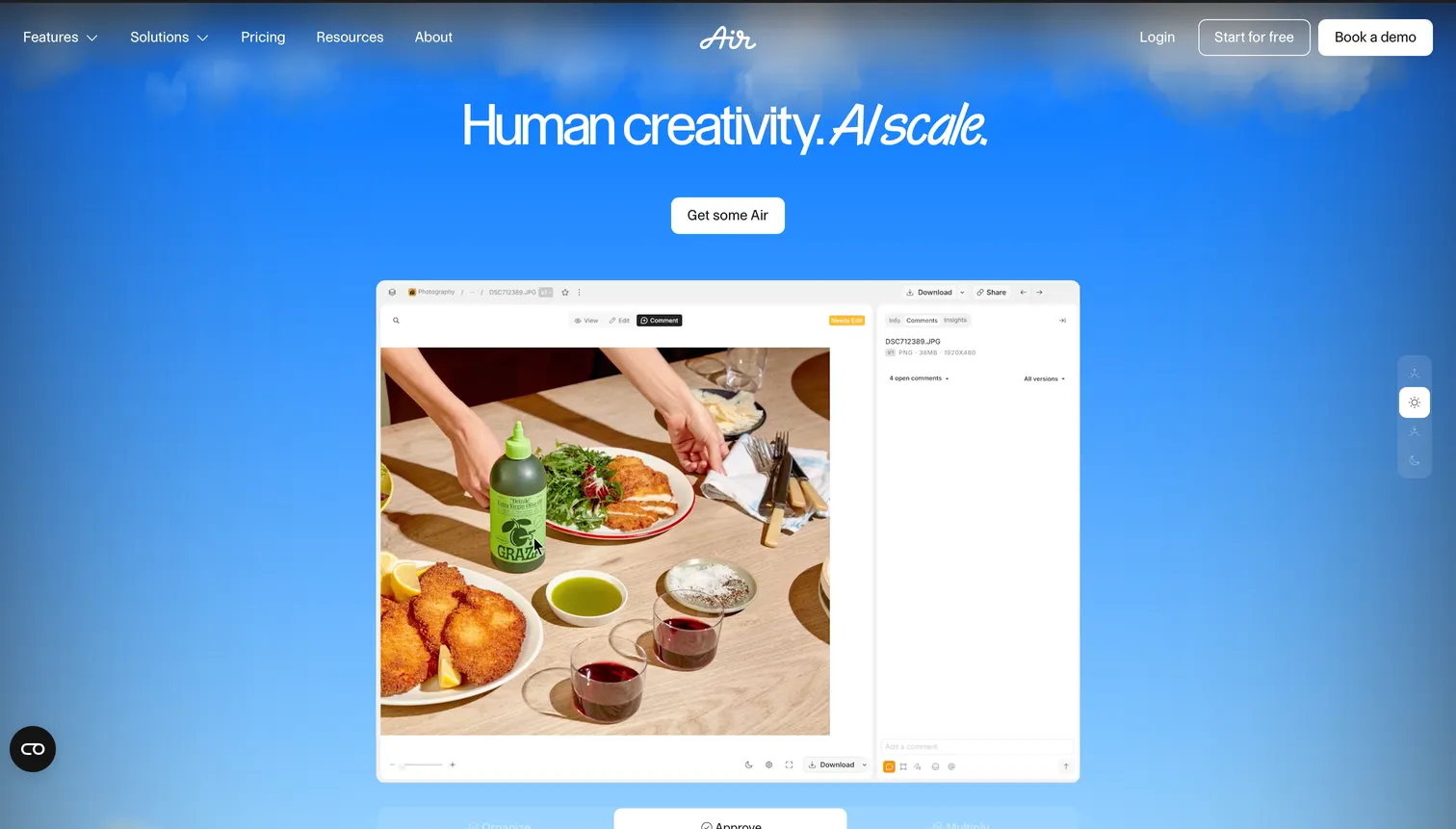
Air is a creative operations platform with AI tagging, Kanban boards and integrations with Figma, Slack and Adobe Premiere Pro, and its free plan is built for a small team rather than a solo user. Air Free gives 10 GB, 100 AI credits a month and up to 3 users, and Air says the plan has full access to every Air feature; credits on Free cannot be topped up and do not roll over. Paid plans are annual: Starter $100 a month for 200 GB and up to 5 users, Business $900 a month for 2 TB and unlimited users.
- Best forCreative and marketing teams of up to three that want to test a full creative ops tool
- PricingFree $0; Starter $100/mo and Business $900/mo billed annually; Enterprise custom (air.inc/pricing, read 2026-10-27, free plan rechecked 2026-10-29)
- Free plan10 GB, 3 users, 100 AI credits a month
- Watch outThe jump from Free to Starter is $100 a month; no month-to-month price published
9Google Drive: best de facto free option for teams already on Google
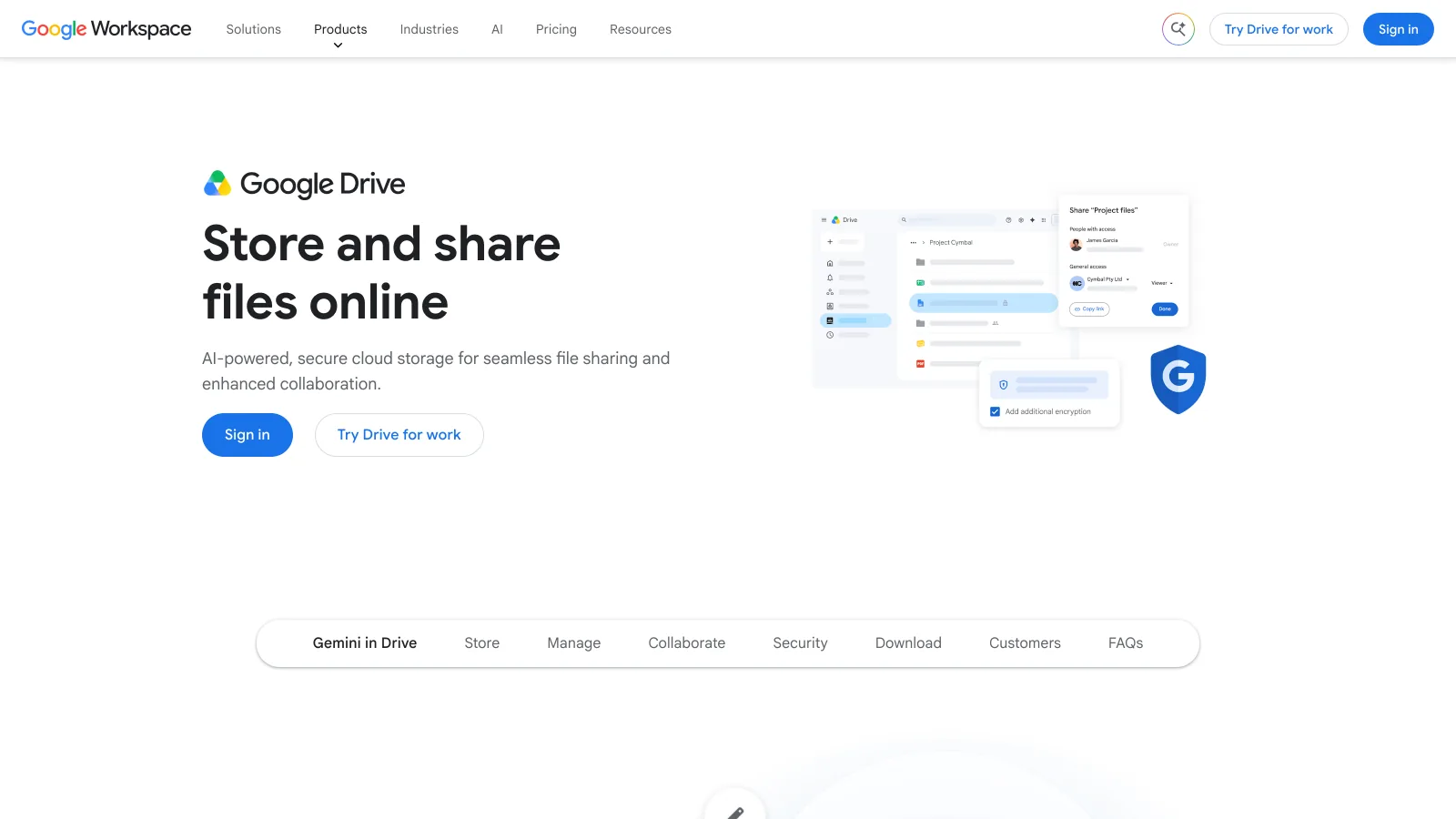
Google Drive is the free DAM most small teams actually use, even though it is cloud storage rather than digital asset management. Every Google account includes 15 GB, shared across Gmail, Drive and Google Photos, with sharing, comments and search by file name and some content. What it lacks is the DAM layer: metadata fields, approval states, branded links and search by what is inside a video or a RAW file. Drive is the right free choice while folders are enough; our Google Drive vs Brault comparison covers the point where they stop being enough.
- Best forTeams already on Google Workspace that need shared folders, not a DAM yet
- Pricing15 GB free per account; Google One and Workspace plans add storage (checked 2026-10-29)
- Free plan15 GB shared across Gmail, Drive and Photos
- Watch outNo metadata schema, approval workflow or branded delivery; Gmail eats the same quota
10Eagle: best for a local, one-time-purchase library
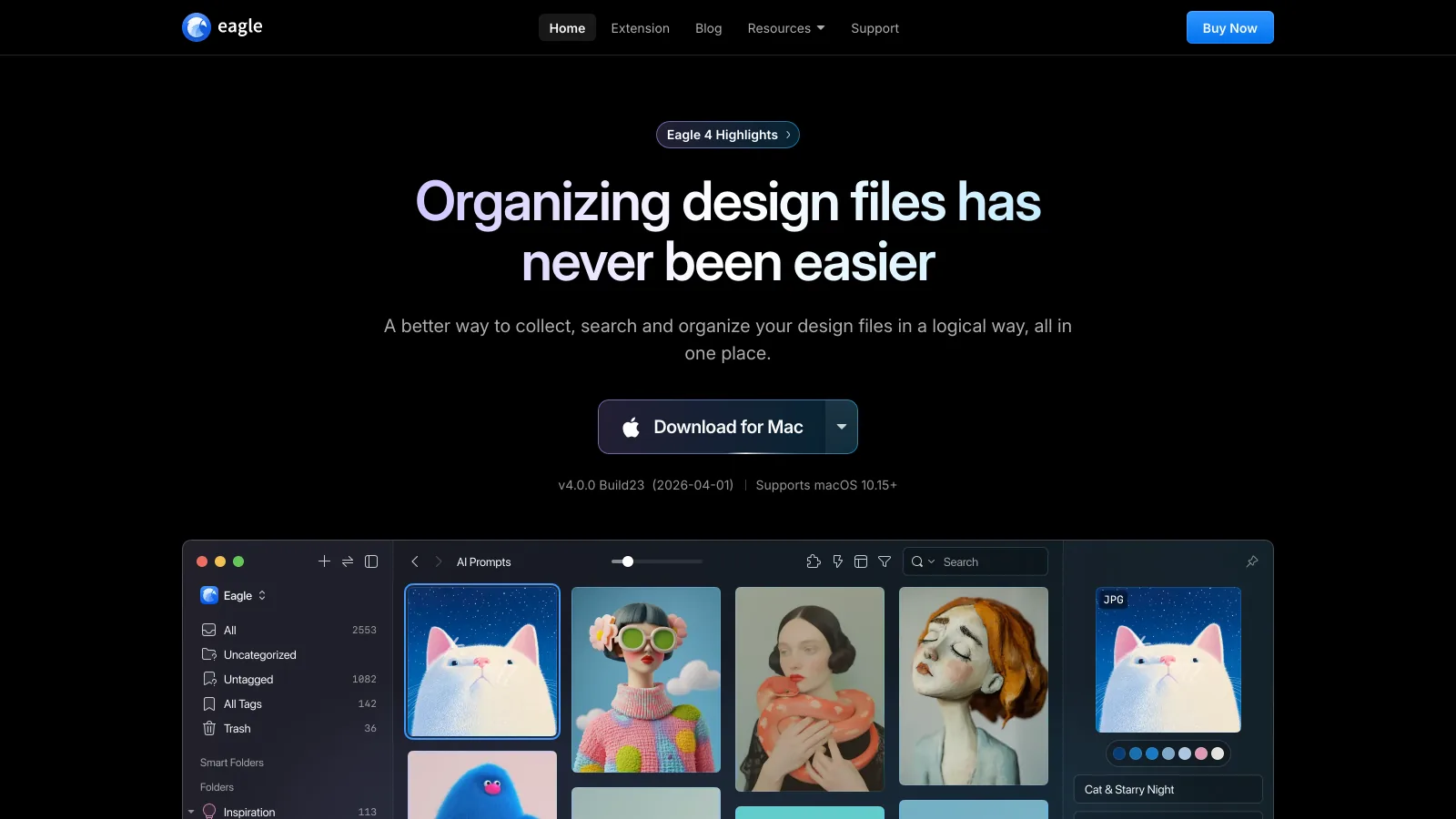
Eagle is a desktop app for organizing design references, images, fonts and inspiration on your own computer, with color and tag search and a browser extension for saving from the web. It is not free and not open source, but it is the cheapest way to own your tool outright: a single licence costs US$34.95 once, covers 2 devices on macOS and Windows with all future updates, and comes with a 30-day full trial. The library lives locally; sharing it means pairing it with a sync tool of your choice.
- Best forIndividual designers and illustrators organizing references on their own machine
- PricingUS$34.95 one-time, 2 devices (checked 2026-10-29)
- Free plan30-day full trial
- Watch outSingle-user and local; no shared library, client links or permissions built in
Which popular DAM tools have no free plan?
Pics.io, Dash and Filecamp are well-reviewed DAMs that offer a trial instead of a free plan, which matters if your search started with "free DAM software". Pics.io, which layers DAM features over Google Drive or Amazon S3, gives a 7-day trial and starts at $100 a month on Solo. Dash, built for e-commerce and brand teams, gives a 14-day trial and starts at $109 a month on Start Up with unlimited users. Filecamp gives a 30-day trial and starts at $29 a month on Basic with 20 GB and unlimited users (all checked 2026-10-29). Each is a solid paid choice; none belongs in a list of permanent free options.
When should you self-host an open source DAM?
Self-hosting an open source DAM pays off when control is the requirement and the people already exist. Three situations qualify: a law, client contract or funder requires assets to stay on servers you control or in a specific country; you need custom code, a PIM or a deep integration that a hosted product will not allow; or you are an institution with an IT team that already runs Linux, PHP and database servers. In those cases the hours in our cost model are hours your team spends anyway, and the licence saving is real.
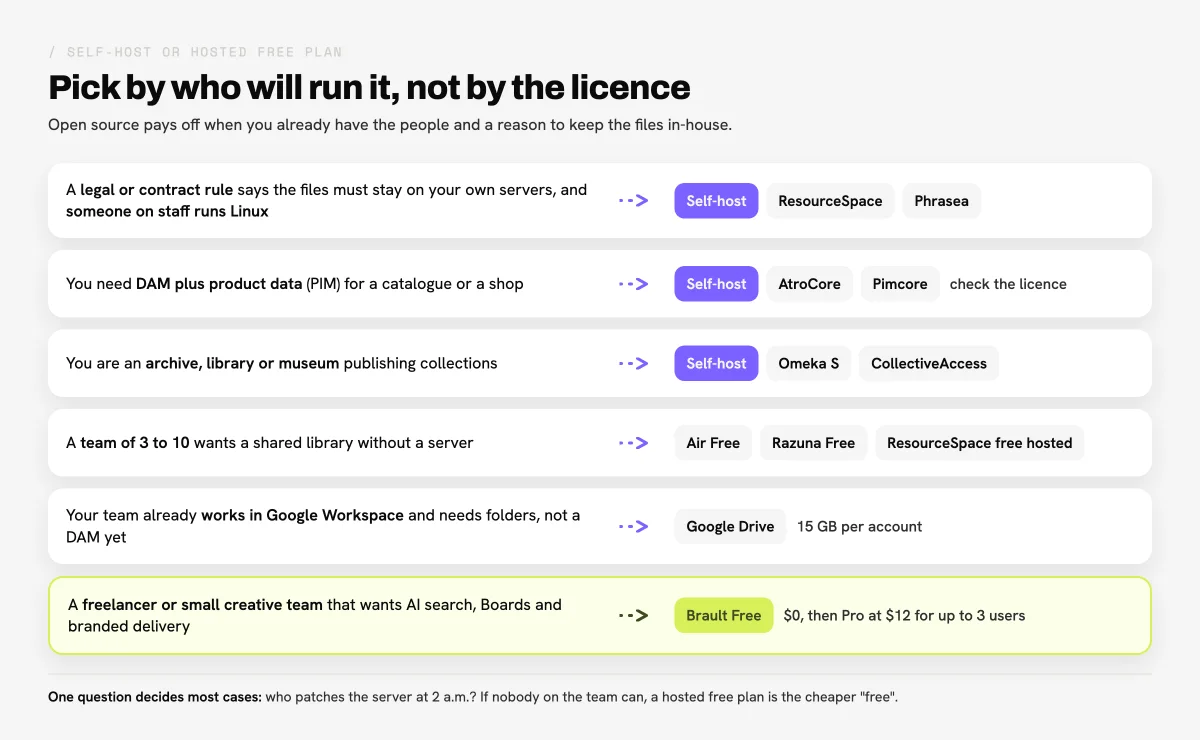
A hosted free plan is the better free for everyone else. A small agency, a brand team inside a growing company or a freelancer has no one to patch a server, test backups or upgrade PHP. For them, the realistic comparison is between hosted free tiers: Razuna for raw storage, Air for three seats, ResourceSpace hosted for a ten-person pilot, and Brault for one person who wants AI search, Boards and branded delivery from day one. Our guide to DAM for small business walks through that choice for teams that expect to pay within a year.
What should you check before choosing a free DAM?
A free DAM decision is easiest to reverse when you check five things up front:
- The licence file, not the marketing page. "Open source" on a homepage can mean OSI-approved (BSD, MIT, GPL) or source available with conditions, as with Pimcore's revenue threshold.
- The last release date. A project with no release in two years will not get security fixes. All five self-hosted options here released in 2026.
- The exit path. Can you export originals and metadata in bulk? A free plan you cannot leave is the most expensive kind.
- What happens at the limit. Brault blocks an upload over the quota with a message and never upgrades you automatically; check how each vendor handles the same moment.
- Who answers when it breaks. Community forums for open source, email support for hosted plans. Decide which one your team can live with.
If you are new to the category, what a DAM is covers the vocabulary, and the Digital Asset Management hub collects every guide in this cluster.
Frequently asked questions
Is open source DAM software really free?
The licence of an open source DAM such as ResourceSpace (BSD-style), Phrasea (MIT), AtroCore (GPL-3.0) or Omeka S (GPL) costs nothing, but running it does not. A small DigitalOcean server at $24 a month plus a 1,000 GiB block storage volume at $0.10 per GiB comes to about $1,488 a year, and the hours to install, patch and back it up add roughly $3,000 more in the first year at the BLS median wage for systems administrators ($47.66 an hour, May 2025). Hosted free plans, such as Brault Free ($0, 2 GB) or Razuna Free ($0, 500 GB), cost nothing until you outgrow them.
How much does it cost to self-host an open source DAM?
For 1 TB and three users, self-hosting an open source DAM costs about $1,488 a year in infrastructure on DigitalOcean list prices (a $24 a month server with 4 GiB of memory and a 1,000 GiB volume at $0.10 per GiB a month), or about $4,538 in year one once 16 hours of setup and 4 hours a month of upkeep are counted at $47.66 an hour. Off-site backups and a staging copy come on top. For comparison, Brault Pro gives 2 TB for 3 users at $336 a year billed annually.
Which free DAM plan gives the most storage?
Razuna Free gives the most storage of the hosted free DAM plans checked on 2026-10-29: 500 GB for 5 users and 2 workspaces, with basic image AI, at $0 with no trial or expiry. Google Drive gives 15 GB per Google account, Air Free 10 GB for up to 3 users, the ResourceSpace free hosted plan 10 GB for up to 10 users, and Brault Free 2 GB for one user with AI search, Boards and 5 branded transfers a month.
Is Pimcore still open source?
Pimcore is no longer open source in the OSI sense. Its code is public under the Pimcore Open Core License (POCL, last updated June 2025), which gives a free production licence only to organizations with total global revenue up to 5 million euros a year; above that threshold a paid commercial licence is required, and Pimcore may charge fees retroactively. Pimcore remains actively developed, with release v2026.3.3.1 published on 2026-10-22.
Is Razuna still open source?
The original open source Razuna lives on GitHub as razuna-legacy under the AGPL-3.0 licence, and its own description says it is no longer actively maintained. Today Razuna is a hosted service: Razuna Free gives 500 GB and 5 users at $0, and Unlimited costs $99 a month for 1 TB with unlimited users (razuna.com/pricing, checked 2026-10-29).
Is Google Drive a digital asset management system?
Google Drive is cloud storage, not a digital asset management system. It stores, syncs and shares files and every Google account includes 15 GB shared across Gmail, Drive and Google Photos, but it has no metadata schema, approval states or branded delivery. Teams usually move from Drive to a DAM when they lose time finding files; Brault imports Drive folders and adds AI search across 50+ formats, Boards and branded sharing from $0.
Do Pics.io, Dash or Filecamp have a free plan?
No. On 2026-10-29 Pics.io offered a 7-day trial and paid plans from $100 a month (Solo), Dash a 14-day trial with plans from $109 a month (Start Up, unlimited users) and Filecamp a 30-day trial with plans from $29 a month (Basic, 20 GB, unlimited users). None of the three has a permanent free tier.
When should a team self-host its digital asset management?
Self-hosting a DAM makes sense when a legal or contract rule requires files to stay on servers you control, when you need deep custom code or a PIM next to the DAM, or when you are an archive or museum with an IT department already running Linux servers. For teams without a systems administrator, a hosted free plan such as Brault Free, Razuna Free or Air Free costs less in practice than a $0 licence on a self-managed server.
Key takeaways
- Free DAM software comes in two kinds: open source you host yourself (ResourceSpace, Phrasea, AtroCore, Omeka S, and source-available Pimcore) and hosted free plans (Brault Free, Razuna Free, Air Free, plus Google Drive as plain storage).
- Every self-hosted project checked shipped a release in 2026, but licences differ: BSD-style, MIT and GPL are open source, while Pimcore's POCL is free only under 5 million euros of revenue, and the open source Razuna is a legacy repository.
- Self-hosting 1 TB for three people costs about $1,488 a year in infrastructure and about $4,538 in year one with admin time counted, against $336 a year for Brault Pro (2 TB, 3 users) or $1,188 for Razuna Unlimited (1 TB).
- Among hosted free plans, Razuna gives the most storage (500 GB, 5 users), Air the most seats for a small team (3 users, 10 GB) and Brault the fullest workflow for one person (2 GB with AI search, Boards, review and 5 branded transfers a month).
- Self-host when compliance or custom code demands it and the IT people already exist; otherwise a hosted free plan is the free option that keeps working.