Photographers look for a Pixieset alternative for three reasons: the storage ceiling on their plan, the split between what the client sees and what the studio has to archive, and the price of the bundle once website, booking and video hours are added. The five tools in this guide cover both halves of that problem. Pic-Time, ShootProof, CloudSpot and SmugMug are client-facing platforms that deliver and sell photos; Brault is the delivery, review, transfer and archive layer underneath a photography business, which is a different fit rather than a like-for-like swap.
Every figure below was read on the vendor's own US pricing page and verified on 2026-09-22. Pixieset's own numbers are in Pixieset pricing in 2026, the product itself is assessed in the Pixieset review, and the closest head-to-head is Pixieset vs Pic-Time. For the wider category, see the best cloud storage for photographers.
TL;DR
- Closest swap: Pic-Time, $0 / $7 / $21 / $42 a month billed annually, with automated sales campaigns built into the gallery.
- Zero commission on every plan: ShootProof, $8.33 to $50 a month billed annually, sized by photo count rather than gigabytes.
- Galleries plus a studio manager on one bill: CloudSpot, $7, $17, $34 and $50 a month, free tier at 5 GB.
- Unlimited photo storage and a portfolio site: SmugMug, $20, $23.50 and $37 a month billed annually, plus $10 a month per terabyte of RAW on Source.
- Different fit: Brault, $0 to $70 a month billed annually, for the library under the galleries, RAW and PSD previews, AI search, review and branded transfers up to 250 GB.
Why do photographers look for a Pixieset alternative?
Pixieset is a client gallery platform that grew into a business suite, and the friction shows up at the edges of that model. Storage on Client Gallery runs 3 GB on Free, 10 GB on Basic, 100 GB on Plus and 1,000 GB on Pro, so a wedding photographer delivering 5 to 15 GB per job moves up a tier every season. HD video is metered in hours on every plan and costs $5 a month per extra hour. RAW upload only arrives on the Pro plan at $24 a month billed annually. And the Suite bundle that makes the price attractive, at $28 a month, is only good value for a photographer who actually wants the website and the booking flow.
None of that is a defect. It is what a gallery-and-store platform is for. The question a photographer should answer before switching is which of the two jobs is hurting: the client-facing one, where the alternative is another gallery platform, or the studio-facing one, where the alternative is a storage and delivery platform that never shows a print store.
Which are the best Pixieset alternatives in 2026?
Five tools, ordered from the closest gallery-for-gallery replacement to the platform that solves the other half of the problem. Prices are the vendor's published US rates on 2026-09-22.
1Pic-Time: best like-for-like gallery with automated sales
Pic-Time is the alternative photographers name first, because it does the same job as Pixieset Client Gallery and puts more of its engineering into selling. Plans are $0 on Free, US$7 a month on Beginner, US$21 on Professional and US$42 on Advanced, all billed annually, with monthly billing at $8, $25 and $50.
- Best forPhotographers who want the gallery to run sales campaigns for them
- Pricing$0, $7, $21 and $42 a month billed annually; $8, $25 and $50 monthly (verified 2026-09-22)
- Free planYes, 10 GB of photos (3 GB after six months) and 1 GB of video
- Watch outVideo storage is metered separately, and each extra brand is a $6 a month add-on
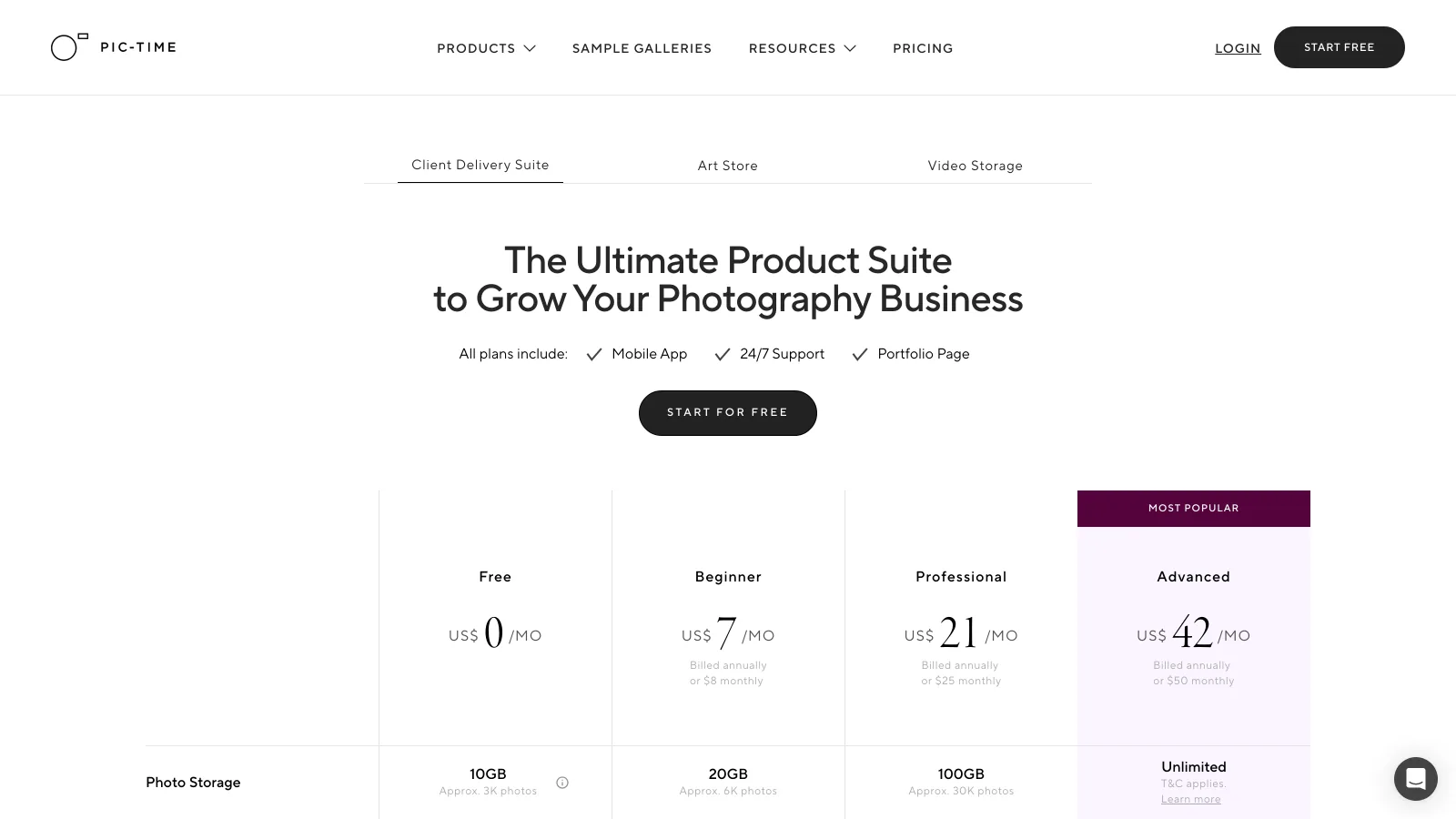
Storage follows the plans: 10 GB on Free, 20 GB on Beginner, 100 GB on Professional and unlimited on Advanced, with video on its own meter at 1, 5, 30 and 60 GB. The sales layer is where Pic-Time separates itself. Campaigns fire on their own after a gallery is delivered, the Art Store sells wall art, and client-facing search lets a guest find themselves in a 2,000-photo event by uploading a selfie.
The trade-off is scope. Pic-Time is a delivery suite, not a business suite: there is no website builder in the plan and no contract-and-invoice CRM of the kind Pixieset Studio Manager provides. A photographer who chose Pixieset for the Suite bundle is comparing two different purchases, which is the subject of Pixieset vs Pic-Time.
2ShootProof: best for photographers who want zero commission on every plan
ShootProof prices by photo count rather than by gigabyte, and it puts no commission on any sale, on any plan, including the free one. That single term is why it keeps showing up on shortlists next to Pixieset, whose free tier carries a commission fee on store sales.
- Best forPhotographers who sell prints and want to keep the whole markup from day one
- Pricing$8.33, $16.67, $26.67 and $50 a month billed annually; $9.99 to $60 monthly (verified 2026-09-22)
- Free planYes, 100 photos, plus a 14-day trial on the paid plans
- Watch outPlans cap photos, not storage; older work moves to the Archive add-on from $2.99 a month
The ladder is Free (100 photos), 1,500 photos at $8.33 a month billed annually, 5,000 at $16.67, 25,000 at $26.67 and Unlimited at $50, with monthly billing at $9.99, $19.99, $31.99 and $60. Contracts, invoices, booking and a mobile app come with the paid plans, which makes ShootProof closer to the Pixieset Suite in scope than Pic-Time is.
Counting photos instead of gigabytes changes the arithmetic. A wedding photographer who delivers 800 images a wedding fits 30 weddings a year inside the 25,000 plan at $26.67 a month, whatever the file size, which is friendlier to full-resolution JPEGs than a gigabyte cap. It works the other way for a studio with a few enormous files. ShootProof's own pricing page returned HTTP 403 to our headless capture on two attempts, so the figures above were read from the page's HTML and are cited by link rather than shown as a screenshot.
3CloudSpot: best galleries plus studio manager on a low entry price
CloudSpot sells two shapes of the same platform: gallery-only plans and a full suite that adds invoices, lead capture, questionnaires and a print store. It is the cheapest paid entry in this comparison.
- Best forPhotographers who want galleries, a store and a studio manager without a bundle price
- PricingEntry $7, Lite $17, Pro $34, Unlimited $50 a month; promotional $3 a month for the first three months (verified 2026-09-22)
- Free planYes, 5 GB on a gallery-only plan
- Watch outThe headline figures on the page are the promotional ones; check the standing rate before signing
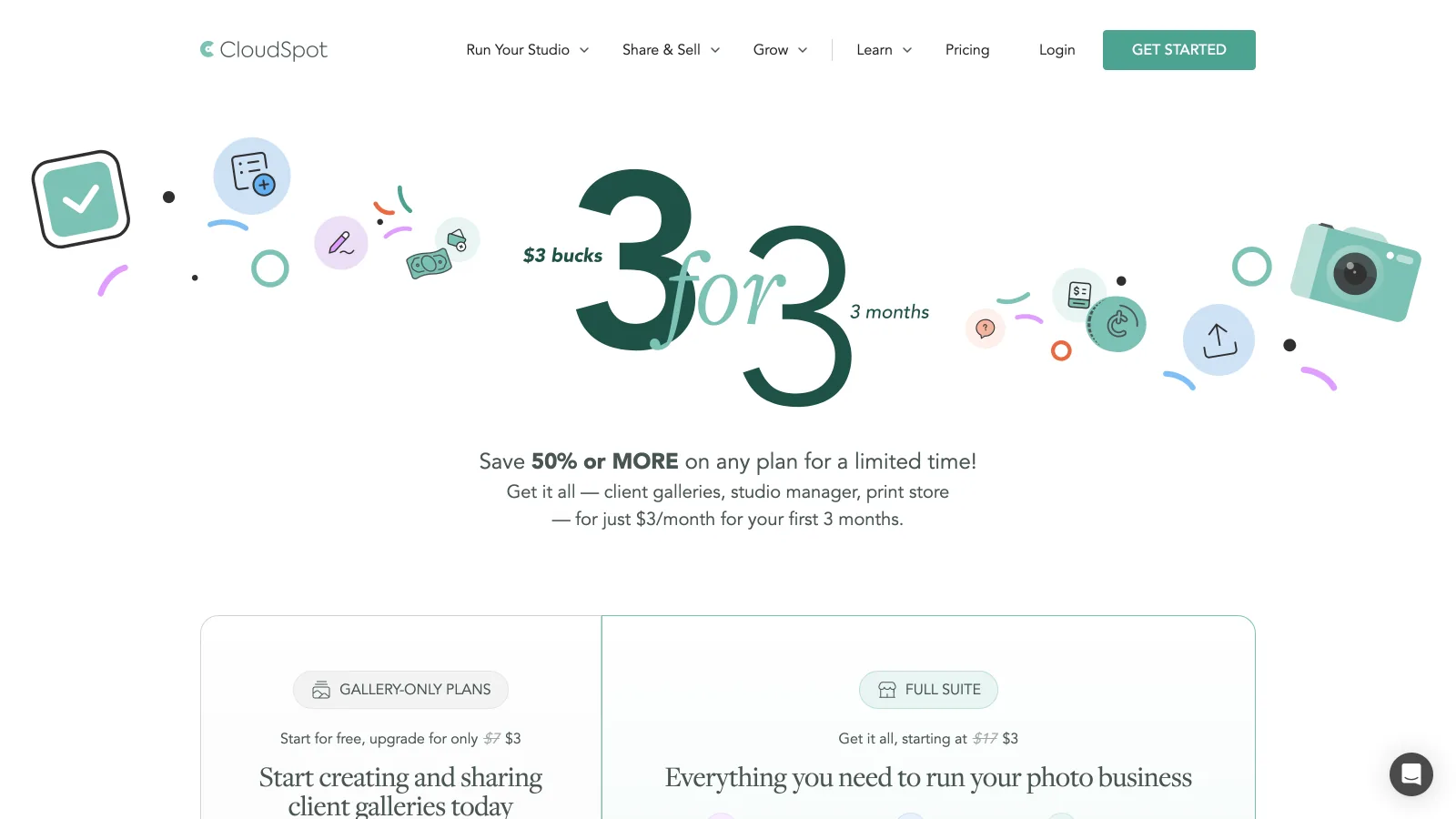
Storage runs 5 GB on Free, 15 GB on Entry, 100 GB on Lite, 500 GB on Pro and unlimited on Unlimited. Gallery-only covers Free and Entry; the full suite starts at Lite. For a photographer who wants what the Pixieset Suite offers but resents paying $28 a month for it, the $17 Lite plan is the closest thing on this list to a direct price challenge.
The caution is the promotion. At the time of verification the page led with $3 a month for the first three months and struck through the standing prices, which is exactly the pattern that makes a subscription look cheaper than the year will be. Price the fourth month, not the first.
4SmugMug: best unlimited photo storage with a portfolio site
SmugMug is the oldest name here and the one with the simplest storage story: unlimited photo storage on every plan, wrapped in a portfolio website that also happens to deliver client galleries. Plans are Direct at $20 a month, Portfolio at $23.50 and Pro at $37, all billed annually.
- Best forPhotographers who want a portfolio site and never want to think about a storage tier again
- Pricing$20, $23.50 and $37 a month billed annually; Source RAW storage $10 a month for 1 TB, then $6 per TB (verified 2026-09-22)
- Free planNo, 14-day free trial only
- Watch outSelling prints starts on Portfolio, and the entry price is the highest of the five
Unlimited storage is the reason a photographer with fifteen years of archives ends up on SmugMug. It applies to photos, so the RAW archive goes on the separate Source product at $10 a month for the first terabyte and $6 a month for each one after, billed on what is actually used. Lightroom integration, client galleries and 24/7 human support are in every plan.
What SmugMug is not is a studio platform. There is no booking flow, no contracts and no invoicing, so a photographer replacing the Pixieset Suite would be buying a CRM elsewhere. The comparison SmugMug wins is against Pixieset Ultimate at $40 a month for unlimited photo storage, where SmugMug's Direct plan does the storage half for $20.
5Brault: best library underneath the galleries, for delivery, review and archive
Brault is the different fit on this list, and saying so plainly is more useful than pretending otherwise. It has no print store, no booking flow and no client gallery with a checkout. What it has is the layer a photography business runs on once the gallery is delivered: Boards to organize jobs where the files live, AI search that finds a frame by describing what is in it, previews for RAW, PSD and video, branded transfers and apps for Mac and iPhone.
- Best forPhotographers who deliver to clients and agencies and need the archive searchable, not a storefront
- Pricing$0 / $4 / $12 / $70 a month billed annually, $6 to $14 per TB (verified on brault.app/pricing 2026-09-22)
- Free planYes, 2 GB with AI search, Boards, review and Brault Transfer, no card
- Watch outNo print store, booking or website builder; Pro tops out at 3 users
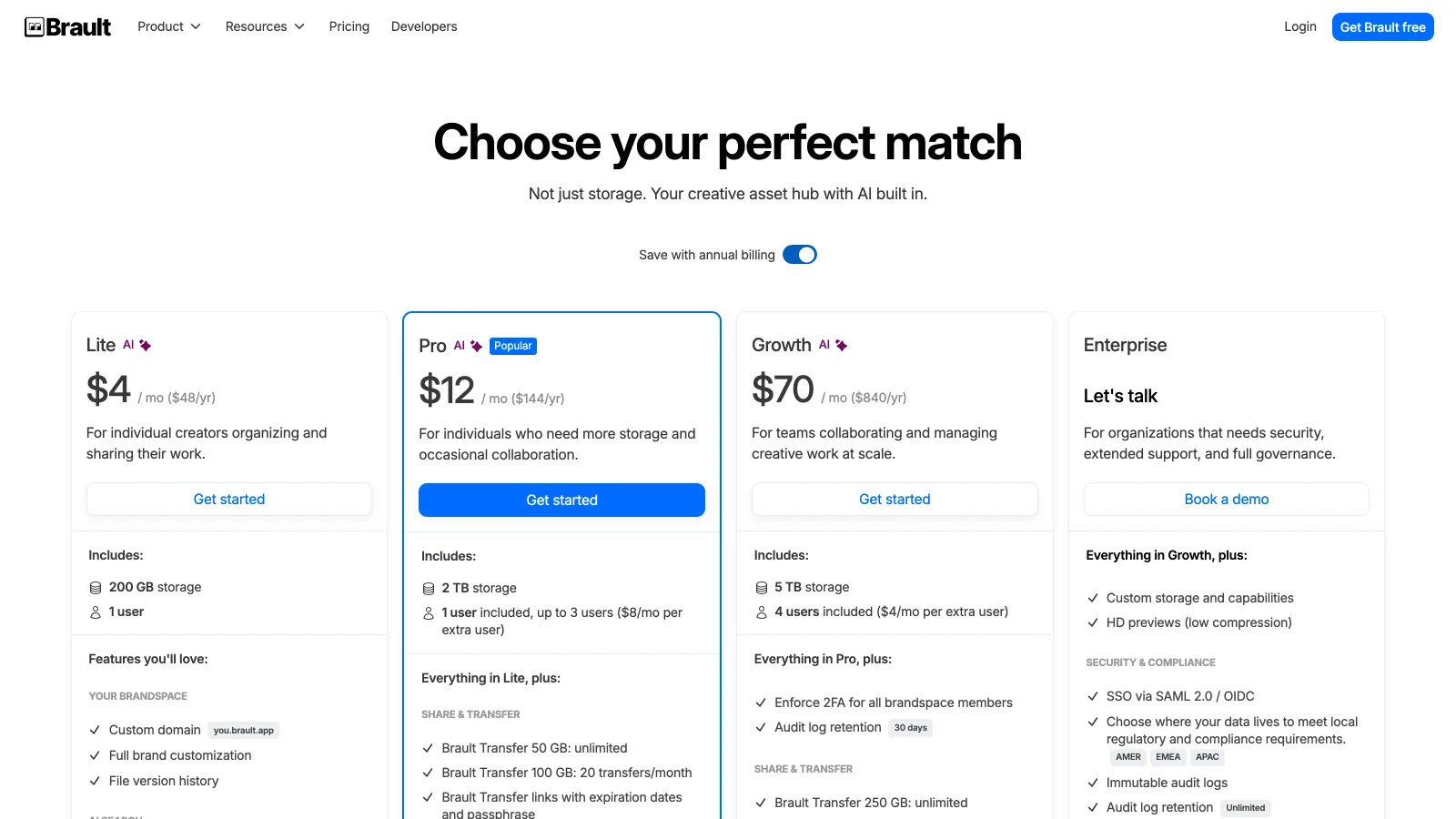
The storage maths is the reason a photographer runs it alongside a gallery tool. Pro is $12 a month billed annually for 2 TB with up to three users; Growth is $70 a month for 5 TB with four users included. Against a gallery platform that charges $24 to $40 a month for 1 TB or unlimited JPEG storage and meters video by the hour, that covers the part of the archive galleries were never designed to hold: the RAW originals, the graded video, the layered PSDs and the client deliverables that have to be found again two years later.
Delivery is the other half. Brault Transfer sends up to 250 GB with a branded page, a password and an expiry date, which is what a photographer sends an agency or a magazine instead of a gallery link. The category view is in what creative asset management is.
How do the Pixieset alternatives compare on price and storage?
| # | Tool | Free plan | Paid from | Storage on the entry paid plan | Print store | Built for the archive |
|---|---|---|---|---|---|---|
| -- |  Pixieset Pixieset |
Yes, 3 GB | $8 a month | 10 GB | Yes, commission-free on paid | Partly, RAW upload on Pro |
| 1 |  Pic-Time Pic-Time |
Yes, 10 GB | $7 a month | 20 GB photos, 5 GB video | Yes, plus Art Store | No |
| 2 | SShootProof | Yes, 100 photos | $8.33 a month | 1,500 photos | Yes, $0 commission on all plans | No |
| 3 |  CloudSpot CloudSpot |
Yes, 5 GB | $7 a month | 15 GB | Yes, from the $17 plan | No |
| 4 |  SmugMug SmugMug |
No, 14-day trial | $20 a month | Unlimited photos | Yes, from Portfolio | RAW on Source, $10 per TB |
| 5 |  Brault Brault |
Yes, 2 GB | $4 a month, $12 on Pro | 2 TB on Pro | No | Yes, RAW, PSD and video previews |
Verified 2026-09-22 on pic-time.com/pricing, shootproof.com/pricing, cloudspot.io/pricing, smugmug.com/plans and brault.app/pricing; Pixieset figures from pixieset.com/pricing as recorded in the Pixieset pricing guide. All prices in US dollars on annual billing where the vendor offers it. Pixieset's pricing page serves euros from some locations, so the USD figures come from the verification recorded in that guide.
Two patterns come out of the table. Among the gallery platforms the entry price is nearly identical, $7 to $8.33 a month, and the real difference is the unit: gigabytes at Pic-Time and CloudSpot, photo count at ShootProof, unlimited at SmugMug for a higher floor. And none of the four is sized for a terabyte-scale archive of originals, which is why the fifth row prices storage instead of galleries.
Three costs that are not in the headline price
- Video, always metered separately. Pixieset charges $5 a month per extra HD hour, Pic-Time sells video storage on its own meter from 1 GB to 60 GB. A photographer who also films will pay outside the plan on either.
- Introductory rates. CloudSpot led with $3 a month for three months when we checked, and several vendors quote the annual rate next to a higher monthly one. Compare the twelfth month, not the first.
- The archive nobody priced. Gallery plans hold delivered JPEGs. The RAW originals live on a drive, on SmugMug Source at $10 per TB a month, or on a storage platform like Brault at $12 a month for 2 TB.
Which Pixieset alternative is right for your photography business?
You sell prints and want the gallery to do the selling
Pic-Time at $7 to $42 a month billed annually for automated campaigns and the Art Store, or ShootProof at $8.33 to $50 for zero commission on every plan including Free.
You want galleries, invoices and booking on one low bill
CloudSpot full suite at $17 a month for 100 GB, or ShootProof, whose paid plans include contracts, invoices and booking alongside the galleries.
You never want to look at a storage tier again
SmugMug at $20 a month billed annually for unlimited photo storage and a portfolio site, with RAW files on Source at $10 a month per terabyte.
Your problem is finding, reviewing and sending the files, not selling them
Brault at $12 a month for 2 TB: AI search across RAW, PSD and video, Boards per job, review on the frame, branded transfers up to 250 GB, Mac and iPhone apps.
A photographer whose client work is delivered through Pixieset and whose originals sit on a pile of external drives does not have a gallery problem. Running a gallery platform for the client and a storage platform for the studio is the normal shape of a photography business in 2026, and the two bills together are usually smaller than the top tier of either one alone.
Frequently asked questions
What is the best Pixieset alternative in 2026?
It depends on what you sell. Pic-Time is the closest gallery-for-gallery replacement with stronger automated sales, at $0, $7, $21 and $42 a month billed annually. ShootProof is the alternative for photographers who want zero commission and photo-count plans, at $8.33 to $50 a month billed annually. CloudSpot bundles galleries with a studio manager from $7 a month, SmugMug is the unlimited-storage portfolio host from $20 a month, and Brault covers the delivery, review and archive layer from $0 to $70 a month billed annually. All prices verified on the vendors' own pricing pages on 2026-09-22.
Is there a free alternative to Pixieset?
Yes, three of the five. Pic-Time Free gives 10 GB of photo storage (reduced to 3 GB after six months) and 1 GB of video. ShootProof Free carries 100 photos. CloudSpot Free gives 5 GB on a gallery-only plan. Brault Free gives 2 GB with AI search, Boards, review and branded Brault Transfer and no card required. SmugMug has no free plan, only a 14-day trial. Verified 2026-09-22.
Which Pixieset alternative is best for selling prints?
Pic-Time and ShootProof are the two built around selling. Pic-Time runs automated sales campaigns, holiday promotions and an Art Store on top of the gallery, while ShootProof advertises $0 commission on every plan including Free, so the markup on a print order stays with the photographer. CloudSpot includes a print store on its full-suite plans from $17 a month. SmugMug sells prints and digital downloads from its Portfolio plan at $23.50 a month billed annually, and Brault has no print store at all.
Which Pixieset alternative handles RAW files and large video?
SmugMug sells a RAW add-on called Source at $10 a month for 1 TB and $6 a month per additional terabyte on top of a plan from $20 a month. Brault takes the archive as its main job: 2 TB on Pro at $12 a month billed annually with previews for CR3, NEF, ARW, PSD and video, AI search across the library and branded transfers, and 5 TB on Growth at $70 a month. Among gallery tools, Pic-Time meters video storage separately (5 GB on Beginner, 60 GB on Advanced) and CloudSpot tops out at unlimited storage on its $50 plan.
Do I have to leave Pixieset to use one of these tools?
No, and most photographers who switch to Brault do not. A gallery platform is the storefront a client sees, and a storage-first platform is the library the studio works in, so they sit on top of each other rather than competing. A common setup is Pixieset or Pic-Time for the client-facing gallery and print store, and Brault underneath for the RAW archive, AI search, review with the retoucher and branded transfers to agencies. Moving gallery to gallery, from Pixieset to Pic-Time or ShootProof, is the change that needs a real migration of collections and links.
Key takeaways
- The four gallery alternatives start within a dollar or two of each other: Pic-Time $7, CloudSpot $7, ShootProof $8.33 and SmugMug $20 a month billed annually, all verified 2026-09-22.
- The unit matters more than the price: gigabytes at Pic-Time and CloudSpot, photo count at ShootProof, unlimited photos at SmugMug, terabytes at Brault.
- ShootProof is the only one advertising $0 commission on every plan, free included; Pixieset charges commission only on its free tier.
- Video and RAW are priced outside the gallery plan almost everywhere: $5 an hour at Pixieset, a separate meter at Pic-Time, $10 per terabyte on SmugMug Source.
- Brault is a different fit rather than a replacement: $0 to $70 a month billed annually for the delivery, review, transfer and archive layer, with AI search, RAW and PSD previews and Mac and iPhone apps, under whichever gallery platform the client sees.
Want the archive under your galleries searchable this afternoon? Try Brault free.