Pixieset and Pic-Time are the two client gallery platforms photographers shortlist against each other most often, and they are close enough that the decision comes down to what happens after delivery. Pixieset is a gallery that grew into a business suite: Client Gallery plus a website builder, a booking and invoicing manager and a print store on one account, from $8 a month billed annually. Pic-Time is a client delivery suite built around selling: the same branded gallery, with automated sales campaigns, an Art Store and client-facing photo search, from $7 a month billed annually.
This comparison walks storage, selling, video, business tools and price, and says who leads on each. Prices were verified on 2026-09-22; Pixieset's own plan detail is in Pixieset pricing in 2026, the product on its own in the Pixieset review, and the wider field in best Pixieset alternatives.
TL;DR
- Entry price: Pic-Time $7 a month for 20 GB, Pixieset $8 for 10 GB, both billed annually.
- Selling: Pic-Time leads, with automated post-delivery campaigns and an Art Store.
- Business tools: Pixieset leads, with Website, Studio Manager and Store in the Suite at $28 a month.
- Video: both meter it separately; Pic-Time gives 5 to 60 GB of video storage, Pixieset sells hours at $5 a month each.
- Neither is a studio archive; that is where a storage-first platform sits underneath, from $0 to $70 a month.
How do Pixieset and Pic-Time compare at a glance?
| Criteria |  Pixieset Pixieset |
 Pic-Time Pic-Time |
|---|---|---|
| What it is | Client gallery plus website, booking and store | Client delivery suite built around selling |
| Free plan | Yes, 3 GB, Pixieset branding, commission on store sales | Yes, 10 GB (3 GB after six months), 1 GB video |
| Paid from | $8 a month billed annually, 10 GB | $7 a month billed annually, 20 GB |
| Top published plan | $40 a month, unlimited photo storage | $42 a month, unlimited photos, 60 GB video |
| Selling | Print and digital store, commission-free on paid plans | Store plus automated sales campaigns and an Art Store |
| Video | Metered in hours, $5 a month per extra hour | Metered in gigabytes, 1 to 60 GB by plan |
| Website builder | Yes, in the Suite from $28 a month | No |
| Booking and invoicing | Yes, Studio Manager in the Suite | No |
| RAW upload | Pro plan and above | Not a published feature of the delivery suite |
| Client-side search | Gallery browsing and favorites | People, keyword and selfie search for guests |
Verified 2026-09-22 on pic-time.com/pricing and, for Pixieset, the USD figures recorded in our Pixieset pricing guide; pixieset.com serves euro prices from some locations and did not reach a stable load state in two headless attempts, so it is cited by link.
Which one should you choose?
Choose Pixieset if
- You want galleries, a portfolio site, booking and invoices on one subscription.
- You sell prints and want zero commission from the first paid tier.
- You need RAW upload inside the same platform, from the Pro plan up.
Choose Pic-Time if
- You want the gallery to keep selling after you stop thinking about it.
- Your clients are event guests who need to find themselves in a big gallery.
- You already have a website and a CRM and only want delivery and sales.
Which one gives you more storage for the money?
EdgePic-Time
Pic-Time gives more gigabytes at every step of the ladder below the top tier. Its Beginner plan is $7 a month billed annually for 20 GB of photos and 5 GB of video, against Pixieset Basic at $8 for 10 GB of photos and 30 minutes of HD video. At the next rung both platforms land on 100 GB, Pixieset Plus at $16 and Pic-Time Professional at $21, but the Pic-Time plan carries 30 GB of video with it. The free tiers tell the same story: 10 GB at Pic-Time against 3 GB at Pixieset, though Pic-Time drops its free allowance to 3 GB after six months.
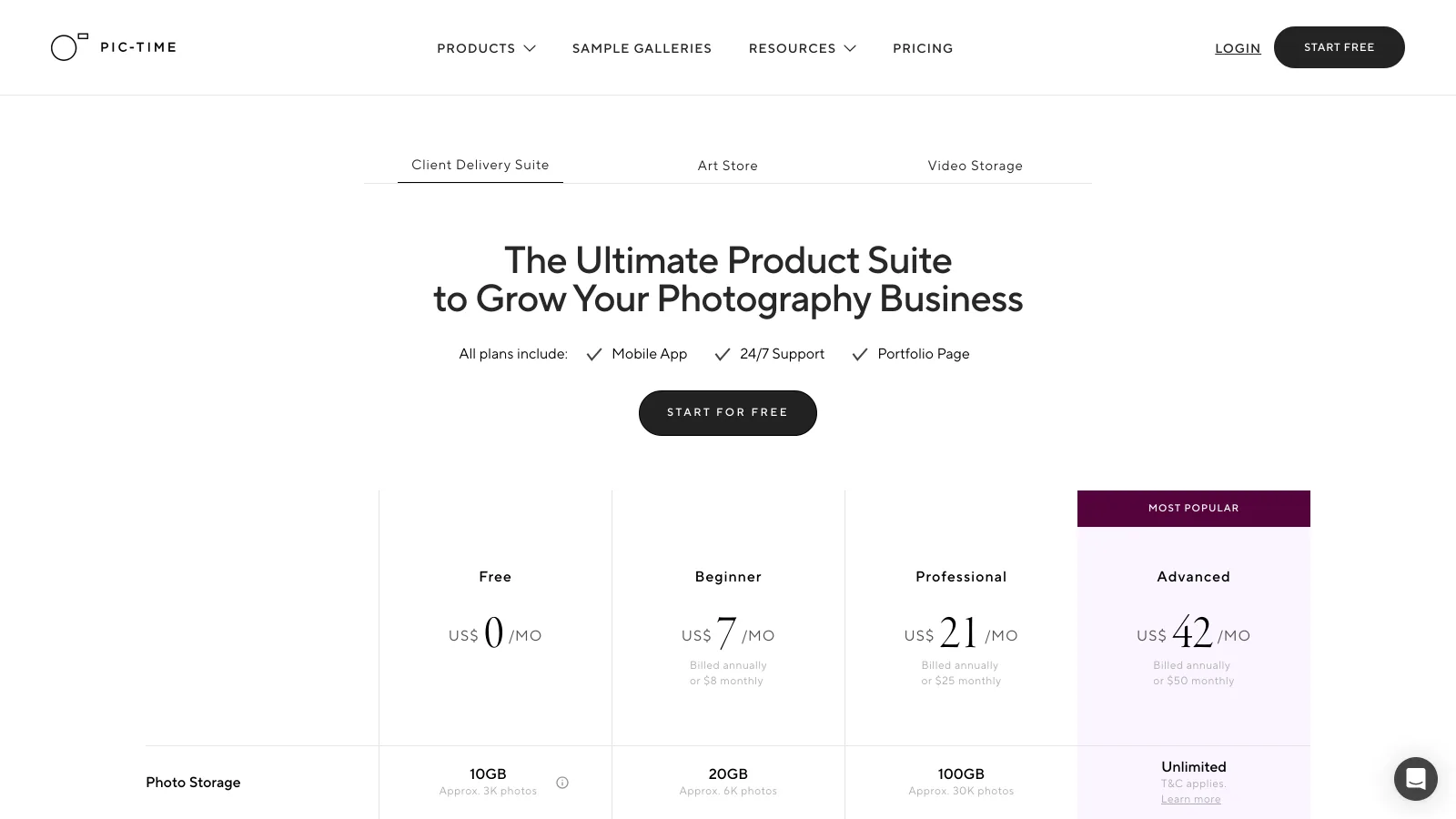
The exception is the top of the range, where Pixieset Ultimate reaches unlimited photo storage at $40 a month against Pic-Time Advanced at $42. Two dollars is not a decision, so the storage edge belongs to Pic-Time on the plans most working photographers actually buy.
Which one is better at selling photos?
EdgePic-Time
Pic-Time treats the gallery as a sales channel that runs without the photographer. Sales campaigns fire automatically after a gallery is delivered and at seasonal moments, the Art Store sells framed prints and wall displays, and client-side search lets a guest at a wedding or a marathon find their own frames by keyword, by person or by uploading a selfie. Those features exist to raise the order rate on galleries that are already sent.

Pixieset sells competently and charges nothing for it on paid plans: the store handles prints and digital downloads through lab partners, price sheets and coupons are built in, and there is no commission on any upgraded account. What it does not do is market the gallery on the photographer's behalf. For a photographer whose print revenue matters, that difference compounds over a season.
Which one is better for running the whole business?
EdgePixieset
Pixieset is the only one of the two with a website builder and a studio manager. The Suite bundles Client Gallery, Website, Studio Manager and Store at $28, $38 or $55 a month billed annually, so booking a session, signing a contract, invoicing, taking payment, publishing a portfolio and delivering the gallery all happen on one login with one client record. Pic-Time has no equivalent: it is a delivery and sales suite, and the photographer brings their own site and CRM.
That makes the honest comparison a bundle against a component. A photographer already paying for a website and a booking tool should compare Pic-Time to the Pixieset Client Gallery plan alone; one starting from nothing should compare it to the Suite and count the two subscriptions it replaces.
Which one handles video better?
EdgeEven
Neither platform treats video as a first-class deliverable, and both meter it apart from photo storage. Pixieset sells HD video by the hour, starting at 30 minutes on Basic, with each additional hour at $5 a month on any plan. Pic-Time sells it by the gigabyte, 1 GB on Free, 5 GB on Beginner, 30 GB on Professional and 60 GB on Advanced, and also lists a separate Video Storage product. The unit differs, the outcome does not: a photographer delivering a few highlight films fits inside either allowance, and a hybrid shooter delivering full ceremony edits pays extra on both. Treat video as an add-on cost whichever platform you pick.
Which one costs more per year?
EdgePixieset
| Photographer | Pixieset |
Pic-Time |
|---|---|---|
| Starting out, under 20 GB of live galleries | $96 (Basic, 10 GB) | $84 (Beginner, 20 GB) |
| Portrait work, around 100 GB live | $192 (Plus, 100 GB) | $252 (Professional, 100 GB + 30 GB video) |
| Busy wedding season, 1 TB or unlimited | $288 (Pro, 1,000 GB, RAW upload) | $504 (Advanced, unlimited + 60 GB video) |
| Everything on one bill: galleries, site, booking | $336 (Suite Starter, 100 GB) | Not a fit: no site builder or booking |
Per year in US dollars, billed annually, verified 2026-09-22 on pic-time.com/pricing and from the USD figures in our Pixieset pricing guide. Video hours, extra brands and add-ons are billed on top on both platforms.
Pixieset is cheaper over a full year on three of the four profiles, and it is the only one that answers the fourth at all. Pic-Time wins the first row and wins it on storage as well as price, which is why it is the better entry for a photographer whose galleries are small and whose ambition is to sell more of them.
Which one is faster to get running?
EdgeEven
Both are self-serve with a real free tier, so a photographer can have a branded gallery live the same afternoon. Pixieset asks for slightly more setup when the Suite is used, because the website and the booking flow have their own configuration, and Pic-Time asks for more attention to the sales settings that make its automation worth having. Neither has a demo gate, an implementation fee or an onboarding project, which is the practical difference between this category and enterprise asset management.
Where does Brault fit?
Pixieset and Pic-Time solve the client-facing half of a photography business, and both stop at the studio door. The originals, the layered files, the graded video and the search across several years of work sit outside either platform, and that is the gap Brault fills: the delivery, review, transfer and archive layer under whichever gallery a client sees.

- Best forPhotographers who deliver to clients and agencies and need the archive searchable, not a storefront
- Pricing$0 / $4 / $12 / $70 a month billed annually, $6 to $14 per TB (verified on brault.app/pricing 2026-09-22)
- Free planYes, 2 GB with AI search, Boards, review and Brault Transfer, no card
- Watch outNo print store, booking or website builder; Pro tops out at 3 users
What it does and does not replace
Brault holds what the gallery never sees: 2 TB on Pro at $12 a month billed annually, previews for CR3, NEF, ARW, PSD and video, AI search that finds a frame by describing what is in it, Boards per job, review with comments pinned to the image, branded transfers up to 250 GB, and Mac and iPhone apps. It sells nothing, books nothing and builds no website, so it sits under Pixieset or Pic-Time rather than against them. The category is explained in what creative asset management is.
Frequently asked questions
Is Pic-Time better than Pixieset for wedding photographers?
They win on different halves of the job. Pic-Time is better at turning a delivered wedding gallery into revenue: automated sales campaigns run after delivery, the Art Store sells wall art, and a guest can find themselves in a 2,000-photo gallery with a selfie. Pixieset is better at running the whole business from one account, because Studio Manager handles booking, contracts and invoices and Website hosts the portfolio. A wedding photographer who already has a site and a CRM usually prefers Pic-Time; one who wants a single subscription usually prefers the Pixieset Suite at $28 a month billed annually.
Which is cheaper, Pixieset or Pic-Time?
Pic-Time at the entry, Pixieset in the middle. Pic-Time Beginner is $7 a month billed annually for 20 GB against Pixieset Basic at $8 for 10 GB. At the next step Pixieset Plus is $16 for 100 GB while Pic-Time Professional is $21 for the same 100 GB plus 30 GB of video. At the top Pixieset Ultimate is $40 a month for unlimited photo storage and Pic-Time Advanced is $42 with unlimited photos and 60 GB of video. Verified 2026-09-22 on both vendors' pricing pages.
What about Pixieset vs ShootProof?
ShootProof is the third name on most shortlists and it competes on a different term: no commission on any plan, including the free one, and plans sized by photo count rather than by gigabytes. It runs $8.33, $16.67, $26.67 and $50 a month billed annually for 1,500, 5,000, 25,000 and unlimited photos, with contracts, invoices and booking included on the paid plans. Against Pixieset it is the closer match on business tools and the looser one on storage maths; the full field is in our ranked guide to Pixieset alternatives.
Can you use Pixieset and Pic-Time at the same time?
You can, and some photographers do it during a migration, but it is rarely a long-term setup. Both platforms are client-facing storefronts that hold the same delivered JPEGs, so running both means paying twice for one job and giving clients two different-looking galleries. The pairing that does make sense is one gallery platform plus one storage platform: the gallery for what the client sees, and something like Brault underneath for the RAW originals, the graded video, the search across years of shoots and the branded transfers to agencies.
How hard is it to move galleries from Pixieset to Pic-Time?
The files move easily and the links do not. Collections are re-uploaded to the new platform, which is a bandwidth and time cost rather than a technical one, and both platforms accept bulk uploads from a folder structure. What breaks is every gallery link already in a client's inbox, every download page bookmarked by a couple, and any embedded gallery on the photographer's own site. The practical approach is to deliver new work on the new platform, keep the old one alive on its cheapest tier until the last active gallery expires, and archive the originals somewhere neither platform controls.
Key takeaways
- Pic-Time gives more storage per dollar below the top tier: $7 a month for 20 GB against Pixieset's $8 for 10 GB, verified 2026-09-22.
- Pic-Time leads on selling, with automated post-delivery campaigns, an Art Store and selfie search for guests.
- Pixieset leads on running the business, because Website and Studio Manager put the portfolio, booking and invoicing on the same account.
- Over a year Pixieset is cheaper on the portrait, wedding and all-in-one profiles; Pic-Time is cheaper for a photographer starting out.
- Neither is a studio archive: RAW originals, graded video and search across years of work belong on a storage layer such as Brault, from $0 to $70 a month billed annually.
Want the archive under your galleries searchable this afternoon? Try Brault free.