Canto and Bynder are two enterprise digital asset management platforms that hide their prices behind the same sales call, and a team shortlisting them is choosing between two ways of packaging the same category. Canto sells named packages built on power users and storage, with brand portals, review and AI search bundled into the middle tier; Bynder sells one custom package per customer, an AI-powered DAM base plus modules for production and delivery, backed by 160+ integrations. Both are demo-led, both bill annually, and both treat onboarding as a project with its own line on the quote.
This comparison answers the six questions buyers ask before the demo: pricing, brand portals, AI search and tagging, integrations, onboarding, and who each one actually fits. Neither vendor is Brault, and the last section says where a creative team of 3 to 20 sits instead. The plan detail lives in Canto pricing in 2026 and Bynder pricing in 2026; the other enterprise head-to-head is Bynder vs Brandfolder, and the wider field is in best Brandfolder alternatives.
TL;DR
- Both quote-only. Canto's one public figure is $25,000 a year for 2 TB and 5 power users; Bynder's reported median is $39,270 (Vendr, February 2026).
- Canto has the edge on brand portals and on a price a small buyer can read before the call.
- Bynder has the edge on integrations (160+), modules and multi-market scale.
- AI search and tagging are even on what each vendor publishes; test both on your own formats.
- Onboarding is a project either way: Canto bundles dedicated onboarding in its top tier, Bynder buyers report services at 15% to 30% of year one.
How do Canto and Bynder compare at a glance?
| Criteria |  Canto Canto |
 Bynder Bynder |
|---|---|---|
| What it is | Enterprise DAM sold as named packages | Enterprise DAM sold as one custom package per customer |
| Pricing | Quote-only; $25,000 a year published on AWS Marketplace for 2 TB and 5 power users | Quote-only; $8,950 to $71,310 a year reported, $39,270 median |
| Pricing unit | Power users and storage | Users, storage, MarTech usage, products included, support level |
| Free plan or trial | No free plan; seven-day trial by request form | No free plan; no trial, quote request instead |
| Brand portals | Customizable brand portals and brand style guides in the DAM Plus tier | Customizable homepages and portals; deeper experiences as modules |
| Search and AI | AI search and AI tagging, brand and product content in one source of truth | AI-powered DAM: AI search, similarity search, search by image |
| Review and approval | Review and approval with proofing in the DAM Plus tier | Asset and content workflow modules |
| Integrations | Basic integrations in the entry package, extended in the top tier | 160+ integrations and an open API |
| Onboarding | Dedicated onboarding and training bundled in the Advanced tier | Onboarding program in every package; services reported at 15% to 30% of year one |
| Best fit | Mid-market marketing teams that want portals and review in one named package | Large brand organizations with several markets and a MarTech stack to feed |
Feature names from canto.com and bynder.com product and pricing pages, captured 2026-09-22; prices are the published Canto AWS Marketplace listing and Vendr buyer data of February 2026 as reported in the two pricing guides, not vendor rate cards.
Which one should you choose?
Choose Canto if
- You want brand portals, style guides and review with proofing inside one named package.
- Your library is a few terabytes and a handful of people manage it, so the power-user unit works in your favor.
- You want at least one public number to budget against before the first call.
Choose Bynder if
- You run several brands or markets and need governance across departments.
- The DAM has to feed a CMS, a PIM or a commerce platform through one of 160+ integrations.
- You expect to add production and delivery modules as the program grows.
Which one has the clearer pricing?
EdgeCanto
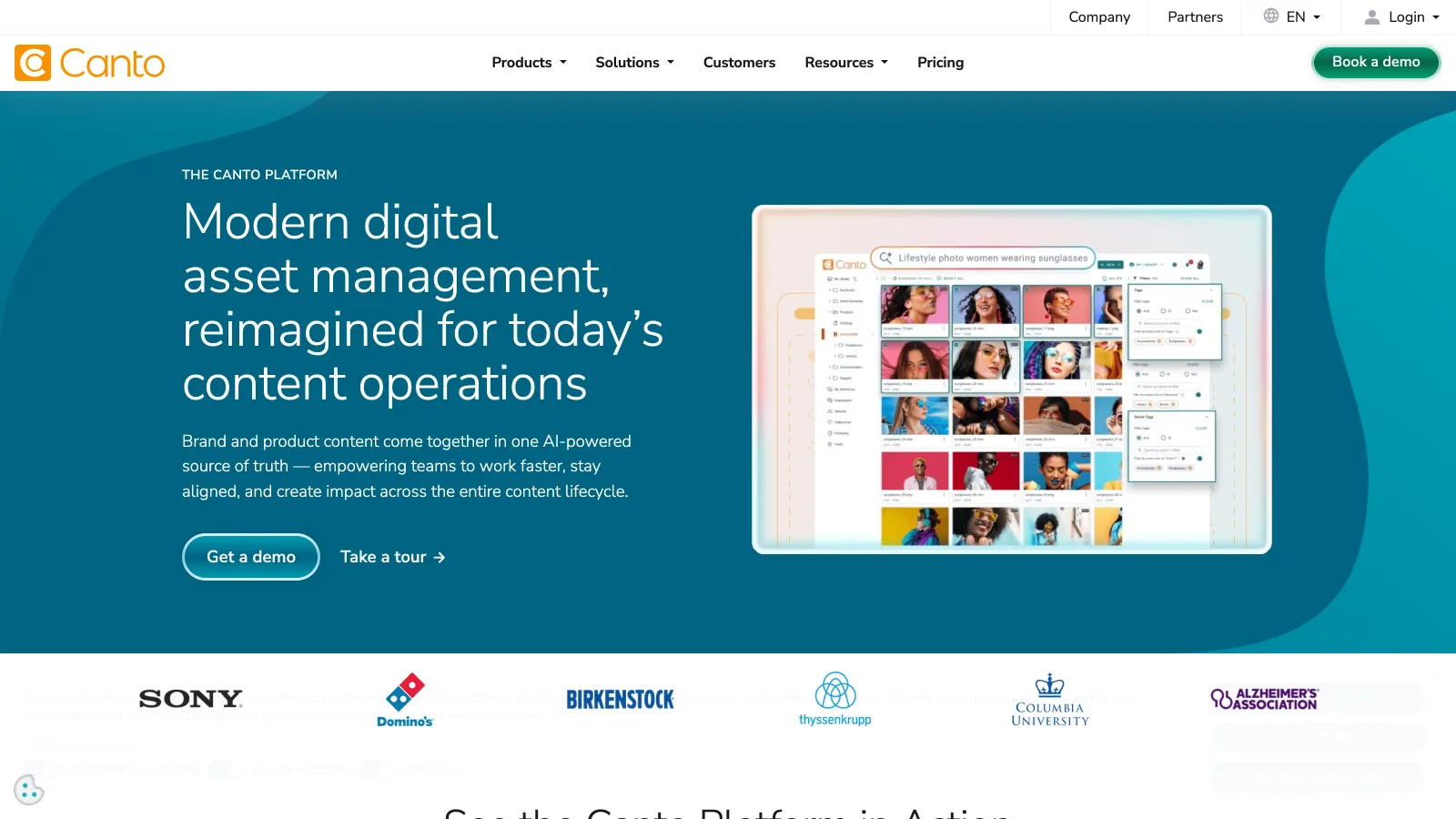
Canto is the only one of the two with a price in public. Its pricing page shows packages with a "Get pricing" or "Talk to sales" button and the note that all packages are illustrative, but its AWS Marketplace listing puts a real number on the smallest configuration: $25,000 per 12-month contract for 2 TB of storage and 5 power users. That is $5,000 per power user or $12,500 per terabyte a year, and it gives a buyer something to compare before the demo. Bynder publishes nothing: its pricing page asks you to build a custom package and names five inputs (users, storage, MarTech usage, products included, support level) without a single figure, so the first number arrives after the scoping call. Both are quote-only in practice; Canto simply lets you start the conversation with an anchor.
Which one is better for brand portals?
EdgeCanto
Canto bundles the brand-distribution layer into a single tier. Customizable brand portals, brand style guides, dynamic brand templates and review with proofing all sit in the DAM Plus package that Canto sells as Enhanced Collaboration, so a marketing team that needs partners and agencies to pull approved assets gets the whole set in one line of the quote. Bynder does portals well and has done them for years, with customizable homepages and role-based portal experiences on the base platform, but the richer content-experience capabilities are modules with their own price. For a team whose first job is getting on-brand assets to people outside the company, Canto reaches that state with fewer moving parts.
Which one has better AI search and tagging?
EdgeEven
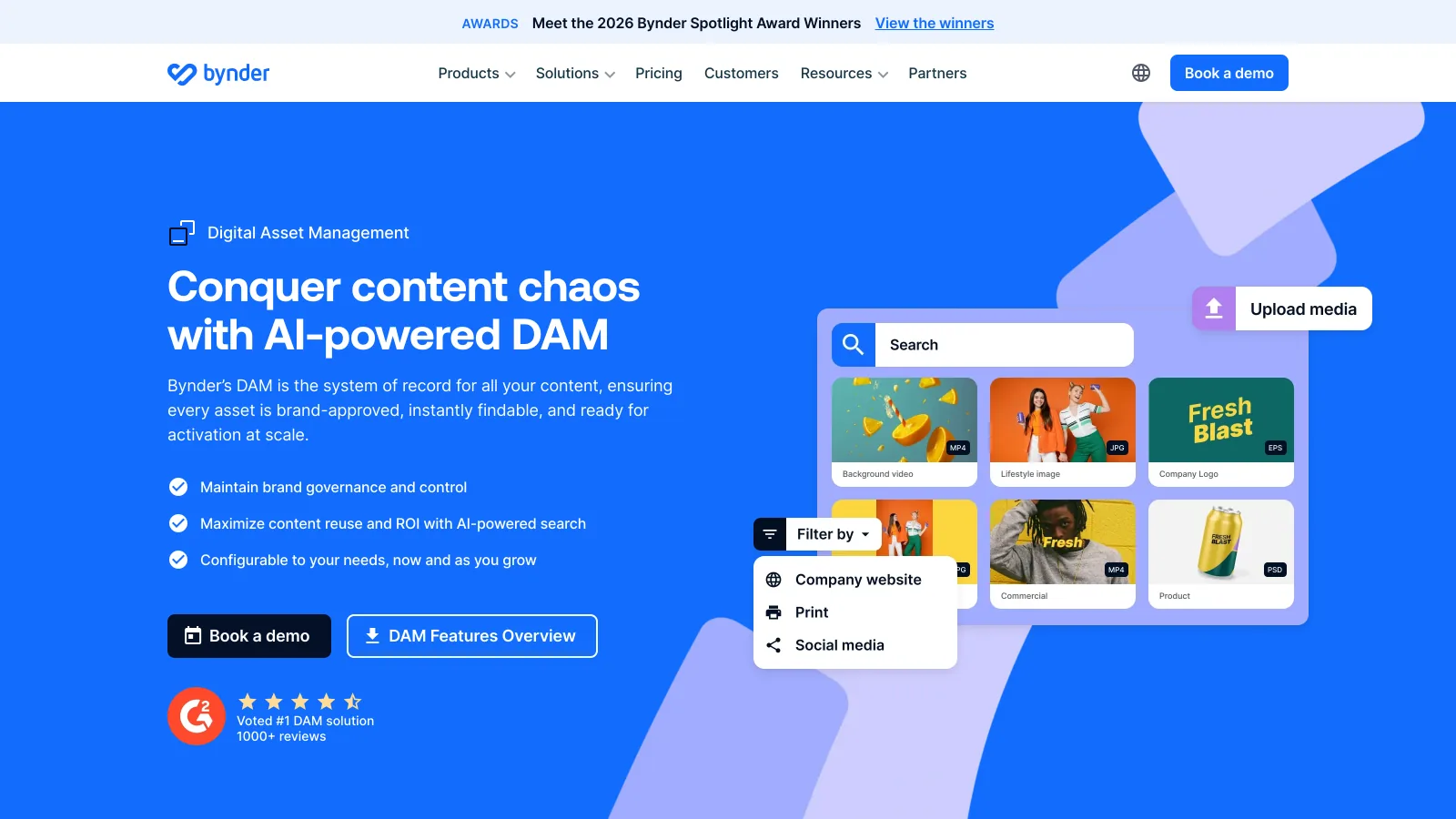
Both vendors lead with AI and neither publishes a number to check it against. Canto describes a platform where brand and product content come together in one AI-powered source of truth, with AI search and AI tagging in its DAM Plus and DAM Pro tiers. Bynder's product page opens with AI-powered DAM and names AI search, similarity search and search by image, with the promise that every asset is instantly findable. Both depend on the taxonomy agreed during onboarding, which is the part of the deployment that decides whether search works a year later. Treat the marketing claims as equal and run the same test on both: upload a folder of RAW files, a long video and a layered design source, then search for something only the file content knows.
Which one has more integrations?
EdgeBynder
Bynder publishes 160+ integrations and an open API, and its module groups are organized around feeding the rest of the stack: content production on one side, digital experience and commerce delivery on the other. That matters when the DAM is the system of record behind a CMS, a PIM and an e-commerce catalog, because the connector already exists and the work is configuration rather than custom development. Canto ships basic integrations in its entry package and extends them in the Advanced tier, which covers the common creative and office tools, but it does not publish a count and it does not sell the stack-integration story the way Bynder does. If your shortlist exists because the DAM has to talk to five other systems, this is the question that decides it.
Which one is cheaper to run for a year?
EdgeCanto
At small sizes Canto is the cheaper and more predictable of the two, because its published package covers 5 power users and 2 TB for a fixed $25,000 and the people who only view or download through a portal do not count as power users. Bynder's lowest observed contract is $8,950, but the reported band for a 10 to 25 user deployment is $20,000 to $40,000 a year, and buyers report that adding seats mid-contract reprices the rest. Above about 25 users the comparison flips: Canto's small package stops applying and everything becomes a custom quote, while Bynder's model is built for that size and its per-user price falls as the count rises. Neither number includes services.
| Team and library | Canto |
Bynder |
 Brault Brault |
|---|---|---|---|
| 3 people, up to 2 TB | $25,000 (AWS package, 5 seats included) | From $8,950 (lowest reported contract) | $336 (Pro, 2 TB, 3 users) |
| 5 people, up to 5 TB | $25,000 (AWS package, 2 TB) | From $8,950 (lowest reported contract) | $888 (Growth, 5 TB, 4 users + 1) |
| 15 people, 5 TB | Custom quote | $20,000 to $40,000 (reported, 10 to 25 users) | $1,368 (Growth, 4 users + 11) |
| 25 people, 5 TB | Custom quote | $20,000 to $40,000 (reported, 10 to 25 users) | $1,848 (Growth, 4 users + 21) |
| Services in year one | Onboarding fee, bundled training on Advanced | 15% to 30% of the contract, reported | None |
Per year. Canto figures as read on canto.com and the AWS Marketplace on 2026-09-14, Bynder figures from Vendr buyer data of February 2026, both re-checked against our sources on 2026-09-22. Canto: AWS Marketplace listing, $25,000 per 12-month contract for 2 TB and 5 power users; larger sizes are quoted. Bynder: Vendr buyer data, February 2026, 78 purchases; reported figures, not Bynder rates. Brault: Pro $12 a month for 2 TB with 1 user included and up to 3 at $8 each, Growth $70 a month for 5 TB with 4 users included and $4 per extra user, billed annually, verified on brault.app/pricing.
Three things to put in the same quote
- Subscription and services on one page. Both vendors bill onboarding separately; ask for the software number and the implementation number together, for year one and year two.
- Who counts as a seat. Canto prices on power users, Bynder on named users. Count the freelancers and agency staff who will upload, tag or approve, not just the staff who will look.
- Storage past the package. Canto's published package stops at 2 TB and Bynder's base is reported at 500 GB to 1 TB. A video library crosses both in its first year, and the overage is quoted, not metered.
Which one is faster to go live?
EdgeEven
Neither vendor publishes an onboarding time, and both run the same kind of project: agree the taxonomy, migrate the library, tag it, set the roles, train the team. Canto bundles dedicated onboarding and training into its Advanced tier and states that its onboarding fees are lower than most, which confirms the fee exists. Bynder includes an onboarding program in every package and its buyers report services at 15% to 30% of the first-year contract. Plan a quarter from signature to a library the team trusts, whichever one wins the shortlist, and put the migration owner in the room before the contract is signed.
Where does Brault fit?
Canto and Bynder are built for the buyer who has a procurement process, several departments to govern and a stack to integrate, and for that buyer the quote model is normal. A creative team of 3 to 20 people, a studio or an agency that needs a searchable library, review on the file and branded delivery this week is a different buyer, and that is where Brault sits: the DAM capabilities creative teams use daily, on a public price, with no implementation fee and no scoping call.
- Best forCreative teams of 3 to 20 that want search, review, branded delivery and transfer in one plan
- Pricing$0 Free, $12 Pro (2 TB), $70 Growth (5 TB, 4 users) a month billed annually (verified 2026-09-22)
- Free planYes; 2 GB, AI search, Boards, review and Brault Transfer, no card
- Watch outNo product-data catalog or MarTech module set; SSO and custom roles are on Enterprise
What it does and does not replace
Brault covers the daily layer: AI search across 50+ formats including RAW, PSD and AI files, custom metadata, Boards with properties on the file, frame-accurate review and approval, and share links, transfer pages and public boards that all carry the brandspace branding, with transfers up to 250 GB. It does not replicate Canto's product-catalog tier or Bynder's 160+ integrations and module catalogue, and enterprise governance lives on the Enterprise plan. The head-to-head with the category is on Brault vs traditional DAM.
Frequently asked questions
Canto vs Bynder for digital asset management: which offers better pricing, brand portal features, and search capabilities?
Neither publishes a list price, so pricing is decided by size: Canto has the only public number in the pair, an AWS Marketplace package at $25,000 a year for 2 TB and 5 power users, while Bynder contracts run $8,950 to $71,310 a year with a $39,270 median (Vendr, February 2026), so Canto is the more predictable buy at the small end and Bynder the one that scales. Brand portals go to Canto at the mid package, where customizable portals, brand style guides and review with proofing are bundled rather than quoted as modules. Search is even: both run AI tagging and AI-powered search over the library, and neither publishes a benchmark, so test both on your own file mix during the demo.
Which is cheaper, Canto or Bynder?
On the public and reported numbers, Canto is cheaper and more predictable for a small deployment and Bynder is the better value at scale. Canto's only published figure is $25,000 per 12-month contract for 2 TB and 5 power users on AWS Marketplace, and third-party pages report entry implementations near $600 a month. Bynder reports no figure at all; Vendr buyer data of February 2026 across 78 purchases shows $8,950 to $71,310 a year, a $39,270 median, $20,000 to $40,000 for 10 to 25 users, and services at 15% to 30% of year one. Both bill annually and both charge for onboarding.
Does Canto or Bynder offer a free trial?
Canto offers a seven-day trial requested through a form that asks for a name, company email, phone number, company, industry and country, so it is not self-serve. Bynder has no trial on its pricing page; the path in is a quote request, with a non-binding quote promised within one business day. Neither has a free plan. The DAM tools a team can start today without a call are Brault (free plan, 2 GB), Filecamp (30-day trial, no card) and Dash (free trial on every plan).
Which has better AI search and tagging, Canto or Bynder?
They are even on what each vendor publishes. Canto describes an AI-powered platform where brand and product content share one source of truth, with AI search and AI tagging inside the DAM Plus and DAM Pro tiers. Bynder leads its product page with AI-powered DAM and names AI search, similarity search and search by image. Neither publishes accuracy figures, and both depend on the taxonomy agreed during onboarding, so the useful test is your own library: upload RAW files, long video and design sources during the demo and search for what is inside them.
What is a cheaper alternative to Canto and Bynder for a small creative team?
Brault is the closest fit for a creative team of 3 to 20 that wants DAM organization without a quote: $0 (Free, 2 GB), $12 a month (Pro, 2 TB) and $70 a month (Growth, 5 TB, 4 users included) billed annually, with AI search across 50+ formats, custom metadata, frame-accurate review, white-label sharing and 250 GB transfers, and no implementation fee. Filecamp ($29 to $89 a month, unlimited users) and Dash ($109 to $589 a month) are the other DAM tools with a published price.
Key takeaways
- Canto and Bynder are enterprise peers: quote-only, demo-led, annual contracts, portals, AI tagging and an onboarding project on both.
- Canto has the edge on pricing transparency, thanks to the one published package at $25,000 a year for 2 TB and 5 power users, and on brand portals bundled into a single tier.
- Bynder has the edge on integrations (160+ plus an open API), module depth and multi-market governance, and its reported median contract is $39,270.
- AI search and onboarding time are even on what each vendor publishes; the deciding test is your own file mix and the taxonomy work either deployment requires.
- A creative team of 3 to 20 that wants a price it can read today is a different buyer for both; Brault covers the daily DAM layer at $0, $12 Pro with 2 TB and $70 Growth with 5 TB a month, billed annually.
Want DAM-level organization without the quote? Try Brault free.