Bynder and Brandfolder are the two digital asset management platforms most often shortlisted against each other by marketing organizations, and they are peers: both are quote-only enterprise DAMs with brand portals, SSO, role-based permissions, AI tagging and analytics, sold by demo and onboarded as a project. The differences are structural. Bynder is a base platform that grows by paid modules, with 160+ integrations and 4,000+ customers; Brandfolder is Smartsheet's DAM, with brand guidelines, portals and analytics in the product and a data connector into Smartsheet.
This comparison walks the six things a buyer asks about, pricing, portals and brand guidelines, search, workflow, analytics and onboarding, and says where each one has the edge. Neither includes Brault; the last section says where a creative team that wants a price instead of a quote fits. The plan detail lives in Bynder pricing in 2026 and Brandfolder pricing in 2026, and the wider field in best Brandfolder alternatives.
TL;DR
- Both quote-only. Reported medians: Bynder $39,270 a year, Brandfolder $24,999 (Vendr, February 2026).
- Bynder wins on modularity, integrations (160+) and scale; Brandfolder wins on Smartsheet and on brand guidelines in the product.
- Search and AI tagging are even; both add similarity or image recognition.
- Onboarding is a project on both: 1.6 months on average at Brandfolder, 15% to 30% of year-one services at Bynder.
- Creative teams of 3 to 20 that want a price today are the wrong buyer for both; that is where Brault, Dash and Filecamp fit.
How do Bynder and Brandfolder compare at a glance?
| Criteria |  Bynder Bynder |
 Brandfolder Brandfolder |
|---|---|---|
| What it is | Enterprise DAM sold as a base plus modules | Enterprise DAM owned by Smartsheet |
| Pricing | Custom quote; $20,000 to $100,000+ a year reported | Demo-led; about $500 a month on Basic, $1,500 to $3,000 on Premium reported |
| Free plan or trial | No | No |
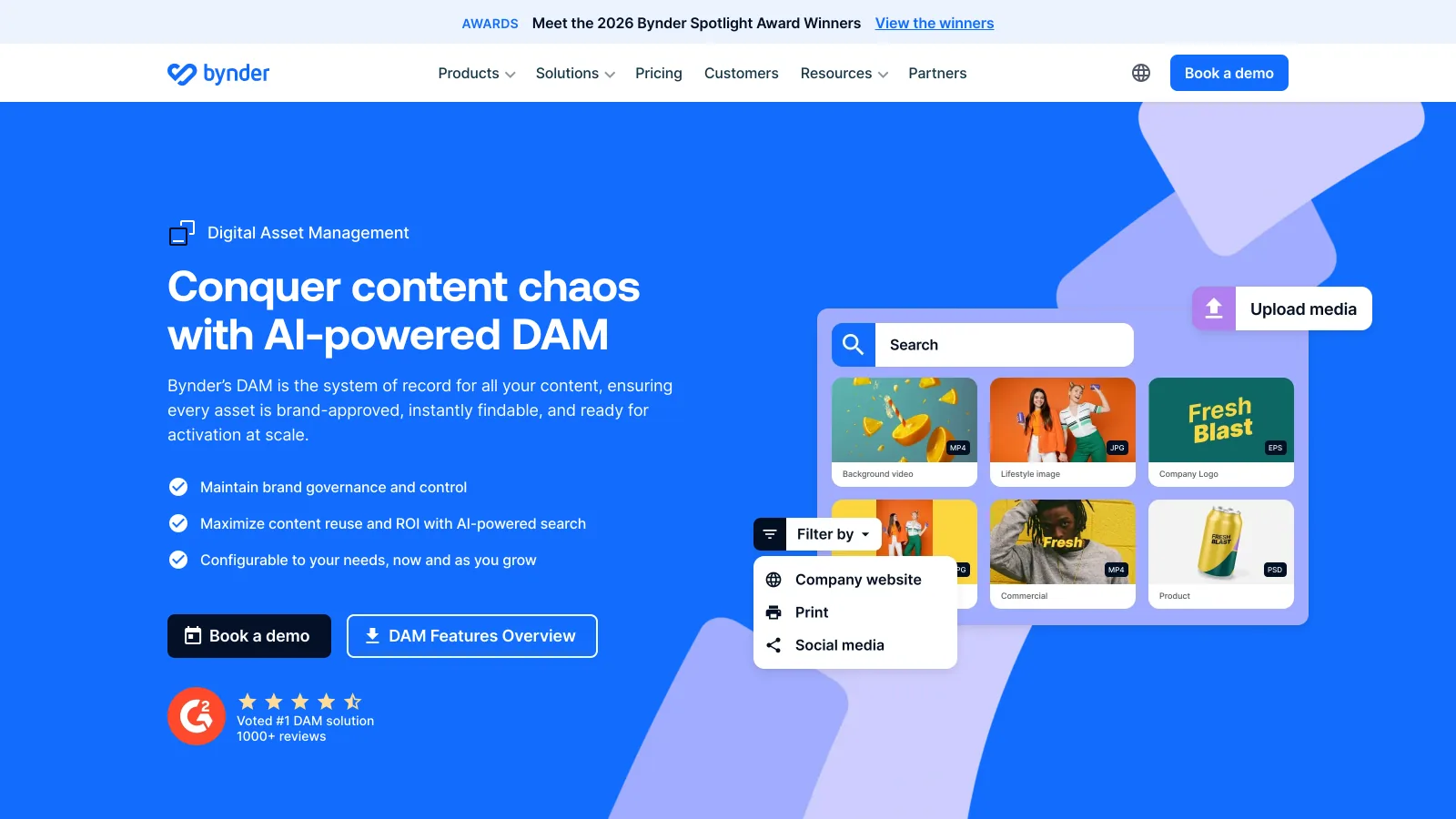
| Brand portals | Customizable portals and homepages; Content Experiences as modules | Portals and Brandguide on the product |
| Search and AI | AI search, Similarity Search, Search by Image, Duplicate Manager | Brand Intelligence: AI image recognition and auto-tagging |
| Workflow | Asset Workflow and Content Workflow modules | Creative workflow, asset approvals, links to Smartsheet, Wrike, Workfront, Jira |
| Analytics | Reporting in the platform | Asset Analytics, User Insights, Insights connector to Smartsheet (Enterprise) |
| Integrations | 160+ integrations, open API | Adobe plugin, Salesforce, Microsoft Office, open API, Smart CDN |
| Users | Named seats; more users mid-contract reported to raise the price | Named seats; guests free and unlimited |
| Onboarding | Services reported at 15% to 30% of year one | 1.6 months on average; $2,000 to $10,000 reported |
Feature names from bynder.com and brandfolder.com product pages, captured 2026-09-20; prices are Vendr buyer data of February 2026 as reported in the two pricing articles, not vendor rates.
Which one should you choose?
Choose Bynder if
- You run several brands, markets or teams on one platform and want portals per audience.
- You will buy workflow and content-experience modules as the program grows.
- Your stack needs one of the 160+ integrations or a wide open API.
Choose Brandfolder if
- Your team already plans work in Smartsheet, Wrike, Workfront or Jira.
- You want brand guidelines (Brandguide) and asset analytics in the product, not as modules.
- Many outside guests view and download and only a few people upload.
Which one is better for a multi-brand organization?
EdgeBynder
Bynder is built to host multiple brands, markets and teams on a single platform, with a configurable taxonomy aligned to the business language, role-based access controls and customizable homepages and portal experiences per audience. The Content Experiences modules extend that to a user community and to omnichannel delivery. Brandfolder covers the same ground with Portals and public-or-private asset controls, and does it well for one brand or a franchise network, but the module structure at Bynder is what a holding company with distinct brands ends up buying.
Which one is better for brand guidelines and portals?
EdgeBrandfolder
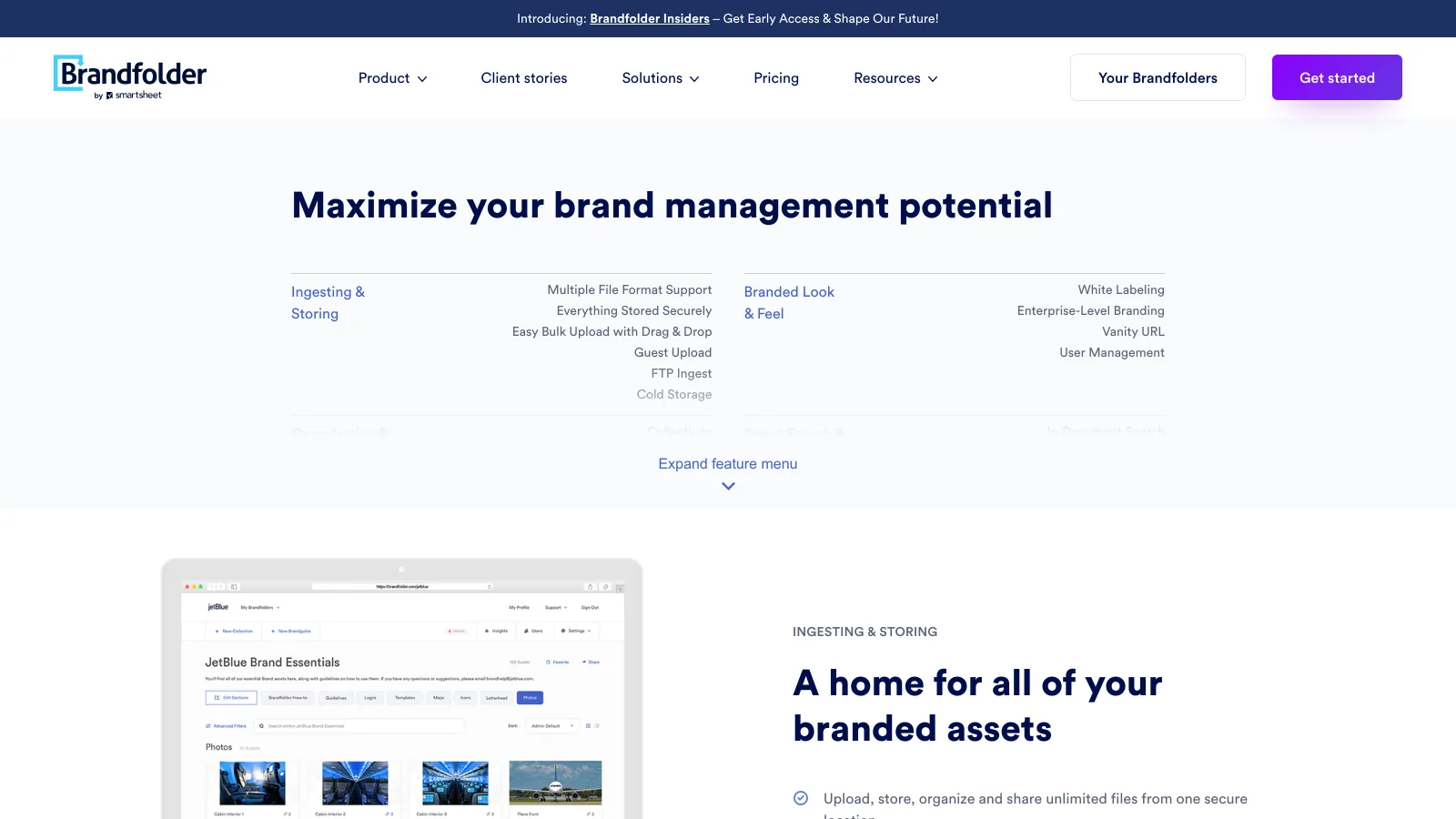
Brandfolder ships Brandguide, always-up-to-date brand guidelines reachable from anywhere, plus Portals for curated content experiences and Templating with editable fields for branded materials, all as parts of the product. Bynder's brand guidelines and portals are real and mature, but the deeper experiences are modules with their own line on the quote. For a team whose first job is to keep partners and agencies on brand, Brandfolder gets there with fewer moving parts.
Which one has the better search?
EdgeEven
Both find assets beyond their metadata. Bynder names AI-powered search, Similarity Search, Search by Image and a Duplicate Manager; Brandfolder names Brand Intelligence with AI image recognition and auto-tagging, plus bulk tagging, move and merge for cleanup. Neither publishes a benchmark, and both depend on the taxonomy the team sets up during onboarding. Treat search as a tie and test it on your own files in the demo.
Which one is better for creative workflow?
EdgeEven
Bynder sells Asset Workflow (brief, proof and approve) and Content Workflow (structured content creation and review) as modules, so the workflow is inside the DAM once bought. Brandfolder runs asset approvals in the product and pushes the project side to the work-management tools it integrates with: Smartsheet first, then Wrike, Workfront and Jira. If the team plans in Smartsheet, Brandfolder's route is shorter; if it wants the workflow inside the library, Bynder's modules are the more complete answer. Even, decided by where the team already plans its work.
Which one is better for analytics?
EdgeBrandfolder
Brandfolder names Asset Analytics, User Insights and Brandfolder and Collection Analytics, and on the Enterprise plan an Insights data connector that feeds asset usage into Smartsheet dashboards. Bynder reports on usage inside the platform and through its integrations, but analytics is not a headline of its product page. For a brand team that has to prove which assets partners use, Brandfolder is the more direct route.
Which one is cheaper?
EdgeBrandfolder
On reported numbers, Brandfolder starts lower: about $500 a month on Basic and a $24,999 median contract, against Bynder's $20,000 to $40,000 a year for a small deployment and a $39,270 median. Both add services: $2,000 to $10,000 of implementation at Brandfolder, 15% to 30% of year one at Bynder. Both count named users as the unit, and Bynder buyers report that adding users mid-contract raises the per-user price. The edge is Brandfolder's at the entry, and the gap narrows as modules and users grow.
Three things to put in the same quote
- Implementation and onboarding. Both vendors bill it separately; ask for the subscription and the services number on one page.
- Named users and guests. Count the freelancers and agencies who will upload or approve; on both platforms they are seats, and only viewers are free.
- Modules and connectors. Bynder's workflow and content experiences, Brandfolder's Insights connector: price the year you will actually run, not the base.
Which one is faster to go live?
EdgeEven
Brandfolder states an average onboarding of 1.6 months; Bynder does not publish a figure, and its reported services line suggests a comparable project. Both migrate and tag the library with the customer, and both are live when the taxonomy is agreed and the assets are in. Plan a quarter either way.
Where does Brault fit?
Bynder and Brandfolder are the right answer for the buyer they are built for. A creative team of 3 to 20 people, a studio or an agency that wants a searchable library, review on the file and branded delivery this week is a different buyer, and that is where Brault sits: the DAM capabilities creative teams use daily, on a public price and with no implementation fee.

- Best forCreative teams that want search, review, branded delivery and transfer in one plan
- Pricing$0 / $4 / $12 / $70 a month billed annually, $6 to $14 per TB (verified on brault.app/pricing)
- Free planYes; 2 GB, AI search, Boards, review and Brault Transfer, no card
- Watch outNo asset-usage analytics dashboard or Smartsheet connector; enterprise governance on the Enterprise plan
What it does and does not replace
Brault matches the daily layer: AI search across 50+ formats including RAW, PSD and AI files, custom metadata, Boards, frame-accurate review and approval, and every share link, transfer page and public board carrying the brandspace branding, with transfers up to 250 GB. It does not replicate Brandfolder's Insights connector or Bynder's module catalogue; SSO, custom roles and dedicated support come on the Enterprise plan. The head-to-head with the category is on Brault vs traditional DAM.
Frequently asked questions
Which is better for digital asset management, Bynder or Brandfolder?
For a large marketing organization they are peers: both are quote-only enterprise DAMs with brand portals, SSO, permissions, AI tagging and analytics, and both report contracts in the tens of thousands of dollars a year (Vendr, February 2026: Bynder median $39,270, Brandfolder median $24,999). Bynder is the more modular and larger platform, with 160+ integrations and add-on modules for workflow and content experiences; Brandfolder is the choice for teams that run on Smartsheet, with Brandguide and Insights analytics in the product. Neither fits a creative team that wants a price and a library this week.
How much do Bynder and Brandfolder cost?
Neither publishes a price. Bynder states that every customer has a unique price point; Vendr buyer data of February 2026 reports $20,000 to $40,000 a year for small deployments and $40,000 to $90,000 for mid-sized ones, plus 15% to 30% in services the first year. Brandfolder shows Premium and Enterprise with a Book a demo button; buyers report about $500 a month on Basic, $1,500 to $3,000 a month on Premium, a $24,999 median contract and $2,000 to $10,000 of implementation.
Does Bynder or Brandfolder have a free trial?
No. Both are demo-led: Bynder offers a demo and Brandfolder answers the free-trial question in its FAQ by pointing to a public Brandfolder and an overview video. The self-serve alternatives with a free plan or a trial are Brault (free plan, 2 GB), Dash (free trial on every plan) and Playbook (free plan).
Is Brandfolder part of Smartsheet, and does that matter?
Yes, Smartsheet acquired Brandfolder in 2020 and sells it as its DAM. It matters if your team plans work in Smartsheet: Brandfolder ships an Insights data connector and workflow links to Smartsheet, Wrike, Workfront and Jira. Bynder has no equivalent tie to one work-management vendor and connects through its 160+ integrations and open API instead.
What is a cheaper alternative to Bynder and Brandfolder for a creative team?
Brault covers the DAM capabilities creative teams use daily, AI search across 50+ formats, custom metadata, frame-accurate review and branded delivery, on a public price: $0 (Free), $4 (Lite), $12 (Pro, 2 TB) and $70 a month (Growth, 5 TB, 4 users included) billed annually, with no implementation fee. Dash ($109 to $589 a month, unlimited users) and Filecamp ($29 to $89 a month) are the other alternatives with a published price.
Key takeaways
- Bynder and Brandfolder are enterprise peers: quote-only, demo-led, named seats, portals, SSO, AI tagging and analytics on both.
- Bynder has the edge for multi-brand organizations and module-driven growth, with 160+ integrations; Brandfolder has it for brand guidelines in the product, analytics and anything that runs on Smartsheet.
- Search and workflow are even; the workflow decision follows where the team already plans its work.
- Reported entry prices favor Brandfolder (about $500 a month on Basic, $24,999 median) over Bynder ($20,000 to $40,000 a year on small deployments, $39,270 median); both add services on top.
- A creative team of 3 to 20 that wants a price and a library this week is not the buyer for either; Brault covers the daily DAM layer from $0 to $70 a month billed annually.
Want DAM-level organization without the quote? Try Brault free.