

Visibility is an online marketing agency founded in Bratislava in 2009 and the parent of Visibility 360 Group, a network of agencies across Central Europe. More than 70 specialists in SEO, PPC, social media, copywriting, web, design, branding and email work for banks, retailers, pharmacies and industrial brands, and the agency is a Google Premier Partner named TOP Performance Agency at DAR 2025. With that many people touching that many clients’ files every day, the hard problem is not storage. It is access, control and speed. This is how Visibility put all three in one Brault workspace.
“Visibility is a business about people. With seventy specialists and dozens of clients in one place, the question is never where a file is. It is who may see it, who may change it and who approved it.”
The challenge
Juraj Sasko founded Visibility with his partner in 2009, as he wrote when the agency founded Visibility 360 Group. The agency grew into teams that work side by side on every account: a project manager per client, so that no email is left hanging, PPC specialists who launch and optimise campaigns daily, SEO specialists on long-term work, copywriters, designers and developers, plus external editors and freelancers when a project needs them.
Then AI multiplied the output.
Every client now gets more versions of everything: ad variants for each placement and size, copy in several lengths and languages, visuals drafted with AI and finished by a designer. The volume grew faster than any folder structure could hold, and the files were spread across separate tools for storage, for sending large files, for collecting client approvals and for handing finished assets to the ad accounts, most of them billed per seat.
“AI gave every specialist ten times the drafts. Without a single place with rules, it also gave us ten times the chaos: the same banner in four tools and nobody sure which one the client approved.”
The second problem was access. Dozens of people work at the same time, in different roles, on accounts that must never mix: a freelancer should see one folder, a client should see its own campaign and nothing else, and when someone leaves a project their access should end there too. Shared drives with broad permissions could not express that, and per-client accounts in every tool multiplied the logins and the invoice.
“Our clients trust us with work that is not public yet. We needed to answer, at any moment, who had access to a file and what they did with it.”
Why Brault
Three things made Brault the pick.
Roles that match how an agency works. Owner, admin, write and read come built in, and custom roles go further, area by area, so a project manager, a PPC specialist, an external editor and a client reviewer each get exactly the access their job needs. Access is set per library and per board, so a client sees its own work and a freelancer only the folder they were invited to.
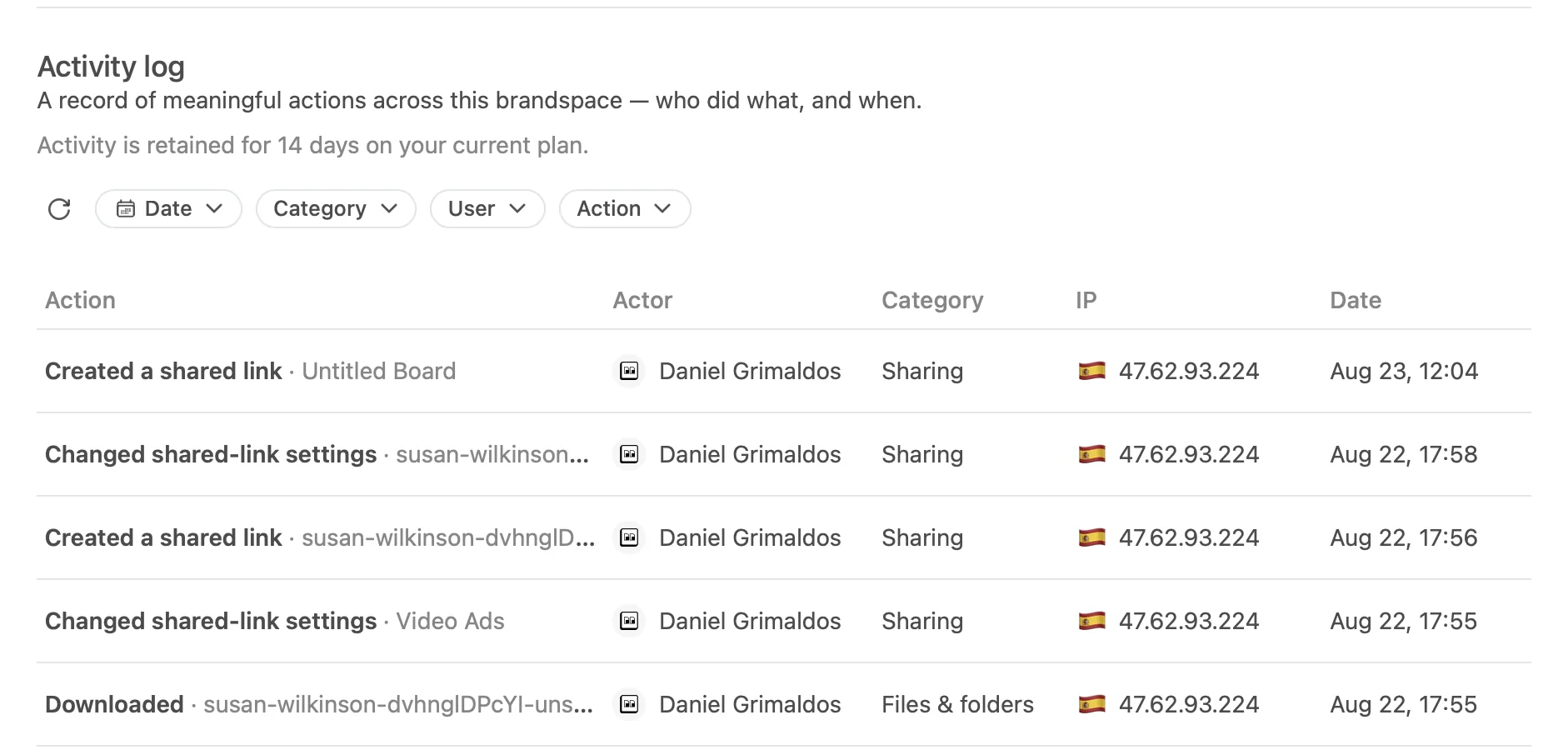
Governance you can read. Brault’s activity log records who did what and when across the workspace: changes to files and folders, downloads, shared links and their settings. It filters by date, category, user and action, and exports to CSV when a client or an auditor asks.
AI and an API in the box. Every file is tagged by AI as it lands, following the agency’s own instructions, and the Brault public API with its n8n node lets the team automate what happens around the files without writing a service of its own.
“We did not want another place to store files. We wanted one set of rules for seventy people, and the tools around it to follow those rules on their own.”
What they set up
Visibility started with one library per client and built the rest on top.
When a contract is signed, a workflow reads the client record in the CRM and creates the client’s library, its board and its access roles in Brault, so a new account is ready before the kickoff meeting. Inside each library, the project manager, the specialists and the client’s reviewers get the role that fits them, and nobody outside the account sees it.
AI came next, on every piece of content. Visibility writes its tagging instructions once, by client, campaign, format and market, and can attach reference images so the model knows what a client’s product looks like. From then on, every banner, video and copy deck is tagged the moment it is uploaded, and anyone with access finds “last month’s Slovak PPC banners for the spring campaign” by asking for it in plain words instead of browsing folders.
Then the approvals. Clients approve inside the file, where the comments and the versions live. A second workflow, built on the Brault API and its n8n node, takes it from there: the approved file goes into the client’s Meta or Google Ads asset library, a message lands in the client’s Slack channel and the card on the board moves to delivered. Final files that do not go to an ad account leave as a branded transfer of up to 250 GB.
“None of this needed a developer. The n8n node and the API documentation were enough for our own team to build it.”
The results
- Seventy people, one set of rules. Every specialist, freelancer and client reviewer works in the same workspace, each with the role their job needs.
- A client sees its own work and nothing else. Access follows the library and the board; take someone off a project and their access to it goes too.
- Every answer is in the log. Who opened, downloaded or shared a file is one filter away, and exportable when a client asks.
- All AI content tagged on arrival. Every AI-assisted draft is findable by what is in it, not by the name someone gave it on a deadline.
- Approved means delivered. An approval sends the file to the ad account, tells the client’s channel and closes the card, with no manual upload in between.
- Four tools off the invoice. Storage, large-file transfer, client approval and delivery to the ad accounts now live in one subscription.
About Visibility
Industry
Online and performance marketing.
Based in
Bratislava, Slovakia, with a sister agency in Prague.
Services
Marketing strategy, SEO, PPC, social media, copywriting, web, UI and UX, graphic design, branding, email marketing and training.
Group and recognition
Parent of Visibility 360 Group. Google Premier Partner, TOP Performance Agency at DAR 2025.