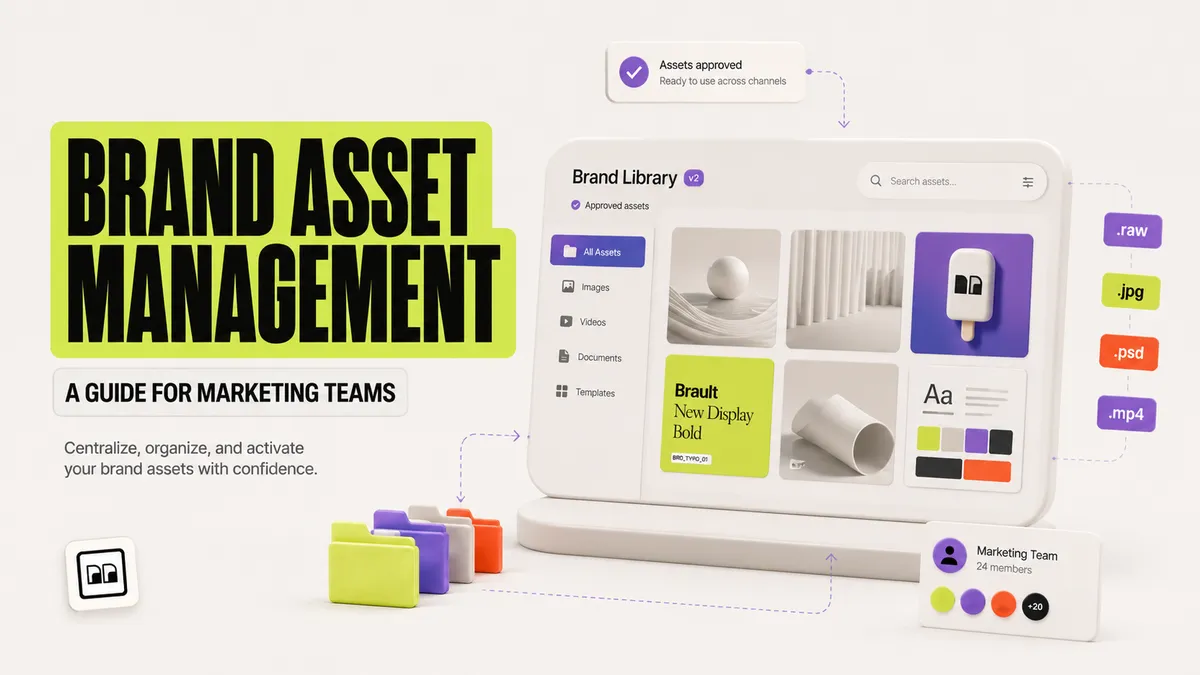
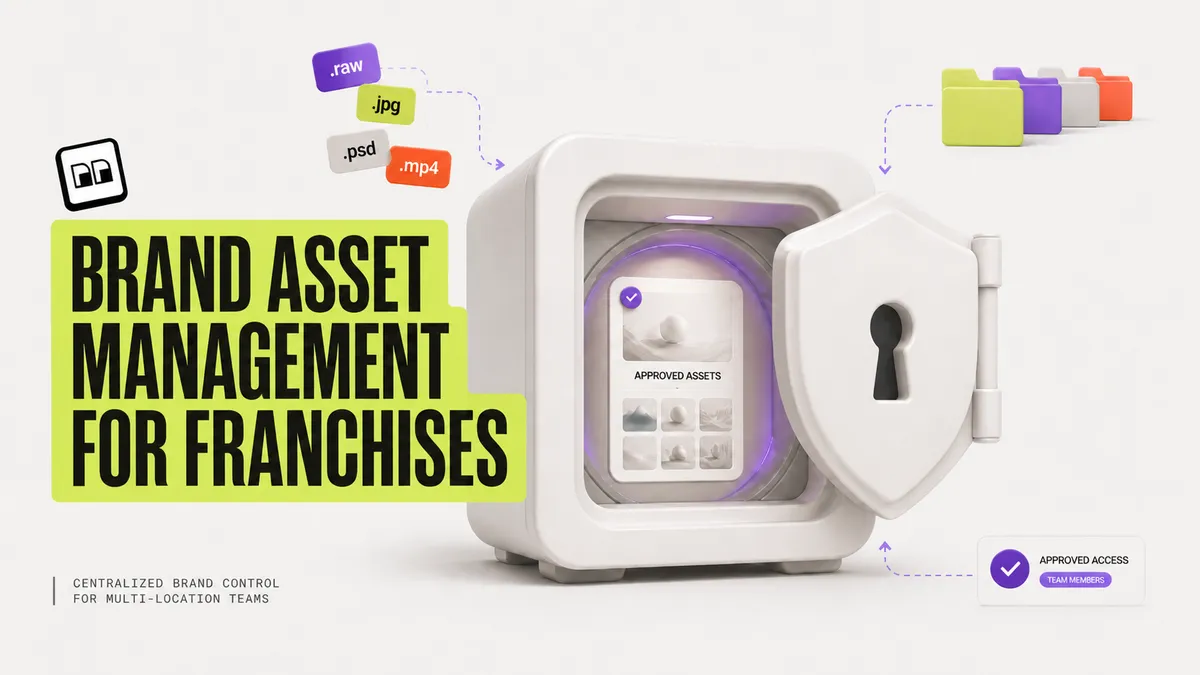
Brand asset management for franchises is the practice of storing, governing, and distributing approved brand assets from a central library to every franchisee location. A franchise BAM system gives the franchisor control over what logos, colors, templates, and campaign materials exist, while giving franchisees self-service access to on-brand materials they can customize for their location. Brault is a creative asset management platform that supports franchise brand workflows through white-label portals, AI search across 50+ file formats, branded file transfer, and transparent pricing from $0 to $70 per month on annual billing. Enterprise platforms like Bynder, Brandfolder, and Frontify dominate the category at $500 to $1,600 per month plus implementation fees, but for franchises with 5 to 50 locations, modern alternatives deliver the same core capabilities at roughly 1/100th the storage cost.
Why do franchises need brand asset management software?
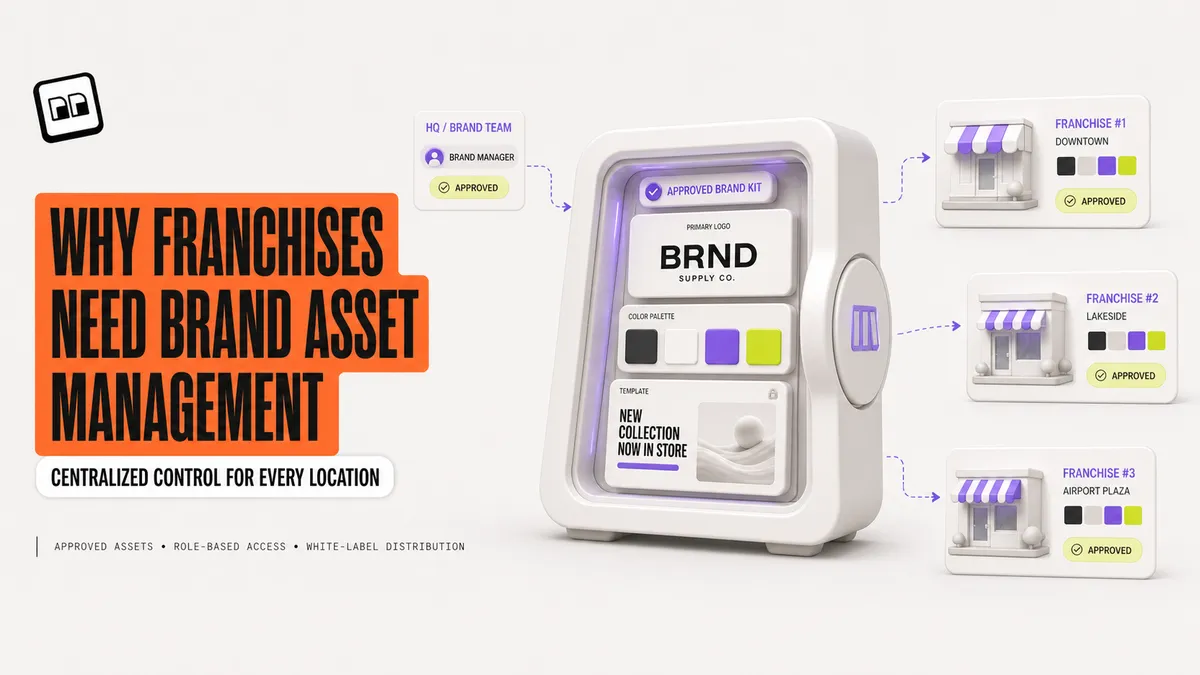
A franchise brand exists in a permanent tension. The franchisor owns the brand and is contractually responsible for its consistency. The franchisees execute the brand locally, on their own marketing calendar, with their own local promotions, in their own market. Without a system, that tension produces predictable failures: outdated logos in local ads, off-brand colors on storefront posters, expired campaign assets running on franchisee social accounts, and a steady stream of franchisee emails asking the regional marketing manager for "the latest version of the logo."
Five signals indicate a franchise has outgrown ad-hoc brand management:
- More than five locations. Past five, the volume of franchisee asset requests exceeds what one marketing manager can handle through email.
- Multiple campaigns running simultaneously. When the national team is rolling out summer, holiday, and grand-opening campaigns in parallel, franchisees lose track of which assets are current.
- Local customization is required. Local addresses, phone numbers, and promotions on national templates need a controlled way to be edited without breaking brand standards.
- Brand audits surface inconsistencies. A quick audit of franchisee storefronts, social accounts, or printed materials reveals outdated logos, retired color palettes, or unauthorized photography.
- Franchisees use personal Dropbox or Google Drive folders. The default fallback when there is no system. It produces version chaos within months.
The cost of brand inconsistency at the franchise level is rarely calculated in dollars, but it shows up in two places that matter: customer trust (a brand that looks different in every location reads as fragmented) and franchisor liability (most franchise agreements include brand-compliance clauses that the franchisor is obligated to enforce). The International Franchise Association reports that brand asset management systems are now standard infrastructure for franchise brands that have moved past five locations.
What is the difference between brand asset management and digital asset management?
Digital asset management (DAM) is the broader category. A DAM platform stores any digital file a creative or marketing team produces: raw photography, video, design files, fonts, audio, document drafts, final deliverables. The DAM is the single source of truth for the entire creative library.
Brand asset management (BAM) is a focused subset. A BAM system governs only the assets that define the brand: approved logos, color palettes, typography, templates, photography that has cleared brand review, and the brand guidelines document itself. BAM emphasizes control, approval workflows, and distribution to non-creative users (franchisees, partners, regional teams) who need access to brand-safe assets without seeing the wider creative library.
For most franchises, the practical answer is to deploy a single platform that covers both. The franchisor's creative team uses the platform as a DAM (storing every photoshoot, every campaign draft, every design source file), and the franchisees see a curated BAM layer (approved final assets, branded templates, distributed campaign packages). Platforms like Brandfolder, Bynder, and Brault all support this dual pattern through library separation and role-based access.
The DAM vs BAM distinction matters less than it used to because modern platforms cover both. What matters is whether the platform supports the specific workflows a franchise needs: template distribution, franchisee-level customization, white-label portals, and approval gates between the franchisor and the locations.
What features matter most for franchise BAM?
Six capabilities determine whether a brand asset management system actually works for a franchise. The rest is noise.
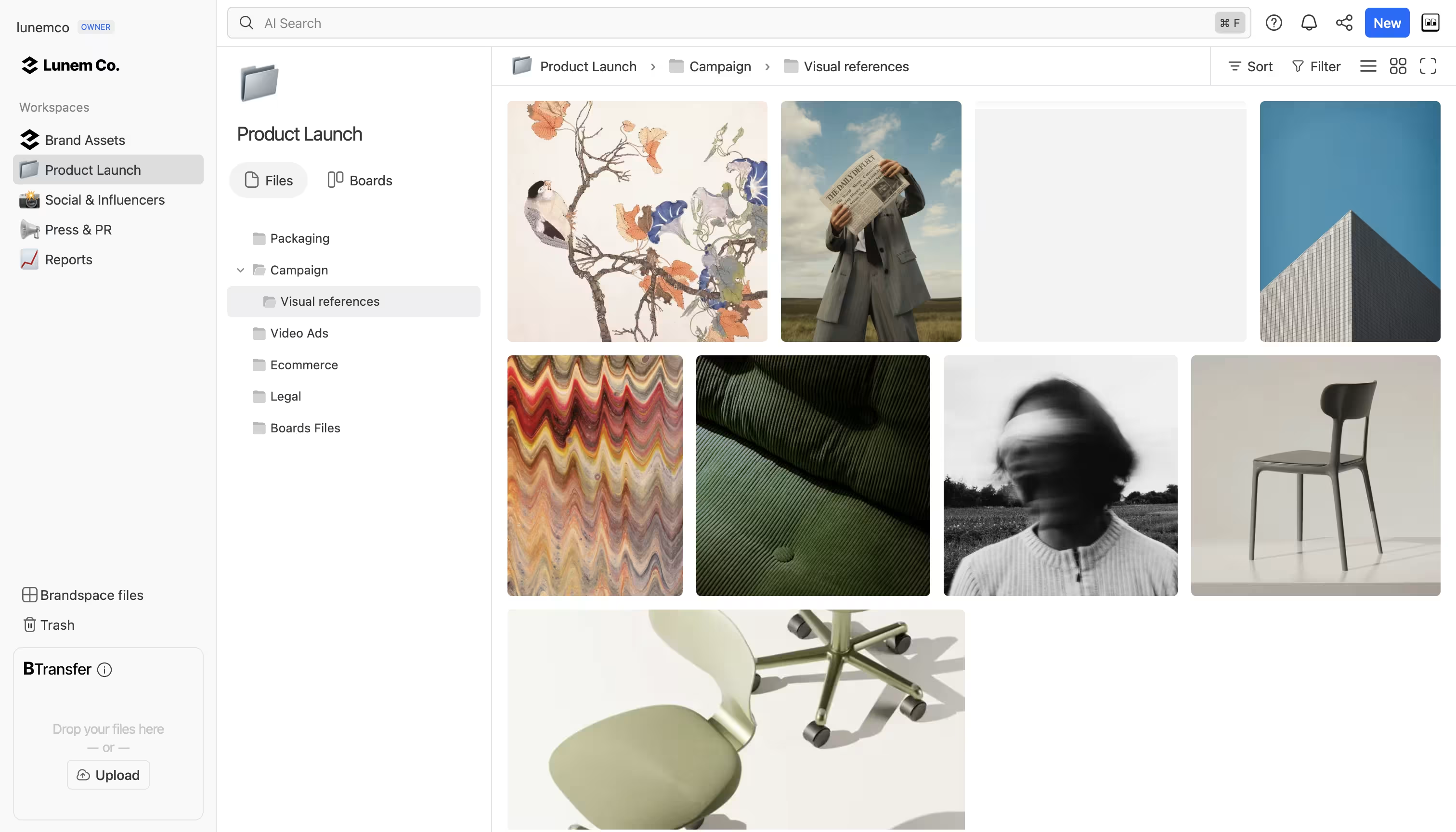
Centralized brand library and guidelines
A single library that holds every approved asset and the brand guidelines that govern their use. The library must support logo variations (full color, monochrome, reversed, small-format), color palettes with exact hex/CMYK values, typography files, photography libraries organized by campaign, and the brand guidelines document itself rendered as a navigable web page (not just a PDF download). Frontify, IntelligenceBank, and Brandfolder all do this well.
Template distribution with franchisee customization
The most-used asset in any franchise marketing operation is the customizable template: a national poster, social post, or print ad where the franchisee can swap their location address, phone number, and local promotion without touching the protected brand elements. Pica9 and MarcomCentral built their platforms around this workflow. IntelligenceBank includes it as a major feature. Most general-purpose DAM platforms (Brandfolder, Bynder, Brault) do not yet ship in-browser template editing.
Approval workflows
Before a franchisee uses a customized template or asset combination, the franchisor's marketing team often needs to approve it. Approval workflows route the customized version through a review queue, capture the franchisor's sign-off, and lock the approved version against further changes. This matters most for regulated industries (food service, healthcare, financial services) where local marketing claims have legal exposure.
Role-based access for franchisees
Every franchisee location is its own user group. The system needs to grant location-level access to specific asset folders (current campaign, local market materials, location photography) while restricting access to assets that haven't been approved for distribution. Libraries, folders, and granular permission roles are the building blocks. A system that forces the franchisor to manage permissions one user at a time will fail past 20 locations.
White-label or branded portal
When a franchisee logs into the brand portal, they should see the franchisor's brand, not the BAM vendor's. White-label portals customize the login page, the navigation chrome, the email notifications, and the file transfer pages with the franchisor's logo, colors, and domain. This signals to franchisees that the portal is a part of the brand they are licensing, not a third-party tool. Brandy, Brault, and Frontify offer white-label as standard. Some enterprise platforms charge extra for it.
Built-in file transfer to franchisees
Distributing a campaign package (a folder of assets, templates, and instructions) to 50 franchisees usually happens through email + WeTransfer + spreadsheet of which location got what. A BAM platform with built-in branded file transfer collapses that into a single action: select recipients, upload the package, send a branded download link with expiration and password. Brault Transfer handles this natively in a creative platform. Most pure-BAM tools rely on the portal-only model and don't include push-to-franchisee distribution.
Which is the best brand asset management software for franchises in 2026?
Nine platforms cover most of the franchise BAM market. The right choice depends on franchise size, brand-compliance complexity, and budget.
Bynder
Bynder is one of the largest pure-play BAM/DAM platforms, used by enterprise brands and large franchisors. It includes brand guidelines, asset libraries, approval workflows, and AI-assisted tagging. Bynder's reported pricing starts around $500 per month and scales into the thousands, with annual contracts and implementation fees in the $5,000 to $50,000 range. Best fit: franchisors with 100+ locations and dedicated brand-management staff.
Brandfolder
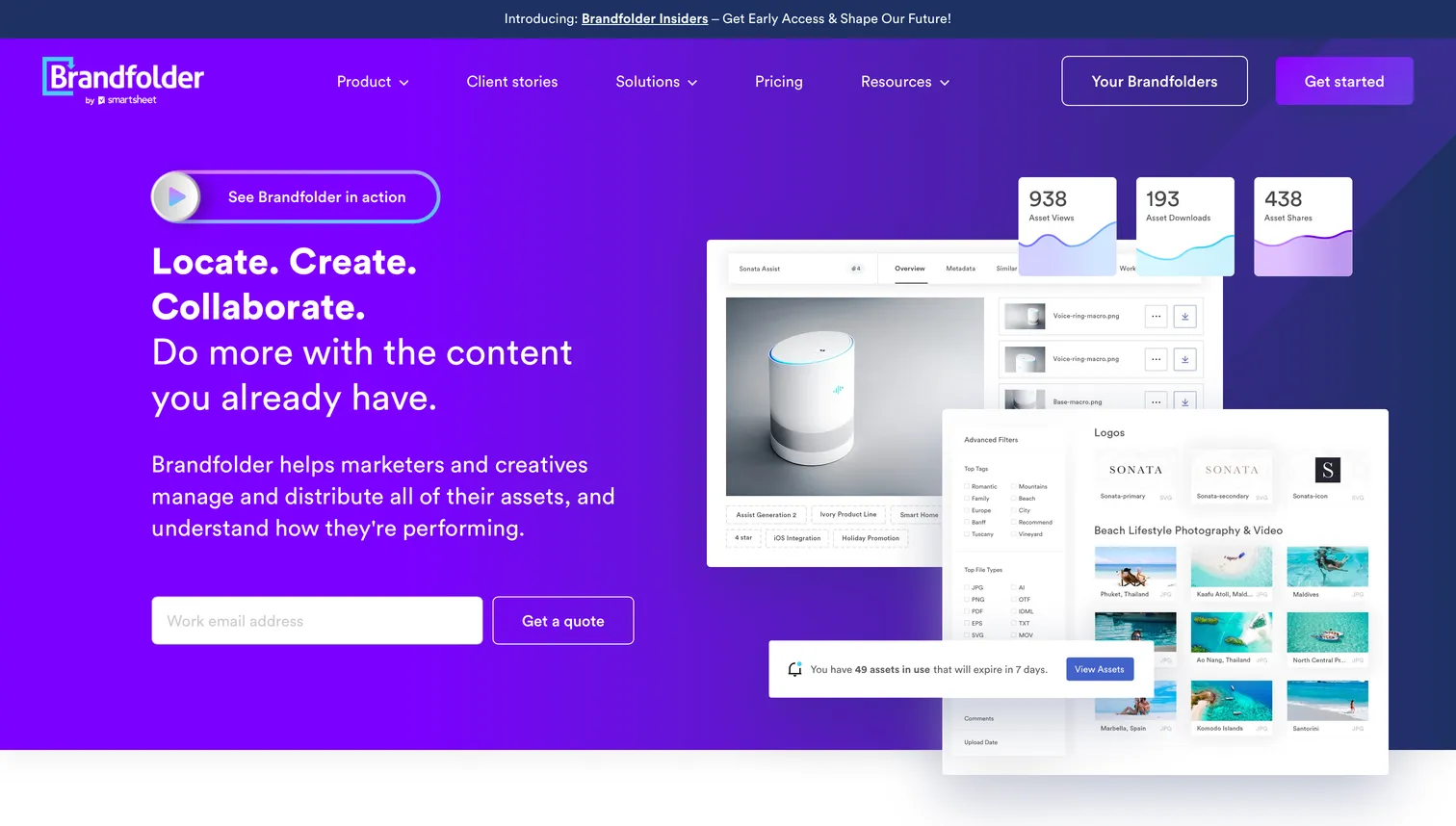
Brandfolder, owned by Smartsheet, is the most visible vendor in the franchise BAM SERP. It offers a strong brand portal, asset analytics, and a feature called Content Automation for franchisee-customizable templates. Reported pricing starts at approximately $500 to $1,200 per month with annual contracts. Best fit: mid-to-large franchises that need polish and integrations with the broader Smartsheet ecosystem.
Frontify
Frontify focuses on brand guidelines as a living web product. The brand portal renders guidelines, asset libraries, and templates in a single navigable site. Frontify is particularly strong for franchises that treat their brand book as a public-facing reference document. Pricing is not publicly listed but is reported in line with Bynder and Brandfolder. Best fit: franchises that prioritize brand guidelines and global brand consistency over distribution mechanics.
IntelligenceBank
IntelligenceBank is a marketing operations platform with strong BAM and template-customization features, popular with franchise systems in food service and retail. It combines asset libraries, brand portals, approval workflows, and a marketing resource management layer. Pricing is by quote. Best fit: franchises with formal compliance requirements and existing martech budgets.
MarcomCentral
MarcomCentral specializes in distributed marketing and is one of the longest-standing vendors in franchise marketing. Its core feature is template-driven local marketing: national HQ creates the template, franchisees customize specific fields, the system enforces brand rules. Pricing is by quote. Best fit: franchises whose marketing operation is built around customizable templates at scale.
Pica9
Pica9 (CampaignDrive) is a focused franchise marketing platform built around the same template-customization workflow as MarcomCentral. It is often considered as a direct alternative. Pricing is by quote. Best fit: mid-size franchise systems that want a turnkey local-marketing platform.
Brandworkz
Brandworkz is a UK-based BAM and brand portal vendor with a long track record in retail and franchise systems. It covers asset libraries, brand guidelines, approval workflows, and basic template support. Best fit: franchises with European operations or specific GDPR-driven preferences for EU-based vendors.
Brandy
Brandy (brandyhq.com) is a modern, lightweight brand asset management tool with a strong free tier. It covers logos, colors, guidelines, and basic asset distribution, and explicitly markets to "agencies, franchises, and brand teams". Pricing starts at $0 with paid tiers reported in the $20 to $100 per month range. Best fit: small franchises with under 25 locations that want fast deployment without enterprise overhead.
Brault
Brault is a creative asset management platform with workflows that fit franchise brand operations: white-label portals, branded file transfer (Brault Transfer) for distributing campaign packages to franchisees, AI search across 50+ file formats, role-based access at the library and folder level, and transparent public pricing at $0 (Free), $4 (Lite), $12 (Pro), and $70 (Growth) per month on annual billing. Brault does not ship in-browser template editing today, so franchises whose primary need is franchisee-customizable templates should pair Brault with a template tool or look at MarcomCentral / Pica9. Best fit: franchises with 5 to 50 locations that need a complete asset workflow (storage + search + branded distribution) and value transparent pricing over deep template customization.
How much does franchise brand asset management software cost?
Pricing in this category spans two orders of magnitude. The split is sharp.
| Platform | Monthly cost | Contract | Implementation fee | Storage cost (per TB) |
|---|---|---|---|---|
| Brault | $0 (Free), $4, $12, $70 | None | $0 | $6-$14 |
| Brandy | $0 to ~$100 | None | $0 | Varies |
| Filecamp | $29+ | None | $0 | Standard |
| MarcomCentral | Reported by quote (~$500+) | Annual | Varies | Standard |
| Pica9 | By quote | Annual | Varies | Standard |
| IntelligenceBank | By quote | Annual | $5,000+ | Standard |
| Brandworkz | By quote | Annual | Varies | Standard |
| Brandfolder | $500-$1,200+ | Annual | $10,000+ | ~$1,000 |
| Frontify | Reported $500+ | Annual | Varies | Standard |
| Bynder | $500-$1,600+ | Annual | $5,000-$50,000 | ~$1,000 |
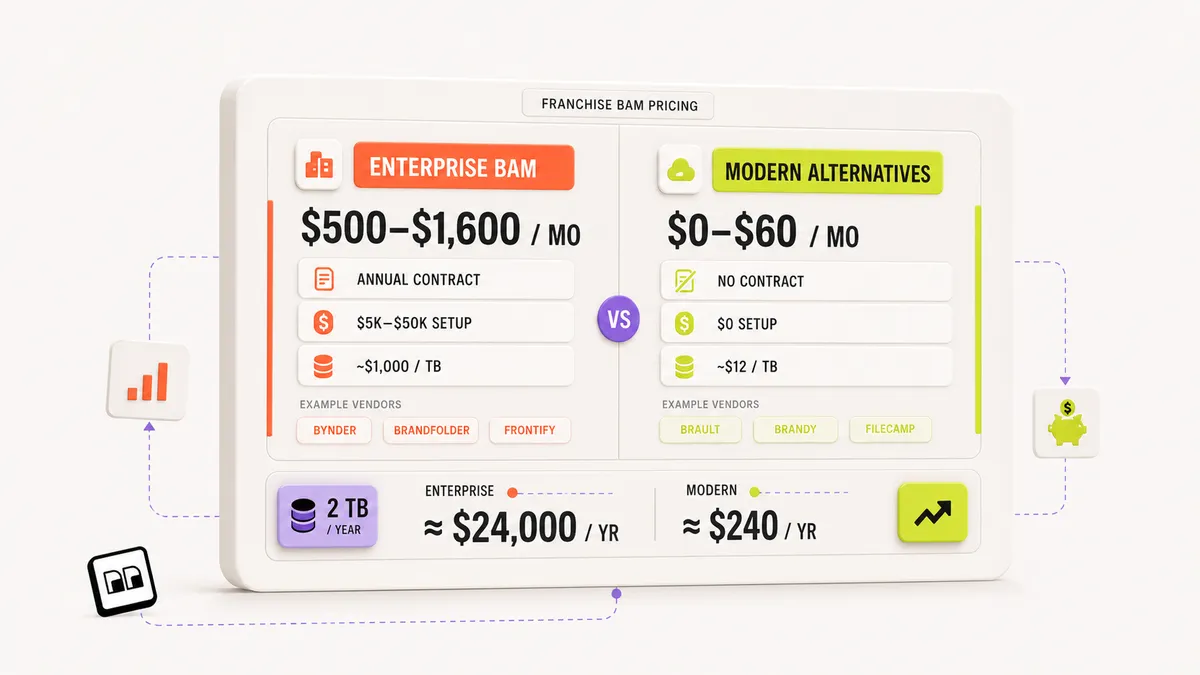
Three patterns are worth noting. First, enterprise BAM pricing is rarely public; vendors prefer sales-led discovery so the price reflects perceived budget. Second, implementation fees are not optional add-ons; they often equal or exceed the first-year subscription. Third, the storage-cost gap is the single largest line item over a multi-year contract. A franchise managing 2 TB of brand assets pays roughly $24,000 per year in storage on an enterprise BAM versus roughly $240 per year on a modern platform like Brault. Over three years, that gap alone funds an entire marketing hire.
For an honest cost framing, see our analysis of DAM software for small businesses and the 100x storage gap.
What's the right choice for franchises with 5 to 50 locations?
This segment is the most underserved in the BAM market. Enterprise vendors are over-built and over-priced. Generic cloud storage (Google Drive, Dropbox) lacks the brand-control features. The realistic shortlist for franchises in this range looks like this:
- Brandy for the simplest deployment. Free tier, fast setup, focused on logos and guidelines. Best when the franchise's main BAM need is "make sure everyone has the right logo and colors".
- Brault for franchises that need the full workflow: storage, AI search, white-label distribution, branded file transfer to franchisees, role-based permissions, and Boards for tracking campaign rollouts. Strongest fit when the franchisor's creative team also needs the platform as their daily DAM.
- Pica9 or MarcomCentral when franchisee-customizable templates are the core requirement. These are the only platforms that ship in-browser template editing as a first-class feature, which is decisive when local customization volume is high.
- IntelligenceBank when the franchise operates in a regulated industry (food service, healthcare, financial services) and needs formal approval workflows tied to compliance audits.
A franchise of 20 locations rarely needs Bynder or Brandfolder unless an enterprise procurement department is involved. The cost of underuse on those platforms typically exceeds the cost of the right-sized alternative by an order of magnitude.
How do you roll out a brand asset management system across franchise locations?
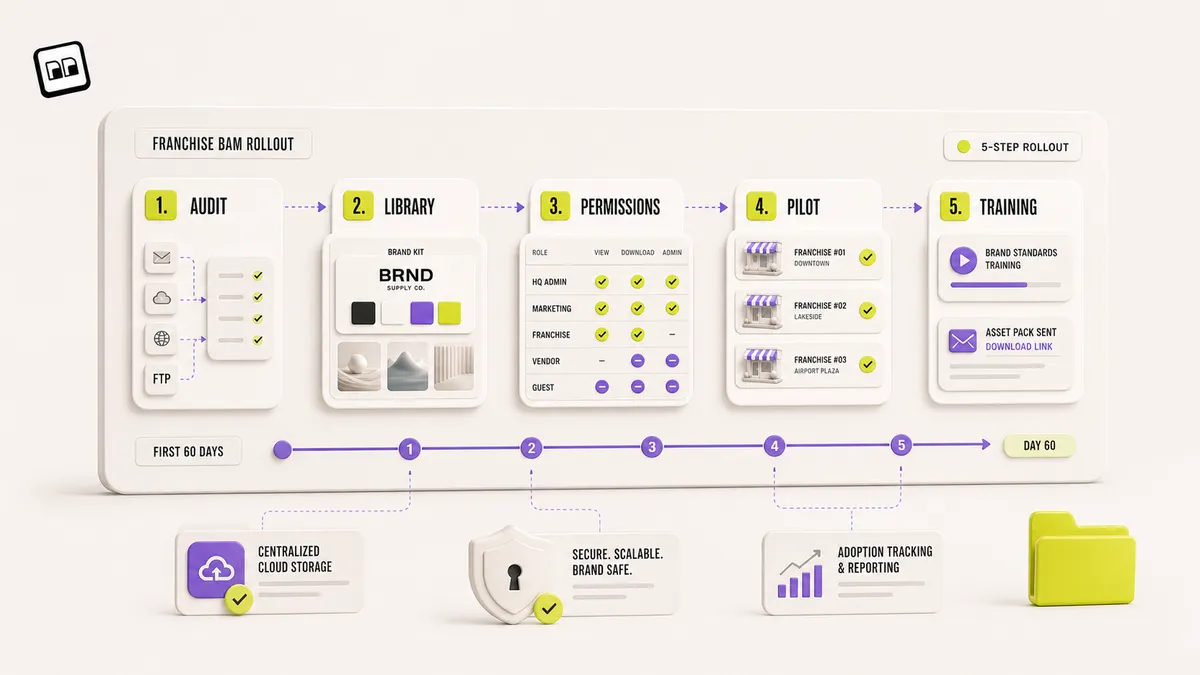
Adoption fails most often in the first 60 days. Five steps reduce that risk.
- Audit the current state. Inventory every place franchisees currently get brand assets: a corporate Dropbox folder, an FTP server, the regional marketing manager's email outbox, an old portal. Document what is in active use versus what is stale. This audit becomes the migration list.
- Set up the central library before inviting franchisees. Migrate logos, color palettes, typography, brand guidelines, and the most-used campaign assets first. Avoid the common mistake of letting franchisees in to a half-finished library; trust collapses fast if the first asset they look for isn't there.
- Define role-based permissions in writing. What can a franchisee see? Edit? Download? Distribute? A simple matrix (roles × asset categories × actions) prevents permission sprawl six months later.
- Run a pilot with three to five franchisees. Pick a mix: a high-performing location, an average one, and a location that has historically been hardest to keep on-brand. Three weeks of pilot use surfaces every gap the rollout plan missed.
- Train franchisees with their own assets, not generic demos. A 30-minute training session where each franchisee finds and downloads the assets they actually need that week is worth more than a generic platform tour. Pair the training with a one-page quick-reference (where to find logos, where to send approval requests, who to contact for missing assets).
Distribution is the half of the rollout most plans underweight. A central library is necessary but not sufficient. Pair it with a push channel (branded file transfer, email-with-download-link) for time-sensitive campaign packages, because franchisees check email more reliably than they check a portal.
Frequently asked questions
What is brand asset management for franchises?
Brand asset management for franchises is the practice of storing, governing, and distributing approved brand assets (logos, colors, typography, templates, photography) from a central library to every franchisee location. A franchise BAM system gives the franchisor control over what assets exist and who can use them, while giving franchisees self-service access to on-brand materials they can customize for their location.
What is the difference between brand asset management and digital asset management?
Digital asset management (DAM) stores and organizes any digital file: photography, video, design files, raw assets, and final deliverables. Brand asset management (BAM) is a focused subset that governs only brand-defining assets such as logos, color palettes, typography, templates, and brand guidelines, with stricter approval and distribution controls. Most modern platforms cover both. A franchise typically needs BAM features layered on top of DAM features.
How much does brand asset management software for franchises cost?
Enterprise BAM platforms like Bynder, Brandfolder, and Frontify report pricing of $500 to $1,600 per month plus implementation fees of $5,000 to $50,000. Modern alternatives publish transparent pricing: Brandy starts at $0, Brault offers tiers at $0, $4, $12, and $70 per month on annual billing. For franchises with 5 to 50 locations, modern platforms deliver core BAM capabilities at roughly 1/100th the storage cost of enterprise vendors ($6 to $14 per TB versus ~$1,000 per TB).
Can franchisees customize national marketing templates?
Yes, with the right system. Modern BAM platforms support template customization where franchisees can edit specific fields (location address, phone number, local promotions) on locked national templates without touching protected elements (logo, colors, layout). Pica9, MarcomCentral, and IntelligenceBank specialize in this. Brault supports template distribution and approval workflows but does not yet ship in-browser template editing.
What is the best brand asset management system for small franchises?
For franchises with 5 to 50 locations, the best fit is usually a modern platform with transparent pricing, white-label distribution, and a free or low-cost entry tier. Brault, Brandy, and Filecamp all serve this segment well. Enterprise options like Bynder and Brandfolder are over-built and over-priced for small franchises unless brand-compliance regulation forces a specific feature set.
How do franchises distribute brand assets to multiple locations?
A franchise BAM system distributes assets through a centralized portal that every franchisee logs into. The franchisor uploads approved assets and templates to the portal, sets role-based permissions, and franchisees download or customize what they need. Some platforms add branded file transfer (a download link with the franchisor logo and expiration date) for distributing campaign packages directly to franchisee email addresses without forcing portal access.
Key takeaways
- Brand asset management for franchises is the practice of distributing approved brand assets from a central library to every franchisee location with the franchisor's controls intact.
- Five signals that a franchise has outgrown ad-hoc brand management: more than five locations, multiple parallel campaigns, local customization needs, brand-audit findings, and franchisees using personal Dropbox folders.
- Six features matter most: centralized brand library, template distribution with franchisee customization, approval workflows, role-based access, white-label portal, and built-in file transfer.
- Pricing splits sharply: enterprise platforms (Bynder, Brandfolder, Frontify) at $500 to $1,600 per month plus $5,000 to $50,000 implementation, versus modern alternatives (Brandy, Brault) starting at $0 with transparent public tiers.
- For franchises with 5 to 50 locations, modern platforms deliver core BAM capabilities at roughly 1/100th the storage cost of enterprise vendors.
- Rollout discipline matters more than platform choice: audit current state, build the library before inviting franchisees, define permissions in writing, pilot with three to five locations, and train with each franchisee's actual assets.
Related reading
- What is a DAM? Costs, features, and modern alternatives
- DAM for small business: how to choose without overpaying
- Best WeTransfer alternatives in 2026: free and paid options compared
- What is creative asset management? Tools, pricing, how to choose
Want to see how Brault handles brand assets across franchise locations? Book a demo or get started for free.